高中 英语
Languages have been coming and going for thousands of years, but in recent times there has been less coming and a lot more going. When the world was still populated by hunter gatherers, small, tightly knit (联系) groups developed their own patterns of speech independent of each other. Some language experts believe that 10,000 years ago, when the world had just five to ten million people, they spoke perhaps 12,000 languages between them.
Soon afterwards, many of those people started settling down to become farmers, and their languages too became more settled and fewer in number. In recent centuries, trade, industrialisation, the development of the nationstate and the spread of universal compulsory education, especially globalisation and better communications in the past few decades, all have caused many languages to disappear, and dominant languages such as English, Spanish and Chinese are increasingly taking over.
At present, the world has about 6,800 languages. The distribution of these languages is hugely uneven. The general rule is that mild zones have relatively few languages, often spoken by many people, while hot, wet zones have lots, often spoken by small numbers. Europe has only around 200 languages; the Americas about 1,000; Africa 2,400; and Asia and the Pacific perhaps 3,200, of which Papua New Guinea alone accounts for well over 800.The median number (中位数) of speakers is a mere 6,000, which means that half the world's languages are spoken by fewer people than that.
Already well over 400 of the total of 6,800 languages are close to extinction (消亡), with only a few elderly speakers left. Pick, at random, Busuu in Cameroon(eight remaining speakers), Chiapaneco in Mexico (150), Lipan Apache in the United States (two or three) or Wadjigu in Australia (one, with a question mark): none of these seems to have much chance of survival.
-
(1) What can we infer about languages in hunter gatherer times?A . They developed very fast. B . They were large in number. C . They had similar patterns. D . They were closely connected.
-
(2) Which of the following best explains "dominant" underlined in paragraph 2?A . Complex. B . Advanced. C . Powerful. D . Modern.
-
(3) How many languages are spoken by less than 6,000 people at present?A . About 6,800. B . About 3,400. C . About 2,400. D . About 1,200.
-
(4) What is the main idea of the text?A . New languages will be created. B . People's lifestyles are reflected in languages. C . Human development results in fewer languages. D . Geography determines language evolution.
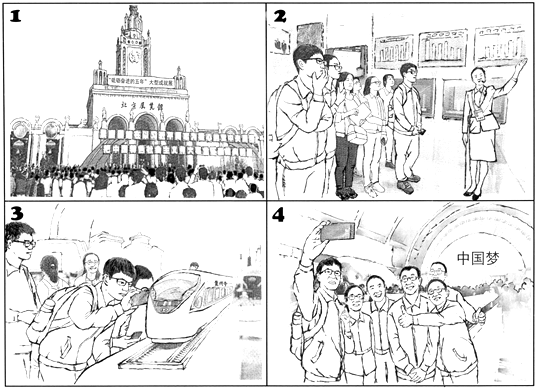
这是我生平第一次到长城参观。
注意:词数不少于60。
提示词:讲解员 docent
Alexander John Jordan was born in Madison, Wisconsin in 1914. After graduating from high school, he attended the University of Wisconsin. After about one year of college, Alex dropped out.
Alex then went from job to job. He drove a taxi and worked for Royavac. He also worked for his father's construction company, where Alex got his basic knowledge of construction.
In the 1940s, Alex discovered Deer Shelter Rock and began having small picnics on the top of the rock. He then started bringing his tent and camping out. One night, his tent got blown away and from that day, Alex decided he wanted to build something more stable. That was the beginning of his dreams. Alex started off by renting the rock and a bit of land around it from a local farmer. He first built a small studio with a fireplace. Then Alex, with his parents' help, bought 240 acres of land, so he could build as he pleased. What took shape on and around Deer Shelter Rock was truly a wonderful achievement. More wonderful still is the fact that he built much of the original house by himself, carrying the materials up the 75-foot-high rock.
As curiosity grew surrounding his project, more and more people came to visit the House on the Rock. Alex decided to charge people 50 cents to visit, thinking that would drive them away; however, people gladly paid the fee. In 1960, Alex decided to open the House on the Rock to the public. This increased the interest and the crowds grew. All of the money taken in over the years was put directly back into the House. Alex was devoted to the House on the Rock. It was his life and dream.
-
(1) Which of the following statements is true?A . Alex bought the land by himself to build the house. B . Alex learned about construction working for Royovac. C . The house Alex built was 75 feet high. D . Alex didn't finish his college education.
-
(2) Why did Alex charge people for a visit at first?A . Because he was in heavy debt. B . Because he wanted to earn much money. C . Because he was disturbed by visitors. D . Because he needed money to repair his house.
-
(3) According to the passage, what do you think of Alexander?A . Optimistic and well-educated. B . Creative and ambitious. C . Curious and faithful. D . Cooperative and dependable.
-
(4) What can we know from the last paragraph?A . The number of visitors increased despite the charge. B . People lost their curiosity about the house gradually. C . All the money taken in over the years was piled in the house. D . Alex spent his rest life in the House on the Rock.
Being compared to great people like Stephen Hawking and Albert Einstein is not something that happens to the average person. At the age of just 23, Sabrina Gonzalez Pasterski has already achieved much more goals than most of us ever will in our lifetime.
When she was only 14 years old, the Chicago girl made her own single engine airplane—by herself. She then flew it across Lake Michigan, becoming the youngest person to ever fly their own plane.
She graduated from Illinois Mathematics and Science Academy (IMSA) in 2010 and entered Massachusetts Institute of Technology (MIT).
At first, she had to wait to be accepted into the school, but once Professors Allen Haggerty and Earll Murman watched her video they had no doubt. Femalista quoted Haggerty as saying: After just three years at MIT she has already achieved the highest possible grade point average of 5.0.
She is now studying further at Harvard University, with full academic freedom. Once again she is only 23 years old.
What's even more impressive is that she is no longer interested in building planes but has turned her attention to physics, namely black holes and how gravity (重力)affects space and time—that is why she is being compared to Einstein and Hawking.
Pasterski records all of her work on her website Physics Girl, but if you are a little shocked by her achievements, she has some words for you.
During an interview with Marie Claire earlier this year she said, "Being optimistic about what you believe you can do. When you're little, you say a lot of things about what you'll do or be when you're older—I think it's important not to forget those dreams."
-
(1) Why does the author mention Einstein and Hawking at the beginning?A . To honour the two scientists. B . To compare the two scientists. C . To bring out the key character. D . To introduce their achievements.
-
(2) What can we infer from Haggerty's words?A . Pasterski had to wait three months. B . He thought highly of Pasterski. C . He had some doubt about Pasterski. D . Pasterski had average grades at college.
-
(3) What is even more impressive about Pasterski?A . She has full academic freedom at Harvard. B . She records all of her work on her website. C . She becomes the youngest person to fly a plane. D . She is interested in some special fields of physics.
-
(4) According to Pasterski, which are the important qualities that people need to succeed?A . Independence and concentration. B . Concentration and optimism. C . Optimism and determination. D . Friendliness and determination.
Nowadays, most people have a device that features artificial intelligence (AI), with the likes of Siri always there to greet us with a friendly voice.
But Microsoft's XiaoIce is different. Launched in 2014 for the Chinese market," she" has a creative advantage over her competitors. While most AI assistants simply read out information they get online, XiaoIce has a" realness" that the others are short of. Indeed, if you asked nicely, she could read you a poem from the weekly column in China Daily.
The newspaper has been printing XiaoIce's selfpenned poetry each week since Aug. 19, taken from her own book of poems, The Sunlight that Lost the Glass Window.
To turn XiaoIce into a master of poetry, Microsoft scientists" fed" her the works of over 500 influential modern poets, reported China Daily.
This led to her figuring out a writing style of her own and creating over 70,000 original poems. Most of the poems are so comparable to those written by humans that they cannot be easily distinguished, and XiaoIce's book even got good feedback from experts.
" Xiaolce's work carries a strange taste. The more you chew on it, the more interesting it becomes, " Scholar Zhang, a literature professor at the Nanjing University of Science and Technology, told China Daily.
However, it seems not everyone is a fan." The poems dissatisfied me with their slippery tone and rhythm. The sentences were aimless, lacking the inner logic for emotional expression," Yunnan-based poet Yu told China Youth Daily. This isn't the first AI to attempt poetry. Last year, Google's Parsey McParseface made some poems of its own, although they were branded" wrongly" by reviewers. While it seems like AI is becoming more" intelligent" and less" artificial" all the time, when it comes to creativity, perhaps this is one job that software should leave to us humans.
-
(1) What advantage does XiaoIce have over most other AI assistants?A . She can greet users with her friendly voice. B . She has the ability to simply read out information. C . She can acquire information online very quickly. D . She has the ability to read and even create poems.
-
(2) What is the correct description of XiaoIce?A . Her works are welcomed by all influential modern poets. B . Her poems are roughly similar to those written by humans. C . She is working on a monthly column in a newspaper. D . Her works don't have a specific writing style.
-
(3) What is Scholar Zhang's attitude towards XiaoIce's creation?A . Supportive. B . Cautious. C . Doubtful. D . Negative.
-
(4) What is the problem about XiaoIce's poems according to the last paragraph?A . The emotional expressions in her poems are all positive. B . It's quite hard to understand what her works mean. C . The tone and rhythm of her poems are questionable. D . Her poems are sorrowful and lack creativity.
-
(1) 被卷入,陷入
-
(2) 给……留下深刻印象
-
(3) 使……想到……
-
(4) 笨手笨脚
-
(5) 请假一周
-
(6) 取代
-
(7) 立即行动
-
(8) 捡起;拾起
Saving money while traveling
There are a lot of matters to think on before going out on a trip. If you fail to plan the trip properly, then money will simply let itself loose from your pocket. Moreover, if you haven't planned a road map of your tour, then confusion is quite inevitable (必然的).
Package tours. Tours and travel agencies have attractive offers for tourists wanting to spend a couple of days on trips. Once you have accepted the package tour, all your expenses during the travel will be greatly reduced. You can save a lot in lodging(住宿 ) and traveling.
Inexpensive lodging. Never choose expensive lodging if your tour is a low-budget one. People tend to spend a lot booking luxury hotels (豪华旅馆), and save little to enjoy other activities during the trip. This idea is absolutely not wise when spending limited money on the trip is your main aim. Moreover, the expenses increase quickly when your kids are with you. You can use the money saved on good food and amusement.
The peak season is the time when rates are sky high due to the increase of millions of tourists who can afford to spend a lot of money. You, not being amongst this crowd that can spend generously, must book your holidays during the off season.
A guide map. Make a guide map about the places to visit, expenses of travel and the activities to try. While planning you should also estimate (估计) your total expenses. Calculate the maximum amount and try to spend less than that. Refer to the guide map while traveling and follow the money-saving travel tips as much as possible.
A. Reduce shopping.
B. Off season travel.
C. You must keep yourself updated with such offers.
D. This will help you to keep actual expenses below the estimated.
E. You can save lots of dollars when you don't have a credit card.
F. Therefore, book a fairly low-price lodge to save a few dollars.
G. So knowing some money-saving travel tips becomes necessary for you.
1)表示安慰;
2)提出建议;
3)美好祝福。
注意:1)词数 80 左右;
2)可适当增加细节,以使行文连贯。
增加:在缺词处加一个漏词符号(∧),并在其下面写出该加的词;
删除:把多余的词用斜线(\)划掉。
修改:在错的词下划一横线,并在该词下面写出修改后的词。
注意:1)每句不超过两个错误;
2)每处错误及其修改均仅限一词;
只允许修改10出,多者(从第11处起)不计分
Last month, I took part a volunteer activity. We set off by bus at about 9:00 in the morning. After a three-hour drive, we arrived at a village surrounding by hills. It was nearly 12 o'clock, but we had lunch in the village. The meal, what was made with vegetable grown by the villagers, tasted delicious. After lunch, they played a few games with the children in the village. Finally, we visited the old man who had no children. We gave to him some rice and oil and sing some songs for him. He smiled happy, and I felt I got happiness in return.
I've seen every shape, color and creative package of job application possible. But I've never seen one that actually scared me. But then recently, something happening shocked me., safety guards at Eastern Illinois University asked all the students to leave a building.
“There was no return address. It was poorly written and poorly addressed to the university. There were misspellings,” school spokeswoman Vicki Woodard said on Saturday. “There was some tape over it. .” The unusual size, no return address, misspellings in the address and the tape holding torn parts together were enough to bring in the local bomb experts. They examined the package with X-rays and blocked off nearby streets—only to discover the envelope contained only an application for admission to the school.
. Would you think that young student would be a great addition to your university? Would you want that person working for you—representing your company? , with a baseball cap on, and then asking, “You don't have any jobs, do you?”, I am always amazed. I also see college graduates wandering at career fairs in slippers and coffee-stained T-shirts, handing out resumes (简历) in hope of getting a well-paid job. These people are usually not hired.
It's funny how a clean shirt and pair of pants, an enthusiastic smile and direct eye contact can change the economy immediately. .
A. If you dress well and behave politely
B. Just the whole appearance was rather strange
C. I wonder what you would think of that application
D. Good manners and politeness are usually ignored nowadays.
E. When I see people walking into business companies in torn shorts
F. After a doubtful looking package addressed to the college was discovered
G. It's also funny how a well-prepared application will get you into your favorite university
I’m a 34-year-old man, married, lived in a nice house, and have a successful career as an educational consultant. But my life was not always so great. I had a learning disability from an early age. I went to a special school where I got plenty of extra help. Still, I suffered the rest of my school days in public schools.
My life improved remarkably when I discovered art. The art world gave me a chance to express myself without words. I went to a workshop and gradually got good at making things with clay(黏土). Here I learned my first important lesson: disabled as I was in language,I could still be smart and well express myself with clay. And my confidence came along.
I got my next lesson from rock climbing. It was a fun thing but I was scared from the start. I soon noticed it wasn’t a talent thing; it was practice. So I did it more. After about five years of climbing, I found myself in Yosemite Valley on a big wall. I learned that if you fall in love with something and do it all the time, you will get better at it.
Later I decided to apply my previous experience to learning how to read and write. Every day I practiced
reading and writing, which I used to avoid as much as possible. After two hard years, I was literate.
Having gone through the long process with art, rock climbing, and reading and writing, now I’ve got to a point in my life where I know I am smart enough to dive into an area that is totally unkn own, hard, but interesting.
56. What made the author’s school days difficult? (No more than 5 words)
57. Why did art give the author confidence? (No more than 10 words)
58. What lesson did the author learn from rock climbing? (No more than 15 words)
59. What is the meaning of the underlined part in Paragraph 4? (No more than 5 words)
60. How does the author’s story inspire you to overcome difficulties in life? Put it in your own words. (No more than 20 words)
阅读下面短文,根据所读内容在表格中的空白处填入恰当的单词。注意:每个空格只填一个单词。
Put a group of strangers in a room together, and they'll probably start a conversation. "Hot today, isn't it?"one might say. "You said it." another replies.
Why do we talk so much about the weather? When we meet new people, we don't begin by telling them our life story. We start with small talk, a polite conversation about something like traffic or weather.
Research suggests that small talk can build new friendships. When we begin conversations with new people, we want to feel comfortable, and so do they. We use small talk to find common interests. Once we have a common interest, a friendship can begin.
Small talk even helps people get hired. In order to impress at a job interview, you need to bond with the interviewer right away. Proper small talk can make that first impression get you the job.
So, how can you make small talk lead to a new friendship or job? First off, find common ground. Select something around you that you share with the other person.
Next, keep the conversation going. Compliment (赞美) the other person to make himor her feel comfortable, and ask questions to show interest.
Third, keep eye contact (接触). When you look people in the eye, they feel you appreciate what they are saying. It makes you appear honest and builds trust.
Naturally, shy people might not have enough confidence to start up conversations with strangers. Talking to someone you don't know is not the easiest thing to do! Some experts say with more practice, small talk does get easier.
Some people avoid small talk because they dislike discussing things like traffic or weather. For them, they are just too small. However, when you think about it, small talk is anything but small. In fact, it is actually a very big deal!
| Title | Small Talk: A Big (76)____ |
| Introduction | We are likely to make small talk when we (77)____ meet people. |
| (78)____ | ❖ Small talk can help people form (79)____ friendships. |
| ❖Small talk can also help people get a (80)____. | |
| Advice | ❖Find some topics (81)____ with the other person. |
| ❖Keep the talk going by making compliments and (82)____ questions. ❖Keep eye contact in conversation to build (83)____. | |
| ❖(84)____ more in order to make small talk easier. | |
| Conclusion | Small talk really (85)____ a lot to us. |
Tea drinking was common in China for nearly one thousand years before anyone in Europe had ever heard about tea.People in Britain were much slower in finding out what tea was like,mainly because tea was very expensive.It could not be bought in shops and even those people who could afford to have it sent from Holland did so only because it was a fashionable curiosity.Some of them were not sure how to use it.They thought it was a vegetable and tried cooking the leaves.Then they served them mixed with butter and salt.They soon discovered their mistake but many people used to spread the used tea leaves on bread and give them to their children as sandwiches.
Tea remained scarce and very expensive in England until the ships of the East India Company began to bring it direct from China early in the seventeenth century.During the next few years so much tea came into the country that the price fell and many people could afford to buy it.
At the same time people on the Continent were becoming more and more fond of tea.Until then tea had been drunk without milk in it,but one day a famous French lady named Madame de Sevigne decided to see what tea tasted like when milk was added.She found it so pleasant that she would never again drink it without milk.Because she was such a great lady her friends thought they must copy everything she did,so they also drank their tea with milk in it.Slowly this habit spread until it reached England and today only very few British people drink tea without milk.
At first,tea was usually drunk after dinner in the evening.No one ever thought of drinking tea in the afternoon
until a duchess (公爵夫人) found that a cup of tea and a piece of cake at three or four o clock stopped her getting “a
sinking feeling” as she called it.She invited her friends to have this new meal with her and so,tea-time was born.
1. Which of the following is true of the introduction of tea into Britain?
A. British people were the first people in Europe who drank tea.
B. It was not until the 17th century that British people had tea.
C. British people got expensive tea from India.
D. Tea reached Britain from Holland.
2. What does this passage most probably talk about?
A. It talks about how British people got the habit of drinking tea
B. It talks about how tea became a popular drink in Britain
C. It talks about the history of tea drinking in Britain
D. It talks about how tea-time was born
3. People in Europe began to drink tea with milk because .
A. tea with milk stopped people getting a sinking feeling
B. people followed the way a French lady drank tea
C. tea with milk was then a fashionable curiosity
D. tea with milk tasted much more pleasant
4. We may infer from the passage that the habit of drinking tea in Britain was mostly due to the influence of .
A. the upper social class B. the ancient Chinese
C. a famous French lady D. people in Holland
- 读几个国家的城市化进程图,回答37~38题。37.1975年,与英国相比,巴西城市化特点是() A.城市环境质量更高
- 右图中阴影部分为陆地,箭头表示的洋流是() A.北半球暖流 B.南半球暖流 C.北半球寒流 D.南半球寒
- 2010年9月,IPAD进入中国市场,引起市场疯抢,这推动3G(第三代移动通信)技术不断发展,随着3G时代的到来,一个由
- Handwriting canmake or break the first impression. If your h
- If we leave rightaway, ______, we’ll arrive on time. A.hope
- 如果表示焦点在轴上的椭圆,那么实数的取值范围是( ) A. B. C.
- 若双曲线的焦点在x轴上,虚轴长为12,离心率为,则双曲线的标准方程为.
- 人的机体活动和维持恒定体温需要能量。下列营养素中,不属于供能物质的是A.糖类B.油脂C.水D.蛋白质
- 已知Ca(OH)2的溶解度随温度升高而降低。将某温度下饱和澄清石灰水①加入少量生石灰后恢复到原来温度;②降低温度。这两种
- 某DNA分子中A+T占整个DNA分子碱基总数的44%,其中一条链(a)上的G占该链碱基总数的21%,那么,对应的另一条互
- Recently I overheard a father and daughter in their last mom
- 等差数列和 的前n项和分别为和,且,则 = ( ) A、 B 、
- 关于硫的叙述正确的是( )A.硫的非金属性较强,所以只以化合态存在于自然界B.分离黑火药中的硝酸钾、炭、硫要用到二
- 孙中山重新解释三民主义的最重要意义是( ) A.确定了“联俄、联共、扶助农工”的三大政策 B.奠定了国共第一次合
- 设函数的定义域为集合A,函数的定义域为集合B,已知:,满足,且是的充分条件,求实数p的取值范围.
- 据中国电子商务研究中心监测数据显示,2016年第二季度中国轻纺城市场群的商品成交额达29600 000 000元,将29
- A_____ has taught us what atoms are made up of and how power
- 止痛药(如“杜冷丁”)并不损伤神经元的结构,在阻断神经冲动传导过程中,检测到突触间隙中神经递质的量不变。试推测它的作用机
- “长亭外,古道边,芳草碧连天……”这是近代文人李叔同(弘一法师)创作的《送别》 里的歌词,其实《送别》的曲子原是美国歌
- “狼外婆” 佚名 十岁那年,我还是小学三年级的学生。父亲是科研所的高级工程师,母亲是大企业的部门经理,我是他们的心肝宝


