阅读理解 知识点题库

| Stanley was a person who loved singing to himself in the bath. One cold winter night, he went into the bathroom to have a hot bath. He took off his clothes and turned on the tap, but there was no hot water─the water from the tap was cold. Stanley didn't know what was wrong, but he finally decided to take a bath without hot water. He started to sing as usual, one song after another. Stanley was surprised that the water felt warm this way. So he kept singing, louder and louder, until he finished his bath. The next morning when Stanley was going to work, he saw a piece of paper on his door: |
-
(1) What does the mother think of Stanley?
A . He gets up too early B . He is a helpful person. C . He should see a doctor D . He makes too much noise -
(2) What does this way mean?
A . Singing to a crying baby. B . Singing when taking a cold bath. C . Taking a cold bath in the morning. D . Taking a bath before going to bed.
Different people have different reasons for travelling. But most people enjoy seeing countries that are different from their own. They also like to meet new people and enjoy new food.
Tourism has many changes in a country and in people's lives. People build new hotels and restaurants and train local men and women as guides to show visitors interesting places.
-
(1) What makes travel more attractive than before?A . Modern telegraph (电报)lines make travel less expensive. B . Travelling by air to other countries is much cheaper today. C . More guides are being trained to show beautiful spots. D . New hotels and restaurants have been built.
-
(2) Many more people travel today than in the past because ______.A . travelling today is easier than in the past B . people now have spare money for travel C . great changes have taken place in the world D . people have become more interested in travelling
-
(3) People make journeys to many parts of the world. This is because ______.
A . they want to make a study of geography B . they want to spend money. C . they want to meet different people and have new food D . they don't want to do anything else except that they visit friends -
(4) Which of the following is TRUE according to the article?A . People have some trouble in making journeys. B . With the development of tourism, great changes will take place in many parts of the world. C . Tourism won't bring any changes in people's minds. D . Tourism causes only some changes in clothing.
Not many animals and plants can live in a desert, because it doesn't rain very often. But one animal likes the desert — the camel. It has big feet to walk on the sand. It can live for a long time without water. Sometimes it doesn't drink anything for weeks — so it gets very thirsty! When it finds water it can drink 100 liters(升) at a time.
-
(1) What's the weather like in a desert?A . Always hot. B . Always cold C . Warm and wind D . Hot in the daytime, cold in the night
-
(2) How many days is the temperature over 48℃ in Death Valley?A . 6 days B . 30 days C . 42 days D . 48 days
-
(3) Which animal can live in the desert?A . Camels B . Horses C . Tigers D . Dogs
-
(4) The hottest place in the world is ______________.A . Sahara Desert B . Death Valley C . Australia D . We don’t know
-
(5) How is a camel like?A . It has big nose B . It can drink much water. C . It can’t live for 7 days without water. D . It can live for 100 years.
Tammy was in her room, getting ready to do her homework. "Yes, Daddy!" she replied. "I'll be right there."
She hurried out of her bedroom and down the hallway. She was only nine years old. Her elder sister, Ella, had just moved away to go to a performing arts high school in another city. Her brother, Harry, was in middle school and always got home late. With Ella leaving home, Tammy was expected to do a lot more than she had ever done before, especially now, because her mother was ill.
Her father was in the kitchen. "Tammy, I know you usually do your homework right now, but with things being different, we all have to change a little bit. I'll help you and Harry with your homework later on, OK?"
Her father had an apron(围裙) on over his clothes, and he looked kind of funny. He was doing the dishes and he always splashed(溅出) water all over when he did that. After helping her father with the dishes, Tammy helped set the table.
After supper, her father helped her and Harry with their homework, and then they played a board game so that their mother could lie down for a while.
The next morning, Tammy got up early on her own because she wanted to help her mother with breakfast. She made orange juice and even put bread in the toaster and got out the butter so that her mother could sleep for a few more minutes.
When her mother got up half an hour later, she was very surprised and moved to see the breakfast on the dining table. She gave Tammy a big hug.
"Thank you, Tammy. You really are mother's little helper now, aren't you?"
-
(1) Why did Tammy's sister move out of their home?A . Because she hated doing housework B . Because she was busy with her work. C . Because her school was far away from home. D . Because she disliked her family.
-
(2) From Paragraphs 3 & 4, we can learn that Tammy_______.A . was a middle school student B . did well in all subjects C . always did a lot of housework at home D . was the youngest child in the family
-
(3) What can we learn about Tammy's father from the passage?A . He was a very serious person B . He wasn't very good at doing housework C . He liked playing board games very much D . He always helped Tammy do her homework.
-
(4) Which is the right order for the things that Tammy did in the story?
①Did her homework. ② Prepared breakfast.
③ Played a board game. ④ Helped with super.A . ①②③④ B . ①② ④③ C . ①④③② D . ①③④② -
(5) Which is the best title for this passage?A . Mother's Little Helper B . The Life of Tammy's Family C . A Happy Family D . Tammy's School Life
Several Asian hospitals are doing experiments with tele-medicine. Tele-medicine is a technology that allows doctors to "see" patients without them being in the same place. This is made possible through high-speed communication networks(网络). At both ends of the line, the way of video-meeting lets them see and talk to each other. Blood pressure (血压) and body temperature are directly shown on computers.
Tele-medicine is already in wide use in some places such as the United States and Germany. Among other uses, village doctors hold "consultations (会诊)"with far-away experts(专家). The experts can also help them during operations.
Tele-medicine has been slow to reach Asia because of high costs besides other reasons. When things improve, this technology will develop very fast. Chinese University of Hong Kong's medical school has joined a big hospital in Beijing, and Thailand is building a tele-medicine station connecting 20 areas.
Tele-medicine will do good to patients because doctors from different places can see them and give their medical advice. The help is quite important if the disease is an unusual one. It also helps spread medical knowledge among experts.
As tele-medicine develops well, its costs will be lower and it will become very popular in the medical field.
-
(1) Tele-medicine is already in wide use in some countries.
-
(2) Tele-medicine allows without them being in the same place.
-
(3) Why does tele-medicine develop slowly in Asia besides other reasons?
-
(4) What is Thailand doing according to the passage?
-
(5) 将文中画线句子译为汉语。
It was a rainy night in New Orleans, US. At a bus station, I watched a young girl cry as her baggage(行李) was taken down. It seemed she'd lost her ticket. She begged the bus driver not to leave her behind.
“Losing your ticket is like losing your money,” the bus driver said, and left her in the rain.
But then an old man stood up and blocked the driver's way. “How can you leave that girl out there? You know she had a ticket. You can't just leave her here. You can't leave her in a city where she doesn't have a friend. You will meet your schedule, but she might meet her end.”
The driver showed no sign that he'd heard or even cared about the young girl's problem, or how her travels went.
So the old gentleman said, “I'll pay for her fare. I'll give her a little money to help her on her way.”
He went and bought the ticket for the girl. “How can I repay the kindness you've shown tonight?” She asked. “We're strangers who won't meet again. A mere 'thank you' doesn't seem right.”
The old man said, "What goes around comes around. I've learned this with time. Whatever you give, you always get back. Always be helpful to others and give what you can spare.”
-
(1) Why was the girl's baggage taken down from the bus?A . Because she needed to go to the hospital. B . Because she wanted to leave for another city. C . Because the bus driver wanted to drop her. D . Because it was hard to carry heavy baggage on a rainy day.
-
(2) What does the underlined part “meet her end” probably mean in the third paragraph?A . End her life B . End her travel. C . Get to her home. D . Get to her final station
-
(3) What is the correct order according to the story?
a. The old gentleman argued with the driver about his rude behavior.
b. The girl thanked the old gentleman for his kindness to her.
c. The old gentleman bought a ticket with his money for the girl.
d. The girl begged the driver not to leave her behind.
e. The driver showed no sign to the old gentleman or the girl.
A . a—b—c—d—e B . a—c—b—d—e C . d—e—a—c—b D . d—a—e—c—b -
(4) What can be learned from the gentleman's words in the last paragraph?A . Do well and have well. B . Better late than never. C . Take the world as it is. D . Barking dogs never bite.
Pablo's room was never tidy.He liked to put his things everywhere.Nico's room was always tidy and clean.He liked to organize(整理)everything.
Pablo and Nico had a baby sister one Sunday. ⑴
"I don't want to stay in one room with Pablo."said Nico.
"How can I do anything fun when everything is so clean?"asked Pablo.
"Find a way to work it out."said their mother.
⑵"It's too clean out there."he said.But the closet(壁橱)was too dark at night,so Pablo moved back into their room.
In the second week,Nico put some tape(胶条)on the floor(地板)."You, stay on your side,"said Nico.But Nico had to cross the tape every day to leave the room,so he took the tape away.
In the third week,they thought they needed some rules.
"The first rule is that you can't use my things,”said Pablo.
"The second rule is that you can't use my things," said Nico.
⑶ And at last they thought there was one more thing to do."We need to paint(用颜料画)in our room!"Lucky for them.they had the same idea about what to paint.
根据材料内容完成下列任务。
-
(1) 将A、B、C三个句子填入文中空缺处。
A.They thought up 15 rules.
B.The boys had to use one room.
C.In the first week,Pablo slept in the closet.
⑴ ⑵ ⑶
-
(2) Pablo didn't like to stay in a very clean and tidy room.
-
(3) Nico took the tape away because his brother didn't like it.
Do you look like your name? Scientists say there's a good chance you do.
This comes from a new study published in a magazine. Researchers from Israel found that our given names may have something to do with our facial (面部的) appearances.
Lead writer Yonat Zwebner of a university, along with her team, did eight different experiments (实验) in Israel and France. The different experiments were set up to answer two main questions: whether people can correctly guess a person's name based only on a photo of a face and what is behind this matching effect.
During the experiments, researchers asked students to look at photos of people's faces and guess each person's name from a list of four choices. They correctly guessed the right name 38 percent of the time, which was better than the 25 percent of a random (随机的) guess.
What's more, when the faces the students looked at came from within their own country, they were able to best match the faces to the names. French students were better at matching only French names and faces while Israeli students were better at matching only Hebrew names and Israeli faces.
Researchers believe it is possible that people change their appearances without paying attention to it, to match their names. One study especially backed up this idea, showing that a hairstyle, something that can be changed by people easily, was enough to guide others in correctly guessing their names.
“Earlier research has shown there are cultural stereotypes (偏见) carried by names, including how someone should look. For example, people are more likely to imagine a person named Bob to have a rounder face than a person named Tim. We believe these stereotypes can, over time, influence people's facial appearances,” Zwebner said.
The results of the experiments may even make parents think twice when choosing a name for their children.
“If a name can influence appearance, it can influence many other things. This research opens an important direction that may suggest how parents should consider better the names for their children,” said Zwebner, who recently had a baby herself.
“As parents, it was really difficult for us to name our 12-day-old daughter as we know the meanings of names.”
-
(1) One of the purposes of the experiments is to _.A . give the students a chance to know each other B . explain what influences our facial appearances C . find out different characteristics carried by different names D . see if people can correctly guess a person's name based only on a photo of a face
-
(2) People could match the faces to the names more easily .A . when they did a random guess B . when the faces are from other countries C . when the faces are from their own country D . when they have more knowledge themselves
-
(3) The underlined part “backed up” in Paragraph 6 most probably means “ ”.A . supported B . changed C . compared D . cancelled
-
(4) Paragraph 6 and Paragraph 7 are mainly to show .A . the results of changing names B . names have something to do with appearances C . the importance of cultural stereotypes carried by names D . the importance of a hairstyle in guessing different looks
-
(5) According to Zwebner, we know that .A . facial appearances may influence names B . we shouldn't think of others just according to their names C . a name may influence many things and should be well chosen D . we should pay less attention to the meanings of names and be ourselves
Songs help memories
The power of music
Most people can remember important news stories clearly, whether it was the murder of President Kennedy in the US or 9/11.But now psychologists Martin Conway and Catriona Morrison, from the University of Leeds in the UK, are investigating how music can create “autobiographical memories” of the main events in our lives. The study is online. People have to choose a song by the Beatles and describe the memories that they have when they listen to it.
Reminiscence bump
Morrison explained that they looked at different age groups and their memories. We often remember more from when we are teenagers and this is called “the reminiscence bump”. This is the time in your life when you form your idea of who you are. For older people who have memories related to the Beatles' music, most of those memories are from when they were teenagers. But younger people also had clear personal memories from their past.
She loves you
This study was different from other memory studies, because people remembered events from their past with lots more details. Morrison explained: “It was like people had travelled back to the past, and they had very clear memories of things that had happened. When they heard a song like She Loves You by the Beatles, they could remember one night in autumn 1963.They remembered what they were wearing, what the weather was like and what their friend said to them. You get a lot more information than if you just say, ‘tell me about a night you remember'. ”
The study has found that music could be used with people who have problems remembering the past. “You could use music to help improve people's ability to remember,” said Morrison. “In the future, we would like to do more experiments to see how useful music is in helping people to remember the past, and compare it to other things that might also help.”
-
(1) Professor Conway and Dr. Morrison's research aims to _____________.A . see how music can help people remember the past B . study old songs' influence on people's behavior C . find out what influences people's memories of the past D . find ways to help people with memory difficulties
-
(2) The example of She Loves You is used to show that ___________.A . love songs can help people to have clearer memories B . songs tell stories that are similar to our experiences C . music can take people back to their teenage years D . people can remember more details with the help of music
-
(3) Morrison's team's future research is probably on ___________.A . why some people have memory problems B . what methods can best help people bring back memories C . how music can help people in their studies or work D . how to help older people remember more details about the past
According to a new study, cats may be just as smart as dogs. Both cats and dogs may have episodic memory(情景记忆), similar to that of human beings.
The discovery shows that cats can recall memories of positive experiences like eating a delicious snack. The study was a test of episodic memory. Episodic memory means memory of past experiences that happened at a special time and place.
In the test, cats were led to four open bowls of food. They were allowed to eat from two of them. After fifteen minutes, empty bowls took the place of the old ones. Then the same cats returned to look for food again. They spent more time searching for the old bowls.
It seemed that the cats were able to remember the information of “what” and “where” about the bowls. This discovery suggests that they may have episodic memory. However, it's still not clear whether cats can truly experience past memories in the same way as human beings do. “It's difficult to know whether the cats can subjectively(主观地)remember the experience,” Nick Diamond, a researcher at the University of Toronto, explained.
Still, the test plays an important role in the development of memory research in animals. “It opens the door to new studies. How long can cats' memories last? We may do some research on this in the future,” Professor Laurie Santos from Yale University told BBC News.
The road to new discoveries is long and difficult. Though there are lots of problems to be solved and discussed along the way, such studies do lead us a step closer to the final success.
-
(1) _______ may have episodic memory.A . Dogs B . Pandas C . Elephants D . Sheep
-
(2) It seems that cats can recall memories of their _____ experiences.A . happy B . sad C . scary D . unusual
-
(3) What can we learn from the study?A . Cats can subjectively remember past experiences. B . The cats spent more time searching for empty bowls. C . Cats are smarter than dogs and as smart as humans D . Cats may have episodic memory similar to that of humans.
-
(4) According to the fifth paragraph, scientists may do some research on ____ in the future.A . whether dogs can recall memories like cats B . why cats only remember good experiences C . how long cats' memories can last D . how humans recall past memories
-
(5) What does the writer think of the study?A . It has already solved many problems. B . It helps memory research in animals. C . It has nothing to do with other studies. D . It is a waste of money and time.
A nationwide survey released earlier this year said an average Chinese adult read less than eight books in 2015, among which 4.58 were paper books and 3.26 e-books. With digital books becoming more popular, many people would find it hard to remember the last time they sat down in a bookstore and enjoyed a quiet moment.
But this does not mean that bookstores are losing their customers. To lure more readers, bookstores are now bigger, more beautiful and grander. Here are some of them.
Zhongshuge
Walking into a Zhongshuge bookstore is like entering a sea of books, above the ceiling overhead, beneath the floor under your feet, on the walls, and under the steps of the staircases. Zhongshuge is known for its beautiful designs. The brand now has chains in Shanghai, Hangzhou, and Yangzhou.
The Bookworm
The bookworm is a bookshop, bar and café all in one. Hidden in downtown Beijing's Sanlitun bar area, the place is among the most popular for foreigners looking for some international experiences in the Chinese capital.
In addition to a larger variety of books, the European-style shop also holds lectures and cultural events. It's often possible for visitors to meet famous authors unexpectedly in the comfortable place.
Paradise Time Travel Bookstore
Tibet(西藏)is a must-visit on many people's travel lists. You can find the beauty of the ancient Tibetan style. Paradise Time Travel Bookstore is decorated in this way. But if you look closely, you will find it is a foreignlanguage bookshop. This kind of mixture is a great surprise, isn't it?
The Paradise Time Travel Bookstore is located near the princess Wencheng Theater in Lhasa(拉萨).
Poplar Kid's Republic
The Poplar Kid's Republic, sitting in Beijing's CBD area, is a fairyland of picture books for children. Thebookshop was selected among one of the most beautiful bookshops in the world by Flavorwire, a popular US news website about art and culture, in 2012.
The colorful designs inside are aimed at encouraging kids to explore books. Pushing the glass doors open, you will see children's drawings and craftworks(工艺)hanging on the pink walls, leading you into a world full of imagination.
-
(1) According to the survey, an average Chinese adult read less than books in 2015.A . 3.26 B . 4.5 C . 8 D . 9
-
(2) We can find Zhongshuge in .A . Yangzhou B . Beijing C . Suzhou D . Lhasa
-
(3) The underlined word 'lure' in paragraph 2 most probably means .A . contact B . attract C . observe D . choose
-
(4) Flavorwire in the passage is .A . a beautiful bookshop B . a recent survey C . a news website D . a noisy bar
-
(5) Which of the following is wrong according to the passage?A . Chinese adults don't read enough books on average. B . We can meet some famous book writers in the Bookworm. C . The Paradise Time Travel Bookstore is located in Beijing. D . You will see children's drawings in the Poplar Kid's Republic.
-
(6) The article is mainly about .A . the importance of reading books B . some popular E-books C . the fun of travelling around D . some beautiful bookstores in China
Are you a big fan of E. T. (Extraterrestrial) or aliens? Then you should read Extraterrestrial Civilizations (《地球以外的文明世界》) by American writer Isaac Asimov (1920~1992). In his 1979 book, Asimov looked at whether there is life beyond the Earth. He also talked about how we might be able to communicate with aliens someday. Asimov even told us that there are possibly about 500, 000 civilizations (文明) in the galaxy(银河系). The book may be a little out of fashion since it came out in the 1970s. But you'll still enjoy the good reasoning (推理 ) and imagination of it. Asimov was a science fiction(科幻故事) master. His most famous works talk about the relationship between robots and humankind.
-
(1) Which of the following sentences best expresses the main idea?A . Most of Asimov's books talk about the relationship between robots and humankind. B . Students are big fans of E. T. C . Some students enjoy the good reasoning and imagination. D . Asimov was a lover of E. T.
-
(2) Asimov was a(n) .A . science fiction master B . writer of funny stories C . actor D . dancer
-
(3) Isaac Asimov comes from .A . England B . America C . China D . Japan
-
(4) The writer indirectly expresses that there are possibly about 500,000 civilizations .A . in America B . in Australia C . in Europe D . in the galaxy
-
(5) The readers will enjoy the .A . good reasoning and imagination of it B . good imagination C . good expression D . good understanding
Teenager Jake Deham was skiing(滑雪) with his family in the USA when he fell over and lost one of his skis. His family didn't know that he had a problem. They kept on skiing. When they got to the foot of the mountain, there was no sign of Jake.
Jake couldn't find his ski anywhere. In the end, he decided to take off his other ski and walk down the mountain. But he couldn't work out the right way to go.
It was now getting dark and he was a long way from any place of safety. He knew that he might die that night in the cold temperatures. But Jake kept calm(镇定). At home, Jake watched a lot of programs about living in difficult situations. He remembered the advice from these programs and knew that he should build a hole in the snow. He made a hole and pointed it up the hill so the wind couldn't blow into it. Outside his hole, the temperature fell to a dangerous﹣15℃that night, but inside it Jake was safe from the cold.
But he had to get down the mountain. The TV programs always said, "If you are lost, you should find someone else's tracks(足迹) through the snow and follow them." "I wanted to live my life." remembers Jake. "So I got up and I found some ski tracks and I followed those." He walked and walked and finally he saw lights. Nine hours after he lost his ski, he found a team of worker who came to save him. He was safe!
His mum was very happy when she heard the news. Amazingly, Jake didn't even have to go to hospital. He got through the terrible experience without any injuries.
So, the next time someone says that watching TV is a waste of time, think of Jake. Sometimes TV can save your life!
-
(1) Jake's parents didn't know that he was missing until .A . they reached the foot of the mountain B . they began to ski down the mountain C . a team of workers found Jake D . Jake lost on of his skis
-
(2) What was the most important decision Jake made for his safety?A . To go skiing with his family in the USA B . To search for the ski that he had lost in the snow. C . To take off his other ski and walk down the mountain. D . To build a hole in the snow to keep himself warm.
-
(3) How did Jake get down the mountain the next morning?A . He followed his parents. B . He followed the workers. C . He followed some ski tracks. D . He followed some light.
-
(4) What was the correct order in which these events happened?
a. Jake made a hole in the snow. b. Jake lost one of his skis.
c. Jake finally saw lights. d. He followed some lights.
A . d﹣b﹣a﹣c B . a﹣b﹣c﹣d C . b﹣a﹣d﹣c D . c﹣b﹣a﹣d -
(5) Facing the difficulties, Jake Denham was .A . polite and hardworking B . calm and clever C . outgoing and helpful D . warm and friendly
Any introduction to Peking Opera would not be complete without telling of Mei Lanfang. During his stage life, he combined(融合) the traditions of the past with his own creations, creating a style of his own and giving birth to "The Mei Lanfang School". He was also the first artist to introduce Peking Opera to foreigners, winning international fame(名声)in the globe. For half a century, Mei Lanfang was a household name in China.
Mei Lanfang began his stage life at the age of 8. His teacher said he showed little hope because of his boring eyes. To improve this, he exercised them day after day. He would fly kites and look at them moving slowly in a blue sky. He also kept pigeons in order to look at them flying higher and higher until they disappeared into the clouds. Thanks to his efforts, he managed to change his dull eyes into a pair of bright and expressive eyes and win national fame before the age of 20.
In over 50 years on the stage, Mei Lanfang played no less than 100 different characters in the traditional Peking Opera performance(表演). He completely changed both stage make-up and costumes, and made characters' performance. He also wrote many new plays, designing the dances himself. They are part of the great legacy(遗赠) that he left to Peking Opera.
In 1930, Mei Lanfang started on a successful US tour. There his great performances fascinated the audience, making them realize that Peking Opera was a most valuable form of art.
-
(1) What does the first sentence mean?A . Peking Opera would not be well-known without Mei Lanfang. B . Mei Lanfang made Peking Opera a complete art form. C . Peking Opera won international fame in the fame. D . Mei Lanfang plays an important role in Peking Opera.
-
(2) How long did it take Mei Lanfang to exercise his eyes into bright and expressive ones?A . About 8 years. B . About 10 years. C . About 12 years. D . About 14 years.
-
(3) What is the main idea of the passage?A . The history of Peking Opera. B . Mei Lanfang's early stage life. C . Mei Lanfang's great contributions to Peking Opera. D . The creations of Peking Opera by Mei Lanfang.
What do you think will happen when the traditional culture meet modern technology? Yes, the words become lively characters at once. How happy it is to enjoy these Chinese cartoons!

Ma Liang is a poor boy who loves painting. He always uses his magic brush to fight against the bad people in the village. The cartoon The Magic Brush came out in 1955.

A group of tadpoles(蝌蚪)are born. They try to find their mother that they have never seen. The story is very easy, but it needs complex technology to show the artistic style of ink(水墨)painting. Little Tadpole Looking for Mom was watched in 1961 first.

The Monkey King:Uproar in Heaven(1961-1964)is China's first color cartoon. It is from the Chinese novel Journey to the West. It's successful. Not only we but also many westerners like the monkey Sun Wukong.

To beat two bad persons, an old man grows 7 calabashes(葫芦), and they change into 7 boys. They try their best to beat the bad. Calabash Brothers(1986)is a masterpiece(杰作)of Chinese paper-cutting art.
-
(1) _______shows the artistic style of ink painting.A . The Magic Brush B . Little Tadpole looking for Mom C . Calabash Brothers D . The Monkey King:Uproar in Heaven
-
(2) The underlined word "complex" in the passage means" _________"in Chinese .A . 重复的 B . 复杂的 C . 杂乱的 D . 冗长的
-
(3) Which is true according to the passage?A . The Monkey King is from a Chinese novel. B . Ma Liang punished the villagers with his brush. C . Calabash Brothers is from Chinese painting art. D . Little Tadpole Looking for Mom came out in 1964.
What's a spacewalk? Any time an astronaut gets out of a spacecraft(航天器) while in space, it is called a spacewalk. Astronauts go on spacewalks for many reasons. For example, experiments can be placed on the outside of a spacecraft. This lets scientists learn how being in space affects(影响) different things. By going on spacewalks, astronauts can also fix things instead of bringing them back to the earth to fix.
When astronauts go on spacewalks, they wear spacesuits to keep themselves safe. Inside spacesuits, astronauts have the oxygen(氧气) they need to breathe and the water they need to drink. To keep the astronauts and the spacecraft safe, the astronauts must leave and go back to the spacecraft through a special door. When on a spacewalk, astronauts use safety tethers to stay close to their spacecraft. Tethers are like ropes, connect the spacewalkers with the spacecraft. They keep astronauts from floating(漂浮) away into space. Another way astronauts stay safe during spacewalks is by wearing a SAFER. SAFER is worn like a backpack. It helps an astronaut move around in space.
How do astronauts train for spacewalks? One way is by going for a swim. Floating in space is a lot like floating in water. Astronauts practice spacewalks underwater in a huge special swimming pool. For every one hour they will spend on a spacewalk, astronauts need to train seven hours in the pool. Another way astronauts practice for a spacewalk is by using virtual reality(虚拟现实). It looks and feels just like a spacewalk.
Today, only three countries have finished spacewalks independently. They are Russia, the United States and China. The first person to go on a spacewalk in the world was Alexei Leonov from Russia. Zhai Zhigang is the first Chinese astronaut to go on a spacewalk. The world record of spacewalks is held by Russian astronaut Anatoly Solovyev. He has been on 16 spacewalks and spent more than 82 hours outside in space.
-
(1) About the spacewalk, we can know .A . some things can be fixed by astronauts during spacewalks B . all experiments must be placed on the outside of a spacecraft C . an astronaut can get out of a spacecraft any time while in space D . a spacewalk lets scientists learn how being in space affects different things
-
(2) How many ways to keep the astronauts safe during spacewalks?A . Two. B . Three. C . Four. D . Five.
-
(3) What's the meaning of the word "tethers" in Paragraph 2?A . 吊篮 B . 系绳 C . 笼子 D . 钩子
-
(4) Astronauts train for spacewalks by .A . floating in space B . using virtual reality C . going on spacewalks outside a spacecraft D . training in water in a common swimming pool
-
(5) According to the passage, which is NOT true?A . China can finish a spacewalk independently. B . Astronauts can breathe and drink in spacesuits. C . Astronauts can move around in space with the help of SAFER. D . Anatoly Solovyev is the first person to go on a spacewalk in the world.
|
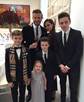
| Hi, I'm Harper Steven Beckham. I'm an English girl. Harper is my first name. Steven is my middle name. Beckham is my last name. Here's my family photo。This is my father, David Beckham. That is my mother Victoria Beckham. Those are my brothers, Brooklyn, Remeo and Cruz. |
| | My name is Kimi. I'm not English. 'm Chinese. My father is Lin Zhiying. His English name is Jimmy. My mother is Chen Ruoyi. Her English name is Kelly. Oh, Angela and Cindy are my good friends. |
| | Who am I? I'm Cindy. My Chinese name is Tian Yucheng. Tian Liang is my father. Ye Yiqian is my mother. Tian Xinchen is my brother. |


-
(1) Harper has_______ brothers.A . one B . two C . three D . four
-
(2) Steven is Harper's ______.A . first name B . middle name C . last name D . full name
-
(3) Cindy is Kimi's _______.A . sister B . cousin C . friend D . mother
Lisa was a single (单身的) mother who lived with her little son. She lost her job two years ago and they had a very hard life. Her heart was broken every time her son asked, "Can I have some more bread and butter please, Mommy?"
One day, when her son asked the same question again, she decided to prepare a big meal for him with the only 6 dollars in her hand. She went to the supermarket, bought some food and cooked at home. Lisa was a shy mother, but she was strong-minded. "It's time to make a change," she thought. She was good at writing. To make some money, she began to write articles for magazines day and night.
Things went better. The food bank started to give her some free vegetables every month. Her son finally had enough to eat. Once he told Lisa that the dishes she made were delicious. Suddenly. an idea came to Lisa's mind, "Why not share my recipes (食谱) on the Internet?" She did. Many people liked her recipes and she became popular.
Soon after that, some reporters interviewed(采访) her and asked her to write a book on cooking. When Lisa got the money for the book she wrote, she had a good sleep for the first night during the two years. Now Lisa has a well-paid job and a beautiful home, but she'll never forget the days when she worked hard for a good life.
-
(1) Lisa ____________ two years ago and lived a very hard life.A . lost her only job B . sold vegetables C . opened a store D . bought a house
-
(2) In paragraph3, the underline word "suddenly" probably means in Chinese.A . 最后地 B . 幸运地 C . 突然地 D . 渐渐地
-
(3) According to the passage, the right order of the following is ______________.
①She prepared a big meal for her son with the only 6 dollars.
②The food bank started to give her some free vegetables.
③She wrote a book on cook and got the payment.
④she wrote articles for magazines day and night.
A . ②④③① B . ②①④③ C . ①③④② D . ①④②③ -
(4) The best title for this passage is _____________.A . A Single but Strong Mother B . Mother's Popular Recipes C . Sharing Makes Rich D . Mother, A Wonderful Cook
There are some easy things you can do to protect the environment and the Earth. Choose ideas from the list or come up with a few of your own.
Plant flowers, grass and trees.
Whenever you visit a park or beach, take away what you bring there-put rubbish in a bag until you put it in a dustbin.
Tum off the lights and TV sets, when you leave the room. This can save a lot of electricity.
Turn off the tap when you are brushing your teeth. You can save some water by not letting it run.
Also use a glass cup instead of a paper cup because this saves paper.
Keep the doors and windows closed in winter to keep warm.
Give your old books and magazines to a library instead of throwing them away.
Give your old clothes to the poor children you know instead of throwing them away.
Use both sides of paper.
Encourage all your friends to do the same things you do to help protect the Earth. You don't Stop pouring(倾倒)dirty water into the rivers or lakes nearby, have to wait until Earth Day to do these things. Make every day Earth Day.
If everyone makes a contribution(贡献)to protecting the environment, the world will become much better.
-
(1) From this passage, we know that this is .A . a sign B . a notice C . an advertisement D . a proposal(倡议书)
-
(2) We can to save paper.A . use a paper cup for drinking B . use both sides of paper in daily life C . save water by not letting it run while. brushing our teeth D . that we can't do all these things until Earth Day
-
(3) Which of the following is NOT true according to the passage?.A . Turn off the lights when you leave the room. B . Close the doors and windows in winter. C . Use a paper cup while brushing your teeth. D . Give your old clothes to the poor children.
-
(4) Which is the best title for the passage?A . Protect the environment and the Earth B . Save water and electricity C . Make better use of old things D . Save money
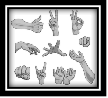
Clara Daly was sitting on a flight from Boston to Los Angeles when she heard a worried voice over the loudspeaker: “Does anyone on board know American Sign Language?”
Clara, 15 at the time, pressed the call button. An air hostess came by and explained the situation. "We have a passenger on the plane who's blind and deaf," she said. The passenger seemed to want something, but he was traveling alone and the air hostesses couldn't understand what he needed.
Clara had been studying ASL for the past year to help blind and deaf people and she knew she'd be able to finger spell into the man's palm (手掌). So she rose from her seat, walked toward the front of the plane, and knelt (跪下) by the seat of Tim Cook, then 64. Gently taking his hand, she signed, "How are you? Are you OK?" Cook asked for some water.
When it arrived, Clara returned to her seat. She came by again a bit later because he wanted to know the time. On her third visit, she stopped and stayed for a while.
"He didn't need anything. He was lonely and wanted to talk," Clara said.
So for the next hour, she talked about her family and her plans for the future. Cook told Clara how he had become blind over time and shared stories of his days as a traveling salesman. Even though he couldn't see her, she "looked attentively at his face with such kindness," a passenger reported.
"Clara was amazing," an air hostess told Alaska Airlines in an interview. "You could tell Cook was very excited to have someone he could speak to, and she was such an angel."
Cook's reply: "Best trip I've ever had."
-
(1) What was the air hostesses' problem in Paragraph 1?A . They had a very difficult passenger. B . They couldn't understand American Sign Language. C . They didn't know the passenger's name. D . They didn't have what the passenger wanted.
-
(2) Why did Clara Daly believe she could help?A . Because she happened to learn some ASL. B . Because she had helped people like Cook. C . Because she thought she might know Cook. D . Because her grandfather had the same problem.
-
(3) Into which did Clara Daly finger spell with Tim Cook?A .
 B .
B .  C .
C .  D .
D . 
-
(4) Why did Tim Cook keep asking for service?A . Because he was hungry and thirsty. B . Because he was interested in Clara's story. C . Because he was afraid of taking planes. D . Because he needed someone to talk to.
-
(5) Which of the following words best describe Clara Daly?A . Brave and clever. B . Beautiful and lovely. C . Patient and caring. D . Outgoing and friendly.
- 将乙烯通入溴水中,发生反应的类型为 A. 加成反应 B. 取代反应 C. 聚合反应 D. 置换反应
- 下列图示的“错误操作”,与对应选项“可能产生的后果”不一致的是() A. 试管破裂 B. 量取的液体偏少 C. 橡皮
- -.Look! It_____be your uncle . ----It_____ be him . H
- 古希腊著名哲学家赫拉克利特有一句名言:“世界是包括一切的整体,它不是由任何神或被任何人创造的,它的过去、现在和将来都是按
- 氢化钙(CaH2)固体是一种储氢材料,是登山运动员常用的能源提供剂。某化学小组的同学在老师的指导下制备氢化钙。 【
- 读下图,该图反映了2001年美国和中国依靠科技转化而来的产值占农业新增总产值的百分比。下面有关叙述正确的是(
- 某无色透明溶液中可能大量存在Ba2+、Mg2+、Fe3+中的几种离子。 (1)不做任何实验就可以肯定原溶液中不存在的离子
- 抗日民族统一战线正式形成的标志是 A.西安事变的和平解决 B.国民党发表《自卫抗战声明书》C.国民党一大的召开
- (2014·南平质检)下图是我国东、中、西部三大经济地带的人口、面积和经济水平示意图。读图,完成1~2题。1.根据材料
- 下列关于分子和分子热运动的说法中正确的是 A.用显微镜观察液体中悬浮微粒的布朗运动,观察到的是微粒中分子的无规则运动 B
- 下列技术依据DNA分子杂交原理的是 ① 用
- 右图是2010年青年歌手大奖赛中,七位评委为甲、乙两名选手打出的分数的茎叶图(其中m为数字0~9中的一个),去掉一个最高
- 诗人杜牧有“甘英穷西海,四万到洛阳”的诗句。诗中的“西海”是指今天的( )A.红海 B.里海 C.
- 下列关于实验现象的描述不正确的是( ) A.把铜片和铁片紧靠在一起浸入稀硫酸中,铜片表面出现气泡 B.用锌片做阳极
- 下列词语中,没有错别字的一组是( ) A.寥廓 漫溯 河畔 吹毛求疵 B.惨淡 清闲
- 已知某样品中存在甲、乙、丙、丁、戊五种蛋白质分子,其分子大小、电荷的性质和数量情况如图所示,下列有关蛋白质分离的叙述正确
- 小明在探究“电流大小与电压、电阻的关系”的实验,如图甲所示的实物电路连接完整. (1)闭合开关后,发现电流表无示数,电压
- 在山岳地区,公路常建造成“之”字形,原因是 A.为了降低线路坡度 B.增加线路长度,发展旅游 C
- 漫画《各人心目中的“上帝”》的哲学寓意是 A.“上帝”也是客观存在的 B.“上帝”纯粹是人的心灵的
- 在下列物质转化关系中,反应的条件和部分产物已略去。已知甲、乙是两种常见金属,甲的焰色反应呈黄色,乙与H2O需要在高温下反


