环保类 知识点题库
GreenHome campaigners (发起者) really love the nature world. In fact, we love it so much that we're determined (决心) to do our best to protect it.For that, we need money, too. GreenHome can be strong only with the support from people like you.
If the joy of walking through the green forest, the excitement of climbing ancient rocks, or even the simple pleasure of watching wildlife in its own habitat (栖息地) really moves you, then share GreenHome's idea with the world. Please turn that idea into some support today.
So take action right now! Even a very small amount, like $ 1 a month, will soon build up into a valuable contribution (贡献) to protecting the nature world we love so much.We'll also use it to develop ways to deal with environmental problems.
Think about it in another way. If you want a future where you can continue to do the things you love in the great outdoors, you need to make sure you've got a great outdoors to do them in.And this way is simple enough—that's got to be worth $1 a month.
|
A. Giving GreenHome your support is one way you can do that. B. But determination alone will not protect the environment. C. That's why we're asking you to join us today. D. And we won't just use it to stop bad things. E. Everything we do costs money. |
You might not think much about where your garbage goes. But now you might want to know. On July 1 Shanghai introduced a new garbage-sorting policy (垃圾分类政策). People there need to put different kinds of garbage into different bins (垃圾箱). Other cities in China will do the same soon.
Why is garbage sorting a big problem? It's because there is too much garbage these days. It is bad for our soil (土壤), air and water. Actually we can make use of some garbage again. And first, we need to sort our garbage.
For example, if you put an old battery (电池) into the “harmful waste (有害垃圾)” bin, people can use it to make new batteries. But if you don't, the battery will end up somewhere else. Then, it will pollute the environment (污染环境).
Can't factories sort garbage for us? Yes, they can. But it takes many workers to do this and costs lots of money. If we all sort our own garbage, things will become much easier. Recyclable garbage includes (包含) paper, books, boxes, newspapers, and glass bottles. Harmful garbage includes lamps, batteries, nail polish (指甲油) and other things with harmful chemicals (有害化学物质). Wet garbage usually comes from the kitchen, such as food, vegetables, flowers, leaves (树叶) and eggshells (蛋壳). Dry garbage is anything you cannot put into the other three bins. It includes pens, toilet paper, tape (胶带), hair, and towels (毛巾).
-
(1) What is the new garbage-sorting policy in Shanghai?A . People should put garbage into dustbins. B . People should put different garbage into different bins. C . If you don't sort garbage right, you will receive a notice. D . People can take buses for free if they give plastic bottles (塑料瓶) to bus stations.
-
(2) Why should we sort out garbage?A . Because we have too much garbage. B . Because too much garbage is bad for our soil (土壤), air and water. C . Because some people want to recycle it. D . Because garbage sorting can help our home clean.
-
(3) What may happen if we just put old batteries into rubbish bin?A . It may go with other rubbish. B . It may be put in a big hole in the ground. C . The poisonous materials inside batteries may get out and make the environment polluted. D . All of the above.
-
(4) Why can't factories sort garbage for us?A . Because they are too busy. B . Because they want to have a better life. C . Because garbage sorting only in factories is tiring and costly. D . Because they are lazy.
-
(5) Can people put eggshells into recyclable bin?A . Yes. B . No. C . I don't know. D . Maybe.
The earth is 4.6 billion years old. We humans have lived on the earth for only 35 000 years, but during this period, we have changed our planet a lot in many ways. Some things we have done are very good for the earth while others are bad.
All over the world, people have cut down millions of trees. When it rains or when the wind blows, the earth is taken away. Forests have become deserts, so many kinds of animals and plants are disappearing.
Factories have also polluted the land and the water. As a result, many rivers and lakes are now dead. Around the earth, there's a special kind of oxygen called "ozone" (O3). It is important to the earth.
But now air pollution is destroying it and making a very big hole in the ozone layer.
Carbon dioxide (CO2) in the air has increased a lot. It mainly comes from burning oil, coal and wood. This has formed a blanket around the earth. The heat from the sun can't escape so the temperature is rising. It causes the level of the oceans to rise and the climate of the earth to change.
All these problems are very serious, so we must do something now.
-
(1) What does "our planet" mean here?A . The sun B . Mars. C . The moon D . The earth
-
(2) According to the passage, what can make rivers and lakes dead?A . Fewer trees. B . Factory pollution. C . The ozone hole. D . More carbon dioxide.
-
(3) In the passage, the underlined word blanket refers to________.A . carbon dioxide around the earth B . the ozone layer in the sky C . the forests around the world D . pollution all over the world
-
(4) The word it in Paragraph 4 refers toA . O3 B . CO2 C . H2O D . O2
-
(5) What is the best title for this passageA . Environmental Problems B . Pollution on the Earth C . Hope for the Future D . The Greenhouse Effect
In order to protect environment, it is very important to learn about the environment. There are many ways to understand how to protect the environment, such as reading books, asking someone and so on. You are students. In your spare time, you can read as many as books. Books in the library are worth reading. They will help you learn. Ask your classmates or librarians for some suggestions. They have good ideas. You can also get information about the environment on some good websites. Besides these, I have some suggestions.
In our everyday life  some people use less energy by carpooling. For example, three or four persons can ride together in one car instead of driving three or four cars to work. Usually it is time-saving and convenient to carpool with their neighbors to take their children to school. Whenever we use electricity, we should turn off lights, the TV, the computer and so on when we don't use them. On the other hand, we should use energy-saving products. Some products, like environment-friendly new energy cars, are made specially to save energy. These cars can travel longer than ordinary cars. They produce less pollution, too. Some products like computers and TVs with the ENERGY STAR label (标签) ® are made to save energy. The products with these labels will help us protect the environment.
Secondly, we should buy recyclable products instead of non-recyclable ones. Recyclable products usually take less energy. When we go shopping, pay attention to the recycle mark on the package: make a circle and three arrows.
-
(1) The passage is mainly written for .A . producers B . students C . businessmen D . drivers
-
(2) The underlined word "carpooling" refers to (指) .A . sharing a car B . buying a car C . repairing a car D . producing a car
-
(3) _______ produce less pollution.A . New shared bicycles B . New energy cars C . TVs with ® D . Computers with ®
-
(4) What should we pay attention to when we go shopping?A . Mark. B . Price. C . Weight. D . Model.
-
(5) From the passage, we can learn .A . how to turn off the electricity B . how to recycle products C . how to use energy cars D . how to protect the environment
Nowadays, it's of great importance to reduce, reuse and recycle, especially in the clothing industry. Every year, about 80 billion items of clothing are made around the world. That's enough to fill over a million football stadiums. It takes about 800 litres of water to make one pair of jeans. With the water, you can take a shower for 285 times. No wonder the fashion industry is the second largest water polluter in the world. Actually, 95% of thrown-away clothing can be recycled to make something new.
As a new industry, clothing rental (租赁) is popular among those who want to protect the environment. But is renting clothes more environmentally-friendly than buying them? In an article for Elle, Elizabeth Cline writes that it's not as sustainable (可持续的) as it seems.
Take shipping for example, which has to go two ways if an item is rented— receiving and returning. Cline writes, "An item ordered online and then returned can send out 20 kilos of carbon ( 碳) each way, and increases up to 50 kilos for rush shipping. However, a pair of jeans bought in a store and washed and worn at home can send out 33.4 kilos, according to a study done by Levi's."
Then there's the burden (负担) of washing, which happens to every item when it's returned. For most rental services, this usually means dry-cleaning, a polluting process. The stain removers ( 去污剂) used for washing can produce harmful waste and air pollution.
Lastly, Cline fears rental services will increase our liking for fast fashion, because it's so easy to get clothes. There's something called "share-washing" that makes people think of wasting not a big deal.
Renting clothes is still preferable to buying them and throwing them away after a few years. However, there's an even better step — wearing what we've already had.
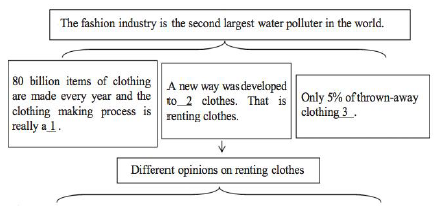
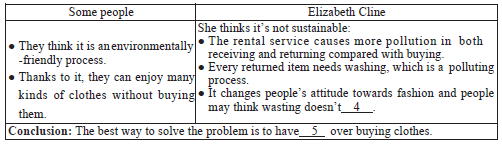
⑴ ⑵ ⑶ ⑷ ⑸
 主席指出,要坚决制止餐饮浪费行为,培养节约习惯。现在全国提倡"光盘行动"。一名中学生写了一封倡议信,号召全校同学和老师一起加入到节约粮食的活动中来。请补全所缺信息,每空一词。
|
Dear teachers and friends, Food waste(浪费) has long been a big problem around the world. Now our government call on us to play a part Clear Your Plate campaign(行动). As middle school students, we should do as much as we can to save food. First, when in a , do not order too much food. , we’d better finish all the food on our plates every time we eat. Third, don’t buy too much food, like vegetables and fruit at a time it is hard to keep them fresh. Finally, When seeing others waste food, try to stop them in a polite way. Clear Your Plate campaign is not only for one person, but for all. I believe if we try our to stop food wasting, the world will be a better place to live in. |
CCTV reported that every year Chinese people throw away a lot of food which can feed 200 million people for a year.
Of course not. According to the UN World Food Programme, there were 900million hungry people all over the world in 2013. About six million children die of hunger every year.
So think about it. We should say no to people who waste food every day. An old saying goes, "Every grain on the plate comes from hard work. "Luckily, a number of people have realized the importance of saving food. Li Hong, a waitress in a restaurant in Jiangsu, once lost her job because she took some leftover(剩余的) food home for her son. But many people were by her side and criticized(批评)the waste of food.
What should we do in our daily life to stop wasting food? Here are some tips:
Don't order too much food in a restaurant. If you can't eat all the food you order, take the rest of it home.
Don't be too picky(挑剔的)about food. Don't keep too much food at home, especially for fruit and vegetables.
|
A. This saying tells us everybody must save food. B. Scientist are trying to find ways to produce more crops. C. Do we have too much food? D. Only order as much as you can eat. E. We can do many things to prevent it from happening. F. some food may not be tasty, but put body need it. G. When we choose what we eat, taste should come first. |
Do you believe in green living? Read the following blog and replies about a fun, easy and creative way to make your lifestyle greener.
Posted by Gina at 8:32 a. m. on 11th February 2020 New uses for old clothing Nowadays, we're more wasteful than ever-buying, throwing things away without thinking. We need to start living more responsibly—but how? One answer is to upcycle (再生利用) . I started upcycling clothing. Making new things out of old clothes is the best way to mix my talent and my interest. Do you upcycle? If so, what new things have you made? If not, why not give it a try? | |
| I love UR idea. But why don't U give UR old clothes to people in need? I even give away the most expensive things I don't wear anymore. So I can help the environment while giving something useful to people in need. Good point! I'm talking about only the oldest clothing in your room — the clothes that are too old to be worn by others. The same idea goes for food waste at restaurants and supermarkets. Before upcycling food that can still be eaten, for example, using it to make soil rich, we should give it to those in need. | |
| I've made shopping bags out of T-shirts and dog toys out of socks. Upcycling clothing is a fun hobby, but the most important thing is that it makes me feel like I'm living less wastefully. |
 What do you think of the "new" hat I made for my sister? It used to be my mum's sweater.
  Terry B Posted at 9:08 a. m. on 11th February 2020
 Gina Posted at 9:28 a. m. on 11th February 2020
  Betty99 Posted at 10:18 a. m. on 11th February 2020
-
(1) What is special about the hat?A . It was new and expensive. B . It was given by Gina's mum. C . It was a gift from Gina's sister. D . It came from an old sweater.
-
(2) Gina give a reply to TerryB to _____.A . show her disagreement B . sell her own food C . further explain her idea D . express her deep regret
-
(3) The language in the passage _____________.A . must be formal B . may be informal C . must be very exact D . must be humorous
-
(4) What can we learn from the blog?A . Betty feels more wasteful by upcycling clothing. B . Terry B seldom gives his clothes to people in need. C . Gina thinks inventing new things can mix her talent and interest. D . Gina thinks that if no one is in need of the food, they can use it to make soil rich.
On December 26th, 2020, China passed a new law to protect the Yangtze River, the "mother river" of China. It is Yangtze River Protection Law. It took effect(生效)on March 1st, 2021. It's the first law to protect a waterway in China.
The 6,397-kilometer Yangtze River is the longest river in Asia. It covers an area of about 1.8 million square kilometers, about one fifth of the national total. The Yangtze River provides one third of the country's freshwater resources(淡水资源), but it has met lots of environmental problems in recent years, such as heavy pollution and overfishing. Especially, the river's Chinese paddlefish(白鲟)has died out. So the "mother river" is in great need of protection. To solve these problems, China put a 10-year fishing ban(禁令)at the beginning of this year to protect fish resources.
According to a report of the government, the fishermen said they would give up fishing along the Yangtze River to protect the "mother river". Chinese officer Han Zheng said that more support should be given to the fishermen to help them find new jobs and places to live.
Yangtze River Protection Law includes resource protection and green development. The government says the purpose of the new law is to strengthen(加强)environmental protection, use resources well and make the development sustainable(可持续的).
-
(1) When did the new law pass?
-
(2) How long is the Yangtze River?
-
(3) Did the fishermen agree to give up fishing along the Yangtze River?
-
(4) What does the new law include according to the passage?
-
(5) What is the passage mainly about?
Look at the Earth from space. Why does our planet look so blue? It's blue because water covers almost three quarters of the Earth's surface. Water is not just an important part of our planet. It is an important part of our body, too. More than half of our total body weight is water.
Our body loses water whenever we exercise or go to the toilet. That's why we need to drink plenty of water every day. We drink water. We use it to cook, clean, and carry waste out of our homes. Farmers use it to grow vegetables and crops like rice and corn; factories use it to make products.
Since the 1950s, the amount (数量) of water people use has increased by three times. But the water supply (供应) hasn't. Scientists worry that soon there won't be enough water for us, as well as for the animals and plants that share our world. What can we do to help? Use water wisely.
Having enough water isn't our only problem. We also need it clean.
Right now, ships and factories are putting wastes into seas, rivers and so on. Even chemicals that farmers use are running into rivers and lakes. All this pollution can make the water dangerous to drink. It can also harm fish and other water-living lives.
We must do something to stop pollution. It's the best way to protect our world's most valuable natural resource (资源).
-
(1) How many important areas of water are mentioned in Paragraph 1?A . One. B . Two. C . Three. D . Four.
-
(2) The underlined sentence "We also need it clean" in Paragraph 4 means" ___________."A . We also need water to wash things B . We also need water that looks clean C . We also need to keep water clean D . We also need to discover clean water
-
(3) This passage was written to __________________.A . ask people to value water B . advise people to drink more water C . introduce the uses of water D . describe the situation of water supply
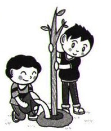
Trees can cool the air, land and water, and take in carbon dioxide(二氧化碳) in the air around the earth. They are very important in improving the environment, especially in slowing global warming(全球变暖).
According to a new study, planting a trillion (万亿) trees could stop global warming for 20 years, and our planet has plenty of suitable land to do so. The study shows there is enough tree-planting land to make a 20-year stop in global warming. The study has also found that tree planting will be the most useful and cheapest way to make a difference to the changing climate and that it can remove plenty of carbon emissions which have been created by human activities.
"When you think about completing the project, it's not only about fighting climate change, but also about keeping ecosystems(生态系统) working well, "said Jean-Francois Bastin, one of the researchers from the Institute of Integrative Biology in Switzerland.
The study was made public just before Australia's National Tree Day which has grown to be Australia's biggest tree planting and nature protection event. Researchers have found there are six countries which have more than half of the suitable land for growing trees. Among those six countries, Russia, the US and Canada have the most tree-planting land, followed by Australia, Brazil and China.
Though it hasn't been clear whether we could ever plant enough trees to make enough difference, everyone is expected to plant as many trees as possible.
-
(1) The first paragraph mainly tells us _______.A . how to cut carbon dioxide emissions B . some advantages of trees C . present situations of the earth D . ways to improve the environment
-
(2) Tree planting is regarded as a _______ way to protect the earth.A . useful but expensive B . quick but difficult C . helpful and inexpensive D . convenient and traditional
-
(3) In the third paragraph, the underlined part" the project" refers to _______.A . planting a trillion trees B . improving the environment C . making the study well known D . finding suitable land for growing trees
-
(4) What can we learn from the passage?A . I's impossible to stop global warming. B . China has the third most tree-planting land. C . Human activities create too much carbon dioxide. D . National Tree Day is very popular in Australia.
-
(5) What can be the best title for the passage?A . How to Find Tree-planting Land B . Fighting to Stop Global Warming C . National Tree Day in Australia D . Let's Plant More Trees Together
We have been used to wearing masks(口罩) in public since February. About 300 million masks are used and then thrown away every day in China. Where do these masks go? You might think they just go in a rubbish bin. But that's just the first stop on the masks' journey.
After the masks are thrown into the bins, rubbish trucks empty the bins and take the rubbish to landfills(垃圾场). Next, the masks will be taken to rubbish incinerators(焚化炉) and burned. Burning masks might not seem to be very good for the environment. Won't it cause pollution?
The answer is "no", according to China Daily. The main material of most masks is polypropylene(聚丙烯).It's non-toxic(无毒的). After burning,it changes into water and Co2.
In fact, burning the masks can bring some benefits(益处). The process of burning the rubbish can produce electricity. Burning one ton of rubbish can produce more than 400 kilowatt hours(度) of electricity. Some people make a prediction that there will be 162, 000 tons of used masks in China this year. Burning all of them can produce more than 64 million kilowatt hours of electricity. This is enough to make an electric car drive about 370 million km, which is 9,250 times as long as the earth's equator.
At last, the slag(残渣) from burning masks can be recycled to make bricks(砖块)or fill the roads.
-
(1) How many masks are used and then thrown away every day in China?A . More than 64 million. B . About 300 million. C . About 370 million. D . About 9,250 million.
-
(2) The first stop on the masks' journey is __________.A . an electricity factory B . a landfill C . a rubbish truck D . a rubbish bin
-
(3) The main material of most masks is __________·A . plastic B . polypropylene C . water D . CO2
-
(4) Which of the following is TRUE according to the passage?A . Burning masks won't cause pollution. B . People are not used to wearing masks in public. C . There are 162, 000 tons of used masks every month in China. D . The process of burning the masks can produce electricity and bricks.
-
(5) What is the best title of the passage?A . How Do We Burn Used Masks? B . How Do People Produce Electricity? C . Where Do the Used Masks Go? D . Why Do We Throw Away Used Masks?
Once there were many thousands of Gourma Desert (荒漠) elephants in Mali, a country in west Africa. Now, there are fewer than four hundred.
Why did the number of the elephants drop so quickly? On the one hand, the elephants' main lake, their only water source(来源), dried up. On the other hand, the land which the elephants lived on was overused by humans.
To protect the elephants' living environment, the Mali Elephant Project (MEP) was started in 2007. MEP met with local people and helped them make rules of using land and water. As a result, the situation became better and there was more food, forest and grassland.
However, from 2012 to 2016, poaching(偷猎) and illegal trade in the elephants increased rapidly. Eighty-three elephants were lost in 2015 alone, and another fifty-one elephants were killed in 2016."If this situation goes on, all the Gourma elephants will be killed by. 2020," said a member of MEP.
Luckily, the voice of MEP was heard. More organizations (组织) have joined together to educate the local people that trading elephants is against the law. Elephant poaching has dropped to a very low level. The local people have learned to live peacefully with the elephants, one of the wildlife treasures in the world.
-
(1) MEP was started to ________.A . raise more elephants in Mali B . stop the main lake from drying up C . discover water source for elephants D . protect the elephants' living environment
-
(2) What does the word" illegal" in Paragraph 4 mean in Chinese?A . 公平的 B . 亏损的 C . 非法的 D . 合理的
-
(3) Eighty-three elephants were lost ________.A . in 2012 B . in 2015 C . in 2016 D . in 2020
-
(4) We can learn from the last paragraph that ________.A . the number of organizations has dropped B . there is much less elephant poaching now C . the local people keep the elephants at home D . the whole world lives peacefully with elephants
-
(5) This passage is mainly about ________.A . the rules of using land and water B . the education of the local people C . the work of the Mali Elephant Project D . the situation of Gourma Desert elephants
Have you noticed the waste bins(垃圾桶)in different colors on the street? Do you often put all the waste in the same bin? It's reported by Changchun Daily that people must do waste sorting(分类)in most places in Changchun at the end of 2019. Waste sorting is a wonderful way to make good use of energy and protect the environment. But do you know how to sort the waste?
Usually, people should sort their waste into four groups: wet, recyclable, harmful and dry. Different kinds of waste should go into different bins. Wet waste means the things you don't want but pigs can eat, mostly coming from your kitchen. Things that can be used again, such as paper, metal(金属) and glass, are recyclable waste. Harmful waste might be dangerous or cause serious pollution, like medicine and batteries(电池). And any waste that's not wet, recyclable or harmful will go into the dry waste bin.
Different countries are trying different methods to sort the waste. A university in England has invented a smart bin. When people drop their waste into the bin, it can tell what kind of waste it is and sort it correctly. The bin can also compress the waste to make it smaller in size and take up less space. In South Korea(韩国), people have to separate their food waste from other kinds of waste and pay for it. The more food waste they throw away, the more they pay. Japan has the strictest rules for waste sorting in the world. For example, plastic bottles and their caps(盖子) should go into different bins.
-
(1) When must people do waste sorting in most places in Changchun?A . At the end of 2018. B . At the beginning of 2018. C . At the end of 2019. D . At the beginning of 2019.
-
(2) According to the second paragraph(段落), how many groups should people sort their waste into?A . Five. B . Four. C . Three. D . Two.
-
(3) Which of the following should go into the harmful waste bin?A . Glass. B . Metal. C . Paper. D . Medicine.
-
(4) What does the underlined word "compress" in the third paragraph probably mean?A . 扩展 B . 延缓 C . 压缩 D . 膨胀
-
(5) What can we learn from the passage?A . Changchun has the strictest rules for waste sorting in the world. B . All the countries around the world are doing waste sorting these days. C . Waste sorting can help make the earth a better place for people to live in. D . People in South Korea have to pay for the harmful waste they throw away.
Protecting(保护) wild animals is our duty. Because wild animals are important to us. They live with us on the Earth together. If there are no animals on the Earth, we can't survive,1. So we should take good care2them to help us live a healthy life.
3some people still don't realise the4of protecting wild animals. They often kill wild animals for food or for money. Every day there are many wild animals being5. So lots of wild animals have died out(灭绝). We can't see them any more. Today the. number of wild animals6becoming smaller and smaller. If we don't protect them, they will all die out. If this goes on, there will be no animals left on the Earth.
7, more and more people have begun to do many things to help protect wild animals. They ask people8killing wild animals. They get people to know that protecting wild animals is one of the most important things. Now many countries have made9laws(法律) to protect wild animals.
Now that(既然) wild animals are so important to man, we should do our10to protect them and it means human beings can make friends with animals and get on well with them.
We need to be responsible for our environment. Being a frugal consumer(节俭的消费者) is one way to help. But, what exactly does that mean?
Use it up
You can use things up instead of wasting them. Squeeze that last bit of toothpaste out of the tube. Use the last little piece of soap. Don't throw away any bits of the biscuit at the bottom of the box.
Wear it out
You do not always need to have new things. Suppose your sneakers have broken laces, but they still fit you. Repair them and wear them longer. You don't need to have the latest iPhone until the old one doesn't work any- more. Then you can get a new one. Think twice before replacing something that still works.
Make it do
When something you want is not on hand, look for something else that you already have to take its place. Suppose you are, packing your lunch for, tomorrow and want a butter sandwich. You are out of butter. Have a cheese sandwich instead so that you can use all of the cheese. Learn to fix broken toys instead of just throwing them away. With a little thought, you can make something do, instead of buying something new.
Do without
Think about all those things that you would like to have. Do you really need them? How long will you really play with that new toy you saw on TV? Making the things that we want uses up our world's resources(资源). And, getting rid of the things we don't want anymore takes up even more resources and space.
-
(1) Do we need to be responsible for our environment?
-
(2) How do we deal with the last little piece of soap?
-
(3) When do we need to get a new iPhone?
-
(4) What should we do when something we want is not on hand?
-
(5) What does the writer want to tell us?
The scientist was in a hurry. She (离开) her lab to get some water before dark. She was testing the water that went into the ocean. Her job was to find out the cause of
(污染) in the sea. She lifted out the water and looked at the things in it. Old clothes, plastic bags and paper boxes were in the (脏的) water. She felt very sad and angry! "Don't people (意识到) that everything they throw onto the street gets washed into rivers? And they lead right into the ocean!" she said (大声地) , "How many years will it take to make it clean again?"
The scientist was (担心的) about the ocean animals as she walked back to the beach. But when she got there, a group of students from a (当地的) school were cleaning the beach. They spent their afternoon carrying bags of (垃圾) to the bins at nearby beaches. When the scientist saw it happen, she was (被填满) with joy! As she talked with the students, they told
her, "We must do something to (保护) the ocean! We should be responsible for the earth."
In most parts of the world, many students help their school protect the environment(环境) and make the life better. They join in "environment clubs". In an environment club, students work together to make the environment clean. Here are the things students often do:
Turn off the water tap(水龙头)! Do you know that some toilets(厕所) can waste twenty to forty tons of water an hour? In a year, that could fill a small river! In environment clubs, students mend(修理) those broken taps in toilets.
No-car day. On a no-car day, nobody comes to school in a car--not the students and not the teachers! Cars give pollution to our air, so remember: walk, jump, bike or run. Use your legs! It's lots of fun.
No-rubbish lunches. How much do you throw away after lunch? Environment clubs ask students to bring their lunches in bags. Those bags can be used again. Every week they will choose the classes that make the least rubbish. Then, they report them to the whole school!
We love our environment. Let's work together to make it clean!
-
(1) What do students in an environment club do?A . Help their school make more litter. B . Make the environment like before. C . Make the life better. D . Make the environment clean.
-
(2) How many things that students in an environment club often do are mentioned(提到) in the passage?A . Two. B . Three. C . Four. D . Five.
-
(3) The underlined word "fill" means ____.A . 填满 B . 流向 C . 到达 D . 珍惜
-
(4) What cannot students do on a no-car day?A . Use their legs. B . Walk to school. C . Ride a bike to school. D . Take a taxi to school.
-
(5) From the passage, which of the following is TRUE?A . Only some of the teachers can come to school in a car on a no-car day. B . Students bring lunches in bags and they cannot use the bags again. C . Some of the toilets can waste thirty tons of water an hour. D . Classes that make the most rubbish will be reported to the whole school.
People depend on plants. We use plants for food, cloth, shelter(住处), and even the air we breathe.
Plants keep our air and water clean. Green plants give us oxygen. Oxygen is part of the air we breathe.
Plants are also part of the water cycle. Most of the water that a plant takes in goes back into the air.
Plants give us a lot of the food on the earth. Fruits, vegetables, and grains(谷物 ) come form plants. Without plants, we would not have bread, rice carrots, apples, oranges, or bananas! Many people are growing plants to eat in their own gardens at home. Having your own garden helps the earth as well.
When you grow your own fruits and vegetables, you help reduce pollution because big trucks don't need to take your food to shops. You also help reduce the amount of rubbish because you don't need to use bags for packing you food. You can just pick it out of the ground or off a plant and put it into a basket.
Trees are an important plant resource. Trees provide wood to build homes and furniture. Trees are used to make lots of things around your home and at your school. And trees provide fruits that are good for you.
Without trees, the earth would be a very different place.
-
(1) ________is part of the air we breathe.A . Sunlight B . Water C . Food D . Oxygen
-
(2) What happens to most of the water that a plant takes in?A . It goes back into the air. B . It stays in the plant. C . It goes into the ground. D . It stays in the river.
-
(3) You would find the passage in ________.A . an interesting novel B . a book about animals C . a popular play D . a book about nature
-
(4) What's the best title of the passage?A . A Different Place B . The Uses of Plants C . Food on the Earth D . Gardens at Home
The UN's Environment Program (UNEP) found that the world wastes about 17% of all the food. That's about 1.03 billion tons of food a year, which is over 93 1 billion kilograms.
According to the study, food is wasted everywhere—at home, in restaurants and in stores. And most food waste—about 61%--comes from homes. 26% of the food waste comes from restaurants. And the remaining 13% is thrown away by stores.
You must think rich countries waste more food than poor countries. That is not true. In fact, some richer countries waste far less food than average (平均水平).
People in rich countries waste less food at home because they often eat out at restaurants. For example, the US has low waste numbers for homes, but very high numbers for restaurants.
The UNEP report says it's important for countries to study food waste more carefully in order to find out ways to solve the problem. "If food waste ends up in landfills(垃圾填埋场) , it does not feed people, but feeds climate change. Food is too important to waste, so we should do something now quickly," says Martina Otto with a smile, the leader of the UNEP.
-
(1) Which can be the best title for the passage?A . The Importance of Food Study B . The Problem about Food Waste C . The Ways of Solving Food Waste
-
(2) Where is the most serious food waste from?A . Homes. B . Stores. C . Restaurants.
-
(3) Martina, the leader of the UNEP, _______ food waste.A . is angry about B . is sad about C . is worried about
- 某化学研究性学习小组为了模拟工业流程从浓缩的海水中提取液溴,查阅资料知:Br2的沸点为59℃,微溶于水,有毒性。设计了如
- “雪碧”等碳酸型饮料的pH小于7,晃动后打开瓶盖,其pH将() A.变大 B.变小 C.不变 D.无法判断
- 综合性学习 阅读下面材料,并完成题目。 常言道:久病床前无孝子。而靖安县双溪镇建设社区居民肖礼秀,却二十年如一日,精心照
- 下列说法或表达正确的是 ( ) ①次氯酸的电子式为 ②含
- 53. I’m afraid I can’t keep _______ my classmates as I’ve mi
- 如图:利用Fe+CuSO4=FeSO4+Cu反应设计一个原电池.下列说法中,正确的是 A.电解质溶液中阳离子向负极移
- 下列物质既能跟盐酸反应,又能与氢氧化钠溶液反应的是() A.Na2CO3 B.NaOH C.NaCl D.NaHC
- 下图中甲、乙、丙所代表的含义如表中所示,则相应的叙述与图示不符的是 选项 甲 乙 丙 相应的叙述 A 植物体的一部分 愈
- 75°的圆心角所对的弧长是2.5cm,则此弧所在圆的半径是 cm.
- 2005年禽流感在全球蔓延,百姓谈“禽”色变。目前通过从香料八角中提取的莽草酸制得的达菲是抗禽流感病毒特效药物。下列有关
- 下列各组词语中加点字的注音和书写正确的一项是 A. 猝然(cù) 自艾 ( yì) 臧否 ( zàn
- (7分)(1)用元素符号或化学式等化学用语填空:①2个氮分子__________②标出氯化钠中氯元素的化合价______
- 1979~2000年,我国蔬菜种植规模和种植地区分布都发生了显著变化。分析下列表1、表2,完成1-2题。 表1 我国蔬菜
- 诺贝尔委员会给莫言的颁奖词为:“将魔幻现实主义与民间故事、历史与当代社会融合在一起。”魔幻现实主义是通过“魔法”所产生的
- 已知点P(1,2)在圆C:x2+y2+kx+2y+k2=0的外部,则实数k的取值范围是________.
- 我国特有的国家一级保护的爬行动物是 ( )
- After they had worked for thehours they stopped _____ a res
- 直线l过点(-1,2)且与直线2x-3y+4=0平行,则l的方程为() A.3x+2y+8=0
- (5分)硫酸和盐酸组成的混合液100 mL,向里面加入氢氧化钡粉末4.275g,充分反应后,经过滤、洗涤、干燥,得到沉淀
- Day by day, I became to everyone in my clas


