高二英语上学期上册试题
Nowadays, a lot of children have less time to play and communicate with their peer due to extra studies. ________, it is difficult to develop their character and social skills.
A. Consequently B. Occasionally
C. Eventually D. Dramatically
Keeping pace with teachers is a fine way to study English.Teachers are experienced and their plans are systematic.But remember to work in a way that suits you.It's important to learn from past mistakes as well.Keep a notebook to make a record of the mistakes you make-it'll help you avoid making the same ones later.
The time of life may be hard,but you're not alone.You may be busy studying,but you can show your care by calling your friends or sending short messages.Don't let your friendships die.
It's as important to live well as it is to study well.Going to bed no later than 11:30 pm is vital.It puts you in the right mood for the next day.You needn't follow a special diet,but make sure you are eating nutritious meals each day.
The person who plays well,studies well.Having a lot of schoolwork doesn't mean having to give up other activities.Playing basketball or having a talk with your classmates can relax yourself.Time_out is not a waste of time but helps you study more efficiently.
Besides taking the big exam,you have other choices for college.I took the independent enrollment exam held by Peking University and some other students even were preparing to study abroad.Pay attention to any relevant information you can find,whether it's from school,the news media or other sources.
49.What should you do if you want to keep your friendship fresh?
A.Have frequent talks with them.
B.Always have lunch with them.
C.Remain them at some distance.
D.Keep connection by some ways.
50.The third paragraph is mainly about________.
A.study B.friendship C.relaxation D.health
51.Which one is the closest meaning to “Time out” in Paragraph 4?
A.Sleep. B.Exercise. C.Continuation. D.Pause.
52.The passage is mainly written by a(n)________.
A.editor B.student C.teacher D.parent
假定英语课上老师要求同学们交换修改作文,请你修改你同桌写的以下作文。文中共有10处语言错误,每句中最多有两处。错误涉及一个单词的增加、删除或修改。
增加:在缺词处加一个漏字符号(∧ ).并在其下面写上该加的词。
删除:把多余的词用斜线(\)划掉。
修改:在错的词下划一横线并在该词下面写上修改后的词。
注意:1.每处错误及其修改均仅限一词;
2.只允许修改10处,多者(从第11处起)不计分。
Interest is a kind of power that can drive people learn actively and happily. And it also makes learning more effective and efficiently.
I really appreciate the opinion. I begin to be crazy about English when I was a little boy. And I got interested in foreign culture and customs in particular to meet my curiosity. I read English stories,listened to English songs and watched English films on every day, all of that even seemed to be the “meal” of my daily life. As the result, I always did very well in English exams.
In a word,interesting is the key to success. Anyone who are interested in something will devote himself to them.
Starting high school means changes in your life. Most teenagers look forward to the first day of high school, but still feel a little bit nervous.36. .
37 . Take part in some activities that are held at the school for new students to know the school better. If parents are invited to these activities, take yours with you. Carefully look over all the materials you receive. Make sure of the addresses of the school’s buildings .
38 . Buy the things suggested on your teachers’ supply lists and place your materials for each class separately.
39 . If you find you’re not doing well in a subject, make use of after-school study groups or ask your teacher t o help you with your schoolwork. Consider private tutoring to get you through a difficult time.
There are more extracurricular (课外的) activities in high school than in middle school, such as clubs, music and theatre groups, student government, and sports teams. Make friends and be seen at such school activities.40 . Ask someone in the school office about opportunities to take part in school activities if you don’t know how. This is a good time to do what you like doing and an opportunity to try new things. Who said school has to be all work and no play? Since you’re attending more activities in high school than in middle school, you’ll have to learn to manage your time.
A. In order to make your high school life easier, you can follow these tips.
B. Get the things you will need for class.
C. there is no useful information.
D. All work and no play makes Jack a dull boy.
E. Keep pace with your high school workload.
F. Learn all you can about your first day before the first school day.
G. Join a club or other organizations to meet people and develop friendship.
Jack Evans quarreled with his neighbour,Ellen Brown. Mrs. Brown had a dog. Jack did not like dogs. He wanted Mrs. Brown to give away or sell her dog,but she refused.
“I'll take you to court if you don't,” he said.
Mrs. Brown laughed at him. She was not worried.
Jack thought,“I must talk to a lawyer,but lawyers are expensive. I don't want to waste my money. I will waste it if I don't win my case against Mrs. Brown and her dog.”
Then Jack had an idea. There was a young lawyer in the town. He did not have much work. Not many people knew about him. “I'll visit him,” Jack thought. “He needs work.” He visited the young lawyer in his office. “I need some advice,” he said.
“Certainly,” the young lawyer said. “What is your problem? I am here to help you.”
“Good. I want to take my neighbour to court. However,I will pay for your advice only if you think I will win the case in court.”
The lawyer was not pleased by this suggestion. However,he had very little work. Here was a chance to get some.
“All right,” he said. “I agree. I will listen to your problem. I will give you honest advice. You will pay me only if I think you can win in court.”
Jack told him about the problem. The lawyer listened carefully. Sometimes he made notes. When Jack finished,the lawyer sat back in his chair and said,“You will win your case. I have no doubt about it. May I take your case to court?”
Jack stood up and walked towards the door. “No,thank you,” he said. “I will not take it to court.”
“What about my fee?” the lawyer asked. “You have to keep your promise.”
“I am keeping my promise,” Jack said. “I will not win in court. You see,I did not tell you my case. I told you Mrs. Brown's.”
8. Jack Evans argued with his neighbour because _______.
A. his neighbour was not friendly
B. he disliked her dog
C. Mrs Brown wanted to take him to court
D. he was laughed at
9. Whom did Jack see for advice?
A. A lawyer.
B. His neighbour.
C. His friend.
D. Mrs. Brown.
10. Jack agreed to pay the lawyer if _______.
A. the lawyer helped him in court
B. Mrs. Brown couldn't offer the money
C. the dog was sold
D. the lawyer said he would win his case
Last year my summer holiday was spoiled by my bringing along a modem convenience that was too convenient for my own good: the iPad. Instead of looking at nature, I checked my e-mail. Instead of paddling a small hoax, I followed my Twitter feed C 推特简讯) . Instead of reading great novels. I stuck to reading four newspapers each morning. I was behaving as if I were still in the office. My body was on vacation, but my head wasn't.
So this year I made up my mind to try something different: withdrawal from the Internet. I knew it wouldn't be easy, since I'm had at self-control. Bin I was determined. I started by giving the iPad to my wife.
The cellphone signal at our house was worse than in the past, making my aitempts at cheating an experience in fnistration (沮丧). I was trapped, forced to go through with my plan. Largely breaking away from e-mail, Twitter and my favorite newspaper websites. I had few ways to connect to the world except for the radio—and how much radio can one listen to. really? I had to do what 1 had planned to do all along: read books.
This experience has had a happy ending. With determination and the strong support of my wife, I won in my vacation struggle against the Internet, realizing finally that it was I, not the iPad,that was the problem. I knew I had won when we Passed a Starbucks and my wife asked if I wanted to stop to use the Wi-Fi. “I don't need it” I said.
However, as we return to post-vacation life,a harder test begins: Can I continue when I'm back at work?
There are times when the need to know what's being said right now is great. I have no intention of giving up my convenience completely. But 1 hope to resist the temptation to check my e-mail every five minutes, which leads to checking my Twitter feed and a website or two.
I think a vacation is supposed to help you resi your brain to become more productive . Here I hope this one worked.
35. What do we know about the author's last summer vacation?
A. He was determined to enjoy the beautiful view.
B. His iPad ruined his plan of finishing a great novel.
C. He hated himself for acting as if he were working on vacation
D. He felt satisfied that he had stuck To his usual Timetable.
36. What did the author do to keep away from the Internet this year?
A. He cut off his cellphone signal.
B. He handed his iPad to his wife.
C. He refused to cheat in his house.
D. He listened to the radio most of the time.
37. When back at work, the author will probably choose to .
A. keep control of when and how to use the Internet
B. continue to road more and more books
C.stay away from the Internet for ever
D.stop checking what is being said right now completek.
38. What is the author's opinion of a great vacation in the passage?
A. A vacation is having nothing to do but read all day.
B. A vacation proves that a life of pleasure is overvalued.
C. A vacation means a change of pace to make one more creative.
D. A vacation is a period of time to do whatever one wishes to.
假如你是English Corner 栏目的编辑李华,有个叫李明的学生向你请教如何学好英语。下面请你就如何学好英语,以书信的形式给他提出几条建议。
1. 每天早上朗读英语单词、句子及短文,尽量多记一些有用的句子并背诵一些短文章;
2. 经常进行大量的课外阅读;
3. 每天应安排一些时间进行听力训练;
4. 只要你能充分利用业余时间来学习英语,你的英语很快就会得到提高。
注意:1.词数100左右;
2. 可以适当增加细节,可以使行文连贯。
3. 开头语和结尾为你写好,不计入总次数。
Dear Li Ming,
I’m an editor of English Corner. I’ve received your letter asking me to give you some advice on how to learn English well. _________________________________________________________
______________________________________________________________________________________________________________________
____________________________________________________________
Yours
_______ information cost him many chances of finding jobs.
A. Lack B. Short of C. Lack of D. Lacking of
The next day, Sarah was shocked to find a piece of paper on her desk ________ ‘ Stupid Sarah got a D!’
A. writing B. reading C. said D. that says
Health officials in Canada are very busy these days. They are placing chickens at fixed points all along their border with the United States of America. They are using these chickens to see if the deadly West Nile virus exists in their country. The virus spreads to birds, so they think that the chickens have a good chance of catching the virus.
The Canadians are worried because the West Nile virus is passed to humans by mosquitoes. It killed seven people in New York last year. Countries around the world are realizing something important—it may just be possible to stop certain kinds of people from entering their land; but it is very difficult to try and stop viruses that travel from one end of the earth to another. When they travel to new places, they adjust very easily to those climates and sometimes start destroying the local plant and animal life. These biological polluters are called smart polluters.
These smart polluters can be carried across borders of countries unknowingly. Just as we humans are travelling across the globe more often than earlier, these biological polluters have also started journeying much more. They travel in many things carried from one country to another.
There are some good examples of how these polluters work. The water hyacinth(水葫芦) of South America is filling lakes in China and Africa. Tree snakes from Papua New Guinea are busy eating up bird in the country of Guam, which is quite far away. Tiger mosquitoes from Asia are busy biting Americans.
Suddenly, a lot of things become clearer. Like why the customs(海关) officials in many foreign countries prevent you from bringing in a small plant, they tell you that it’s in the rules. They have these rules because they know that these kinds of plants that are special to specific places have the power to spread new diseases among native plants and animals. They are called biological polluters and they always create problems in places where they do not belong . They could be special kinds of plants of animals.
28. According to the text, the West Nile virus______.
A. has existed in Canada B. is dangerous to humans
C. spreads from birds to humans D. is unable to survive in cold climates
29. What’s the characteristic of smart polluters?
A. They are quite tiny
B. They are as smart as humans.
C. They travel with people around the world
D. They get used to the new environment easily
30. The purpose of the examples in Paragraph 4 is to show that_____.
A. a certain kind of mosquito can cause death
B. biological polluters have traveled around the world
C. it’s impossible to bring biological polluters to an end
D. plants as well as animals can damage the environment
31. Why are plants not allowed to be taken to a foreign country?
A. They can’t adjust to the new climates
B. They can’t live together with the native plants
C. They will destroy the balance of the local nature
D. They may spread a certain virus to the native plants.
When I opened the door, I found my father sitting in his chair, completely _______in a magazine.
A. absorbed B. gathered C. focused D. concentrated
读图,下列图画描述的是你(李明明)的一段亲身经历,请据此为一家中学生英文报的故事专栏写一篇短文。
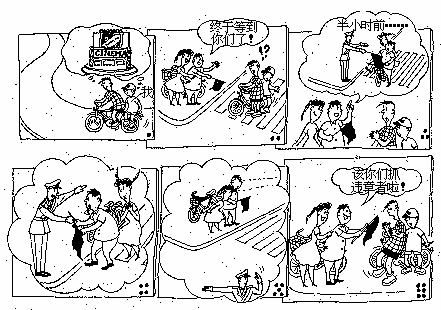
注意:1. 短文必须包括图画所表现的主要内容,可以适当增减细节,使其连贯、完整;
2. 叙述必须用第一人称;
3. 词数100左右。
生词:违章者--offender n. 十字路口--crossroads n
On the night of November 14, 1978, a six-year-old Korean boy was flying to the United States. All he knew was that he was on a plane heading for somewhere. The plane landed at Kennedy International Airport, where he was greeted by a family. This young boy was me.
I have grown up in a town where there were few Asians, so I stuck out in the crowd. I made friends quickly and they treated me just like anyone else. You may ask if anyone made fun of my appearance. Well, of course, I met that kind of person. I just shrugged it off.
As an adopted child, I have something that others don't have. I have had the benefit of two families. I'm lucky to have got a chance to start a new life. But we must try never to forget our past. Someday I will go back to Korea to find out what kind of culture I left behind.
There is only one thing that I regret about being adopted. When I argue with my parents and they realize they are losing the argument, they sometimes wonder what I would be doing if I were back in Korea. I don't understand this because I thought the purpose of adopting someone was to give them a better chance of growing up in a family. Some day when I am older, I want to adopt a girl and raise her the way my parents have raised me, but I would do it better, for I know what went well and what did not.
45.We learn that when the writer was on the way to his new family, ______.
A. he was with his own parents
B. he was very happy and excited
C. he was about ten years old then
D. he didn't know he was going to be adopted
46.If someone sticks out in the crowd, it means that he/she_______.
A. is very good-looking
B. is very kind-hearted
C. is easily noticed by others
D. is disliked by others
47.When the writer was made fun of by others, he _______.
A. was deeply hurt
B. wanted to go back to Korea
C. didn’t care about it that much
D. tried to make friends with them
48.What does the writer want to do when he is older?
A .Go back to live with his parents in Korea.
B. Tell his parents what they have done wrong.
C. Find out how to raise children in a better way.
D. Adopt a girl and raise her in a good way.
Once upon a time, there was a woman baking bread for members of her family and an extra one for a hungry passer-by. She always kept the extra bread on the window-sill, for whoever would 41 it away.
Everyday, an old man 42 and took away the bread without 43 gratitude. This went on, day after day, and the woman felt very 44 . In order to punish him, she decided to add 45 to the bread she 46 for him! As she was about to 47 it on the window-sill, her hands trembled.
Immediately she threw the bread 48 the fire, prepared another one and kept it on the window-sill. 49 , the old man came, picked up the bread and left, totally unaware of the anger in the heart of the woman
That evening, there was a 50 on the door. As she opened it, she was 51 to find her son standing in the doorway. He had gone to a distant place to 52 his fortune. For many months she had heard no news of him.
Looking at his mother he said 53 , “Mom, it’s truly 54 I’m here. My business 55 so I had to beg for food on my way home. I would have died this morning, but just then an old man passed by. He was 56 enough to give me the whole bread.” As he gave it to me, he said, “This is what I eat everyday. Today, I shall give it to you, for your 57 is greater than mine.”
As the mother 58 those words, her face turned pale and red. She 59 the poisoned bread that she had made that morning. If she had not burnt it in the fire, it would have been eaten by her own son, and he would have 60 his life!
| 41. | A. bring | B. put | C. take | D. carry |
| 42. | A. worried | B. came | C. hurried | D. went |
| 43. | A. expressing | B. thinking | C. doing | D. saying |
| 44. | A. sad | B. satisfied | C. strange | D. angry |
| 45. | A. salt | B. milk | C. sugar | D. poison |
| 46. | A. prepared | B. cared | C. begged | D. applied |
| 47. | A. cut | B. keep | C. carry | D. leave |
| 48. | A. to | B. onto | C. into | D. in |
| 49. | A. As a result | B. On the way | C. On the other hand | D. As usual |
| 50. | A. knock | B. knife | C. message | D. key |
| 51. | A. surprised | B. nervous | C. disappointed | D. curious |
| 52. | A. fetch | B. take | C. spend | D. seek |
| 53. | A. carefully | B. cheerfully | C. weakly | D. proudly |
| 54. | A. amazing | B. terrible | C. necessary | D. normal |
| 55. | A. succeeded | B. failed | C. continued | D. grew |
| 56. | A. unique | B. smart | C. mean | D. kind |
| 57. | A. need | B. job | C. strength | D. help |
| 58. | A. wrote | B. heard | C. read | D. said |
| 59. | A. kept | B. discovered | C. remembered | D. threw |
| 60. | A. saved | B. started | C. built | D. lost |
Lots of kids hate school, a new study found. Usually this kind of feeling doesn't last long. But what happens if you feel this way too much? School is a fact of life and getting a good education can help you build the kind of future life you want. So let's talk about school and what to do when you don't like it.
If you don't like school, the first step is to find out why. You might not like school because you don't have enough friends, or maybe you don't get along with your teacher. Sometime it's a big problem with your classes and school-work. You may be getting farther and farther behind, and it may seem like you'll never catch up.
When you know why you don't like school, you can start taking steps to make things better. It's a good idea to talk to someone about your problems with school. Your mum, dad, teacher or school counselor will be able to help you. Another good idea is to write down your feelings about school in a notebook. It's a great way to let out emotions. Remember, you don't have to share what you've written with others.
46. Lots of kids , according to the writer.
A. like school very much B. are good at reading and writing
C. don't like doing homework D. have the thought of hating school
47. What does the underlined word “it” refer to in the first paragraph?
A. A good education. B. School. C. Future life. D. Friendship.
48. If you don't like school, the first step is to _______________. .
A. find out why B. go to see a doctor
C. ask your parents for help D. leave school for a short time
49. How many reasons why you don't like school are given by the writer?
A. Two. B. Three. C. Four. D. Five.
50. When you start taking steps to make things better, one of the good ideas is to .
A. keep silent about your problems B. share what you' ve written with others
C. write down your feelings about school D. get along well with your classmates
We’ve always limited “screen time” at home: on screen time before two years of age, and only occasional educational DVDs after that. Researchers have found a connection between screen time and a host of behavioral and physical problems. Some children have become so addicted to iPads and other tablet devices(平板电脑装置)that their parents have even sought out treatment.
So, should I be perturbed about the increasing dependence on technology in our schools? In addition to a weekly computer class, my first-grade daughter spends much of her instructional school day(教学日)in front of the “smart board”. And now, school districts across the country are talking about replacing textbooks with tablets.
There are several factors(因素)that need careful consideration. Important distinctions must be drawn between television screen time(yes, even educational programming), which is a mostly passive medium, and tablet screen time, which is more interactive(互动的). Another important factor is the age of the child. All people need human interaction, but babies and small children need it most of all. Studies have suggested that tablets may help improve reading and writing abilities in school-age children, however, plus they help children with autism(孤独症)communicate.
Tablets in the classroom could replace expensive and heavy textbooks, allow children to make and read notes more easily, provide interactive functions and help track(追踪)progress. When I was a child, I could hardly carry my backpack---we could avoid a lot of back problems by using one light and thin tablet instead of huge textbooks.
Beyond common concerns(what happens if the tablet is lost, stolen or broken?), I do worry that we are rushing toward a brave new world of technology without considering what we might lose. If our children spend too much time on tablets, they run the risk of becoming addicted and missing out on a lot of what the world has to offer, especially in a time when schools are cutting are, music, and gym. Human brains need real-world connections. Tablets can be a part of a child’s education, but we have to guard against these devices taking over.
28. The underlined word “perturbed” in Paragraph 2 is closest in meaning to”________”.
A. curious B. happy C. excited D. worried
29. According to Paragraph 3, allowing very young children to use tablets________.
A. is worth a try
B. may be harmful
C. helps improve their learning skills
D. offers them more human interactions
30. The author mentions her childhood experience to________.
A. express her support for traditional education
B. stress the importance of taking notes
C. show the disadvantages of textbooks
D. describe her happy childhood
31. Which may be the author’s opinion on tablets?
A. They’re helpful only in a limited way.
B. They are too expensive for most students.
C. They excite students’ interest in learning.
D. They improve the effectiveness of education.
One of the most recent social changes taking place in the world is social networking.Social networking has been in existence for at least 150 years, and probably longer than that. In the times before the invention of the computer and the World Wide Web (WWW), social networking was done in person. People who had similar likes and interests would gather together to share experiences, make new friends, and improve their businesses.
On the Internet, social networking websites made their first appearances during the late 1990s. The first major social networking website in the United States was MySpace. MySpace allowed its users to exchange messages, share pictures, and make new friends in a way that was never thought of in the past. With MySpace, people who did not go out much could reach out to others from their own homes.
In 2004, Facebook was created. It was first a website created for use by Harvard University’s students and teachers, but it soon expanded to include just about everyone. It is now larger than some of the largest companies in the world. It is a website that is changing all the time. Facebook has completely changed the way people stay connected with each other and the rest of the world. The way it works is simple. Users can set up a new account (账户) easily. All a new user needs is an email address to start. Once a person has created an account and his friend also has his own Facebook page, he can invite his friend by sending a request out to him. Once you get started, making new friends will come easily.
32. What can we learn about social networking?
A. It is not a new development.
B. It made World Wide Web famous.
C. It appeared because of the computers.
D. It helped people develop new interests.
33 What can we learn from Paragraph 2?
A. MySpace is less famous than Facebook.
B. MySpace greatly changed people’s lives.
C. MySpace led to the appearance of Facebook.
D. MySpace was improved by Harvard University’s students.
34.. What do new users of Facebook need to create an account?
A. An email address. B. His friend’s help.
C. High-speed network. D. His friend’s Facebook page.
35. What does the passage mainly tell us?
A. The way to be a Facebook user.
B. The importance of social networking.
C. Two important social networking websites.
D. The differences between MySpace and Facebook.
Can you imagine your doctor warning that taking a bath could be unhealthy? In the early 1800s, many doctors thought that bathtubs could carry diseases, so they advised against their use. The advice wasn’t based on personal experience, because few of the doctors owned bathtubs(浴缸,澡盆). The White House did not even have a bathtub until 1851.
In the 19th century, only one home out of six had a bathroom. A child took only one bath a week. On Saturday nights, children all lined up for their turns to wash in a wooden bathtub in the kitchen. Mothers had to boil the water on the stove(火炉) and carry it over to fill the bathtub. It’s no wonder that children could not jump into a bathtub as they do today.
When the first bathtubs were introduced, even their makers weren’t sure whether the new fashion would last. They advertised their products as water containers that “could be used as bathing tubs”.
The bathtub became popular in America shortly after World War I. By then most middle-class families had indoor taps. At first most bathtubs were made of wood, but as the popularity of the product increased, so did the creativity of bathtub makers. Before porcelain(瓷) bathtubs there were rubber ones like the plastic swimming pools kids use today. In the past few years owners often invited guests to see them. They told their friends how wonderful baths in these bathtubs could be.
Now doctors no longer warn that bathtubs carry diseases. Instead, they tell their patients about the benefits of frequent bathing in the bathtubs. Maybe one of the best reasons why doctors encourage frequent trips to the bathtub is that bathed patients smell better!
24. Many doctors in the past were against using bathtubs because ______.
A. they didn’t have their own bathtubs
B. they thought bathtubs could carry diseases
C. the children might hurt themselves in the bathtubs
D. bathtubs were too expensive for the common families
25. Why couldn’t children jump into a tub in the 19th century as they do today?
A. It was unhealthy to do so. B. Doctors advised them not to.
C. Mothers were always busy. D. There were few bathtubs.
26. It can be inferred from the last paragraph that ______.
A. all the doctors have bathtubs in their homes
B. the doctors have realized the advantages of bathtubs
C. the doctors will make lots of money by advertising bathtubs
D. the patients should take a bath before going to see a doctor
27. The passage is mainly about _______.
A. the wrong opinions on bathtubs
B. The benefits of bathing
C. The new development of bathtubs.
D. The history of bathtubs
文中共有10处语言错误,每句中最多有两处。每处错误仅涉及一个单词的增加、删除或修改。
增加:在缺词处加一个漏字符号(∧),并在其下面写出该加的词。
删除:把多余的词用斜线(\)划掉。
修改:在错的词下划一横线,并在该词下面写出修改后的词。
注意:
1. 每处错误及其修改均仅限一词;
2. 只允许修改10处,多者(从第11处起)不计分。
I took our foreign teacher Mr. Brown, he came to China for the first time, to the Great Wall in last weekend. Having told about the history of the Great Wall, he was amazing at this world wonder. He was struck by the beautiful of the Great Wall. So I took photo of him, which would be a good memory for him. At the top, Mr. Brown was very interested in the activity of protecting the environment that he was eager to join in and sign his name. Both the Great Wall and the Chinese people deep impressed him. He decided to visit more places of interest when free.
My sister and I grew up in a little village in England. Our father was a struggling 21, but I always knew he was 22 . He never criticized us, but used 23 to bring out our best. He’d say, “If you pour water on flowers, they flourish. If you don’t give them water, they die.” I 24 as a child I said something 25 about somebody, and my father said , “ 26 time you say something unpleasant about somebody else, it’s a reflection of you.” He explained that if I looked for the best 27 people, I would get the best 28. From then on I’ve always tried to 29 the principle in my life and later in running my company.
Dad’s also always been very 30 . At 15, I started a magazine. It was 31 a great deal of my time, and the headmaster of my school gave me a 32 : stay in school or leave to work on my magazine.
I decided to leave, and Dad tried to sway(影响) me from my decision, 33 any good father would. When he realized I had made up my mind, he said, “Richard, when I was 23, my dad 34 me to go into law. And I’ve 35 regretted it. I wanted to be a biologist, 36 I didn’t pursue my 37. You know what you want. Go fulfill it.”
As 38 turned out, my little publication went on to become Student, a national 39 for young people in the U.K. My wife and I have two children, and I’d like to think we are bringing them up in the same way Dad 40 me.
21. A. biologist B. manager C. lawyer D. gardener
22. A. strict B. honest C. special D. learned
23. A. praise B. courage C. power D. warmth
24. A. think B. imagine C. remember D. guess
25. A. unnecessary B. unkind C. unimportant D. unusual
26. A. Another B. Some C. Any D. Other
27. A. on B. in C. at D. about
28. A. in case B. by turns C. by chance D. in return
29. A. revise B. set C. review D. follow
30. A. understanding B. experienced C. serious  D. demanding
31. A. taking up B. making up C. picking up D. keeping up
32. A. suggestion B. decision C. notice D. choice
33. A. and B. as C. even if D. as if
34. A. helped B. allowed C. persuaded D. suggested
35. A. always B. never C. seldom D. almost
36. A. rather B. but C. for D. therefore
37. A. promise B. task C. belief D. dream
38. A. this B. he C. it D. that
39. A. newspaper B. magazine C. program D. project
40. A. controlled B. comforted C. reminded D. Raised
- 甲植株开红花,乙植物开黄花。若培养一植株上同时开红花和黄花,理论上有多种手段。下列各项不可能的是
- (07年全国卷Ⅰ理)从班委会5名成员中选出3名,分别担任班级学习委员、文娱委员与体育委员,其中甲、乙二人不能担任文娱委员
- 2010年1月26日,人民网报道,某镇人大代表换届选举中,选民们领到选票后各自填写,并将选票郑重地投入投票箱。一选民说:
- 被称为“鱼米之乡”的地形区是( ) A.东北平原 B.华北平原 C.长江中下游平原
- “百元消费周”是指在一周的工作日期间,全部的餐饮、交通、娱乐等所有消费加起来,控制在100元之内。这引发了一场关于“节俭
- 一辆汽车从静止开始由甲地出发,沿平直公路开往乙地。汽车先做匀加速运动历时t,接着做匀减速运动历时2t,开到乙地刚好停止。
- 美国经济持续增长的最根本动力是高新技术产业的发展。发展高新技术产业对美国经济影响的叙述错误的是( ) A.促进经济结
- 古代“银针验毒”的原理是4Ag+2H2S+X=2Ag2S+2H2O,X的化学式为 A.H2
- 我国古代科技高度发达,下列古代文献的记载中,涉及化学变化的是 A.《本草纲目》记载“烧酒非古法也,自元时创始,其法用浓酒
- 有学者论:“政治权力型经济在中国历史上表现得最为突出,最为典型。”这种经济形式在古代中国的表现有①盐铁官营制度 ②早市
- 如图所示,轻杆OA长L=0.5 m,在A端固定一小球,小球质量m=0.5 kg,轻杆以过O点的水平轴在竖直平面内做圆周运
- 继“嫦娥一号”“嫦娥二号”成功发射后,“嫦娥三号”在2013年将直接奔向月球……2025年我国有望实现首次载人登月。我国
- 阅读下面的内容,完成下面3题 看 望 [德国]海??格兰特 上午最后一节课刚开始,有人从外头喊:“培德??
- The little boy has learned many Tang dynasty poems _____ tho
- 翻译下面句子 子曰:“不在其位,不谋其政。”
- 在有机物分子中,若某个碳原子连接着四个不同的原子或原子团,这种碳原子称 为“手性碳原子”。凡有一个手性碳原子的物质一定具
- 有一个小实验:当向两片竖直放置的纸片的中间吹气时,会发现两个小纸片不但不分离,反而靠拢了。这一现象告诉我们,流体运动部分
- 红嘴鸥是我市的一种美丽的动物,她能在陆上、水上、空中进行运动,那么她在空中的主要运动器官是( ) A、翼
- 中国是中国特色社会主义事业的领导核心。
- It remains whether Jim’ll be fit enough to play in the


