科幻未来类 知识点题库
It's March, 2050. Frank and Mary Smith wake up in their comfortable house in the morning and turn on the bedroom computer to get the latest news. They get used to reading The Times over the years. The only difference is that they changed to electronic newspapers many years ago.
After breakfast, as they watch the screen, Mary orders the household robot to make coffee for them. Frank is a computer engineer, working for several companies. He goes into the study to take part in a video conference with his partners around the world.
Mary takes a quick look at the shopping channels at home before beginning the video call to talk to her assistant. She also has a job and she is doing medical researches.
Frank and Mary have one daughter, Louise, who also has her own work station at home. She goes to school only one day a week, mainly to play with other students. Louise is studying Chinese at present. Chinese has become an important language in the world.
According to the family doctor, Louise will live to at least 130 years old. Her wish is to work for a few decades(十年)and then spend her time on music and painting.
-
(1) Frank and Mary turn on the bedroom computer in the morning because ___________.A . they want to play computer games B . they want to watch films C . they want to chat with friends D . they want to get the latest news
-
(2) Who makes the coffee after breakfast?A . Frank. B . Mary. C . The household robot. D . Louise.
-
(3) The underlined word "conference" means "____________".A . game B . meeting C . competition D . education
-
(4) Louise usually ____________at school.A . studies Chinese B . plays with her teachers C . listens to music D . draws pictures
-
(5) Which of the following is NOT true according to the passage?A . Frank and Mary read electronic newspapers in the morning. B . Louise will live to at least 130 years old. C . Mary talks to her assistant in her office. D . Chinese has become important in the future world.
What will our life be like in 50 years? No one knows the answer, but we are sure that it will be very different from the life today. My brother Jill White makes some predictions. Here are some of his ideas.
Firstly, people will have less work to do, and robots will do most work. People will use robots to make cars, do the housework, look after sick people and teach students. People will spend most of their time playing sports and traveling, so they will become stronger and healthier, and they will live to be about 200 years old.
Secondly, cars will become very small and computers will control (控制) their speed (速度). So there will be fewer accidents on the road. Planes will be very popular and most people would like to take them to travel.
Thirdly, people will be able to live in the sea, on the moon or on Mars. The earth won't be crowded or noisy. So there will be much space for people to plant trees. There will be less pollution, and the air will become much fresher.
Finally, water shortage will become one of the most serious problems. If people don't save water now, we will have no water to drink in years.
-
(1) Jill White thinks that in 50 years robots will help to do the following things EXCEPT ________.A . looking after sick people B . driving cars C . teaching students D . doing the housework
-
(2) Jill White thinks most people will travel ________ in 50 years.A . by bike B . by car C . by train D . by plane
-
(3) According to the passage, ________ in 50 years.A . every family will have a car B . people won't need to work C . computers will control cars' speed D . the earth will become crowded and noisy
-
(4) The underlined word "shortage" means "________" in Chinese.A . 短缺 B . 丰富 C . 清澈 D . 浑浊
-
(5) What is the best title for this passage?A . People in the future will become healthier B . Some predictions about future C . My brother Jill White D . We should save water
As space science develops, man has learnt more and more about space. Space is not only amazing but also dangerous. While working in space, spacemen are facing dangers as well as success.
Scientists have found out that radiation (辐射) is the greatest danger to spacemen in space. When spacemen are working in space, they are in danger of radiation from the sun and other stars, which is bad for their health. The damage done by radiation won't be discovered until their children or even grandchildren are born. Some special medicine may work a little, but really helpful medicine hasn't been found so far.
Space junk (太空垃圾) is also thought as a great danger to spacemen. It's reported that there are 9,000 man-made things flying in space. About 30% of these are satellites (人造卫星), 10% are spaceships, and the rest are space junk. An explosion (爆炸) in1996 made a cloud of 300,000 fragments (碎片), each at least 4mm in size, and even a small piece of the fragments knocked against a spaceship window and did some damage. Scientists are watching and reporting any possible danger all the time. They are working on helpful ways to deal with space junk.
Although space is really dangerous, it interests everyone on Earth. In the near future, it may become usual for people to spend a few days in a space hotel. We may even choose to leave the Earth and live in space in a few years. So we should care for space and do something to help improve the space environment.
-
(1) What is the greatest danger in space?A . Space junk. B . Radiation. C . The sun. D . Other stars.
-
(2) What does the underlined word "these" refer to?A . Man-made things. B . Spacemen. C . Dangers. D . Spaceships.
-
(3) How many satellites are there in space?A . 9,000. B . About 900. C . About 2,700. D . 300,000.
-
(4) What does the last paragraph mainly tell us?A . Space is dangerous. B . What the space will look like in the future. C . What people will do in space. D . People should care for space.
-
(5) What can be the best title for the passage?A . How to protect space B . The dangers in space C . How to avoid the dangers in space D . The success and dangers in space
Can you imagine what the world will be like in 100 years? A better worse place? In the modem society of technology, everything (have) a different type. We have invented many new (machine). On the one hand, those things will help people a lot and we are sometimes depending technology too much. For example, we can order something to eat by telephone without (go) out. We can finish all the work by "one touch", we just hold small remote control (遥控器), and it will order everything. For example, the car will drive to our house by (it) with our order.
On the other hand, when we get so many new things in our life, it will make some (problem). Maybe people will feel strange around other people because we will hardly talk to one another. We know all of the answers by modem machines. We use the Internet (connect) everything. However, we need to think that face-to-face communication is very (importance) to human beings.
Since the outbreak of COVID-19, people have been used to their new work situation. But what if your job is to control a mufti-billion-dollar space rover (探测车) on a planet—Mars nearly 200 million km away from Earth?
A team of NASA scientists is doing just that. In order to follow social distancing rules these scientists have had to work from home. But they've still found ways to work together and take care of the complex (复杂的) tasks that are needed to keep the Curiosity rover working on Mars.
Their work-from-home setups (装配) took much like home office setups. They use ordinary (普通) computers. But instead of working on spreadsheets (电子制表), these scientists arc programming complex sequences (序列) of instructions that are then sent to the rover. These instructions allowed the rover to find a rock sample (样本 in a location on Mars called "Edinburgh".
Usually, the team's 20 scientists work together by communicating through apps or video meetings. One scientist might have to follow 15 message channels (通道)at once.
NASA gave the scientists headsets (耳机) monitors and other equipment to allow them to do their jobs from home. However, the goggles (眼镜) they usually use to analyze (分析) pictures from Mars could not be sent out. So they have to depend on red-and-blue glass lenses (镜片) instead.
But difficulties like these have not been a problem for the scientists. In fact, getting used to changing situations is "classic, textbook NASA," according to the head of science operations Carrie Bridge. "We're presented with a problem and we find out how to-make things work. Mars isn't standing still for us; we're still exploring." she said.
-
(1) During the outbreak, NASA scientists________.A . use different computers to work B . work on spreadsheets C . are making Curiosity rover work from home
-
(2) Working at home is not convenient for NASA scientists because .A . they have to use red-and-blue glass lenses B . they cannot communicate with each other C . they don't have the equipment to do their jobs
-
(3) Which of the following is NOT TRUE according to the article?A . Mars is nearly 200 million km away from Earth, v/ B . One scientist might have to contact (联系) with several other scientists at the same lime. C . NASA scientists can't work together.
-
(4) How do we understand "classic, textbook NASA" in the last paragraph?A . NASA wrote a textbook on how to deal with problems. B . NASA always finds ways to deal with new situations. C . Difficulties are uncommon for NASA
-
(5) What is the story mainly about?A . NASA's project on Mars. B . The problems NASA faces. C . How NASA scientists work at home.
What will the schools of the future look like? Smart campuses (大学校园)are being built all over the world. Their high-tech features (特色) help students learn more effectively(有效的) as well as bring convenience (便利) to teachers.
The University of British Columbia has created Canada's first 5G-powered smart campus, according to The Star, a local newspaper. The school worked with a company to build a 5G network across its campus. Their researchers can use the network to test 5G software (软件).
At Staffordshire University in the UK. many students enjoy talking to Beacon and asking it questions. Beacon is an AI chatbot (聊天机器人) that was developed by the university. It is like a personal assistant (助手) for students at the school. They can ask it questions, such as whether or not one of their classes is canceled.
Amazon also has smart campus products. Alexa, the company's voice-activated (声控的)smart assistant, can be used to help teachers run their classes more efficiently(高效率地).For example, Alexa can remember the teacher's classroom preferences(喜好),such as how bright the lights should be, and change them accordingly, according to Amazon.
People often describe universities as "mini-cities". They often have their own roads, shops, and banks. Universities are seen as good places to test smart technology, because they have control over all of their buildings.
"Cities are so big, and there are so many players and stakeholders(利益相关者),it can be difficult. But universities have control over all their buildings... so they can become like a living lab." said Germmy Ginty, a designer who is working on a smart campus development project for the University of Glasgow, the UK, in a report by The Guardian.
-
(1) Who developed Beacon?A . The University British Columbia B . Staffordshire University in the UK C . The company called Amazon D . The University of Glasgow
-
(2) What is Alexa?A . A 5G software B . An AI chatbot C . A voiced activated smart assistant. D . A local newspaper.
-
(3) Which of the following statement is not true?A . The University of British Columbia is in Britain. B . Alexa is one of Amazon's smart campus products. C . Beacon is an AI chatbot that can help students at school. D . Germmy Ginty works on a smart campus development project.
What will life be like in 200 years? Teachers won't(写) on the blackboard with(粉笔) in the future. Students won't do their homework on(纸), and won't draw a line with a(尺子). At that time, every student will study(在……上) the computers. And at the weekend, students can go cycling(和) their friends—robots. That would be very(有趣的). There will be many(机器) on the farms, and they do lots of(工作). What about the climate (气候) then? The weather will be quite warm or even hot all year, with heavy(雨) and wind. That will bring people many problems.
Now, it seems that artificial intelligence(人工智能) is becoming more and more popular in our life, and it has greatly influenced the ways we live, work and play. Can you 1 that you can play table tennis with a robot one day? Recently, a scientist has invented a special robot that can be a table tennis 2. That 3 people can learn how to play table tennis not only from humans but also from a robot.
Named Forpheus, the smart table tennis robot is quite special. It can study the 4 of human players and the speeds of the ball. In this way, it can 5 judge(判断) the players' skill levels. Then it uses the information to 6 the ways to play. If the players are just beginners, Forpheus will play in a slow and easy way. But if the players are better ones, the robot will play in a 7 and more difficult way. 8, while playing, it encourages players to try their best with words like: "Good job!", "Come on!" and so on. At the same time, it gives some good 9 to improve their skills. So, it is both a good partner and a clever coach.
Science and technology is developing quickly these days and no one knows what will happen in the future. "In the next 20 years, it will be 10 that one robot teaches another to play table tennis or even invents another one!" Takurya, the inventor of the robot, said.
Life in the future will be different. Many changes will happen. But what will the changes be? The population(人口)is growing fast. There will be more people in the world and most of them will live longer than people live now.
Computers will be much smaller and more useful, and there will be at least(至少)one in every family. And computer studies will be one of the most important subjects in schools then. People will work fewer hours than they do now, and they will have more free time for sports, watching TV and travel. Traveling will be much cheaper and easier. And more people will go to other countries for holidays.
There will be changes in our food, too. More land will be used for building new towns and houses for all the people. Then there will be less room for cows and sheep, so meat will be more expensive. Maybe no one will eat it every day. Maybe they will eat more fruit and vegetables instead. Maybe people will have a healthier life. Work in the future will be different, too. Robots will do dangerous and hard work. Because of this, many people will not have enough work to do. This will be a problem.
-
(1) What is the change about the number of people in the future?
-
(2) What will be one of the most important subjects in schools?
-
(3) Where will more people go for their holidays?
-
(4) What will people eat more in the future if meat is more expensive?
-
(5) Why will people not have enough work to do in the future?
Many of us have had the same "pleasant surprise". After you mark a song as a favorite on a music app(程序), it suggests songs of the same kind to listen to.
Big data(数据)is a lot of sets of information that are put together so they can be used by a computer program. It can have different kinds of information from many sources(来源), such as information that comes from schools, social media sites, companies, and governments Another set can have what they like, where they go to school, and how much time they spend on the computer.
The government uses it to understand how many people travel on buses or trains. The information is then used to make bus or train systems better. Companies use big data, too. It helps them understand who buys their products. For example, one company uses weather data to see when people eat the most ice-cream.
Big data can be used for good reasons. Some hospitals use big data to predict if a baby who is born too early will get sick. The hospital can then take extra steps to take care of that baby so he or she does not get sick. It can be used to predict which kinds of people are likely to break the law or hurt others, even if they have not done anything wrong.
It is because the computer programs used to look at big data and understand it are written by people. People think a certain way. Because they think a certain way, they build a model of those ideas. These ideas are then used to look at the data. Sometimes, these ideas are helpful for people or businesses. Other times, bad ideas can cause problems for certain groups of people.
|
A. Big data can be used in many ways. B. Why do we use big data for bad things? C. Big data can also be used for bad reasons. D. How can big data be used for good and bad things? E. One set of data can have people's names and addresses. F. In fact, this magic, mind-reading power depends on data. |
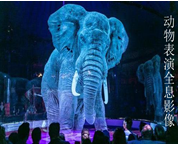
Can you imagine a circus(马戏团)without horses, elephants, monkeys, or lions? Recently, Circus Roncalli hit the headlines by1on shows without any animals. And the shows have attracted2 people.
Circus Roncalli is a German circus founded in 1976.3they fight against the abuse(虐待)that animals often face,they get a creative idea. One year ago, they 4hologram(全息图)animals.
Its shows still include tricks and actors,5none of the animals are real. The pictures
6 on a computer, and then people use a projector(投影仪)to show 7to the crowd. The animals are much like the animals that you usually see in a traditional circus.
8creative idea comes from increasing worldwide worries about the show animals.9, show animals live much of their lives under terrible conditions. They are trained violently and they 10follow what the trainers ask them to do, or they will be treated cruelly.
As a result, many people refuse 11 circus shows performed by animals. Now, 12 the modem technology of holograms, everyone can enjoy the exciting shows happily. Many people expressed 13 love of the technology. “Well, this is amazing!" someone said. "I even think the new Form of performances are14than the traditional one," another said.
It's a complete win-win situation: Visitors get to enjoy the sight of the animals, and the circus can live on,
15 , The most important is that real animals can be left alone!
Imagine the situation. You are an exchange student from China and now you are learning French in a university in Paris, the capital city of France. One day, you come into the kitchen of your flat. Twenty minutes later, you cook several delicious French dishes. We call this kind of wonderful kitchen a French Digital(数字) Kitchen or a “talking kitchen”.
The first French Digital Kitchen appeared at Newcastle University in the UK. The inventors choose the grammar and words carefully to make sure the users can understand French well. For the first time, students can learn the language by following cooking steps. .
How does the kitchen work? There is a computer in the kitchen. With information in the computer, the kitchen starts to teach the users to make a French dish. If you follow the instructions on the computer, it moves on the next. .
The French Digital Kitchen makes learning a language more interesting and more educational. People can use th new kitchen in schools, universities and even their homes.
(Tom and Fred are talking about the year 2050.)
Tom: What will our world be like in the year 2050?
Fred: I don't know. What do you think?
Tom: Well, no one knows, but it's interesting to guess( 猜)
Fred: In the year 2050 everyone will take a pocket( 口袋)computer. The computer will give us the answers to all our problems. We'll have phones in our glasses and will be able to talk to our friends all over the world. Perhaps we'll be able to see them at the the same time.
Tom: A lot of people will live and work under the sea. Perhaps there will be big towns, factories and farms under the sea, too.
Fred: Machines will do most of the work, and people would have more holidays-perhaps they will work only two or three days a week. They'll be able to fly to the moon by spaceship and spend their holidays there.
Tom: I'm looking forward to the year 2050. I hope to go to the moon.
Fred: I hope I'll be able to live under the sea. Won't that be very interesting? Just like a fish!
-
(1) Machines will ________.A . do most of the work instead of people B . do all the work instead of people C . do as much work as people D . do less work than people
-
(2) From their talk, we know that _______ to fly to the moon.A . only Fred hopes B . both of them hope C . one of them hopes D . no one hopes
-
(3) Fred says ________.A . he likes fish very much B . he would like to live under the sea like a fish C . he would like to go fishing under the sea D . he would like to spend a few days on the moon
-
(4) According to the dialogue, which of the following is NOT true?A . People will be able to fly to the moon in a spaceship. B . People will have more holidays. C . Many people will live and work under the sea. D . People will build all the factories and farms under the sea.
Welcome to your future life!
You get up in the morning and look into the mirror. Your face is young-looking. In 2045, medical technology(科技) is better than ever. Many people of your age could live to be 150, so at 40, you're not old at all. And your parents just had an anti-aging treatment(抗衰老的治疗). Now, all three of you look the same age!
You say to your shirt, "Turn red." It changes from blue to red. In 2045, "smart clothes" have particles(粒子) much smaller than the cells(细胞) in your body. The particles can be programmed to change the colors of your clothes.
You walk into the kitchen. You pick up the milk, but a voice says, "You shouldn't drink that!" Your fridge has read the chip(芯片) so it has some information about the milk, and it knows the milk is bad, In 2045, every article of food in the store has such a chip.
It's time to go to work. In 2045, cars drive themselves. Just tell your "smart car" where to go. On the way, you can call a friend using your jacket sleeve(袖子). Such "smart technology" is all around you.
So will all these things come true? "For new technology to succeed," says scientist Andrew Zolli, "it has to be so much better that it replaces what we have already." The Internet is one example. What will be the next?
-
(1) When were you born according to the text?A . In 2005. B . In 2015. C . In 2020. D . In 2045.
-
(2) You can learn from Paragraphs 2 and 3 that in the future ____.A . people will never get old B . everyone will look the same C . red will be the most popular color D . clothes can change their colors
-
(3) What does the underlined word "article" mean in Chinese?A . 文章 B . 物品 C . 论文 D . 条款
-
(4) Which paragraphs describe the future life?A . ①②③④ B . ①②③⑥ C . ②③④⑤ D . ③④⑤⑥
-
(5) What is the best title for the text?A . Food and Clothing in 2045 B . Medical Treatments in 2045 C . Life in 2045 D . Cars in 2045
Most people like shopping. When you do some shopping, you can pay in cash( 现金). But now it's easy to pay with a mobile phone. You can pay by WeChat or Alipay. You can even pay with your faces. It's very interesting, isn't it? Is that enough? Maybe after a few days, you can pay with your hands.
Amazon is trying its new way of payment—pay by hands. Hands are in different shapes( 形状) and sizes. Your hands are your ID. They are connected to your card. When you pay with your card, it usually takes between three and four seconds. Now Amazon's new way of payment can make it in less than half a second. 
They will use a special sensor( 传感器) to identify( 辨认) the human hand. These high-tech sensors are different from fingerprint scanners( 扫 描 仪 ). They won't need users to let their hands touch the surfaces(表面) of the sensors. When you need to pay, you just let your hands near the sensors. Shoppers won't even have to bring their phones. If successful, this technology will cut down the time of payment in supermarkets. But we don't know if the shoppers are interested in it.
-
(1) How many ways of payment does Paragraph 1 mention(提到)?A . 2. B . 3. C . 4. D . 5.
-
(2) The writer thinks it's very interesting to pay .A . with hands B . in cash C . by WeChat D . by Alipay
-
(3) What does the underlined word “Shoppers” mean in Chinese?A . 供应商 B . 商店 C . 购物者 D . 店主
-
(4) Which of the following is NOT true?A . Paying with your hands can be faster than with cards. B . You won't need a mobile phone while paying with your hands. C . When you pay with your hands, you should touch the surfaces of the sensors. D . You need to connect your hands to your cards if you want to pay with your hands.
-
(5) What's the best title of the passage?A . A new way of shopping B . A new way of payment C . A new company D . New technology in the supermarket
What will our life be like in 50 years? No one knows the answer exactly (确切地), but we are sure that it will be very different from the life today. My brother Jill White makes some predictions. Here are some of his ideas.
First, people will have less work to do, and robots will do most work. People will use robots to make cars, do the housework, look after sick people and teach students. People will spend most of their time playing sports and traveling. So people will become stronger and healthier, and they will live to be about 200 years old.
Second, cars will become very small and computers will control (控制) their speed. So there will be fewer accidents ) on the road. Planes will be very popular, and most people would like to take them to travel.
Third, people will be able to live in the sea, on the moon or on Mars. The earth won't be crowded or noisy. So there will be much space for people to plant trees. There will be less pollution, and the air will become much fresher.
Finally, water shortage will become one of the most serious problems. If people don't save water now, there will be water wars (战争)in 50 years.
-
(1) Jill White thinks that in 50 years robots will help to do the following things EXCEPT(除了) .A . looking after sick people B . driving cars C . teaching students D . doing the housework
-
(2) Jill White thinks most people will travel in 50 years.A . by bike B . by plane C . by train D . by car
-
(3) According to Jill White, in 50 years.A . every family will have a car B . people won't need to work C . computers will control the cars' speed D . the earth will become crowded and noisy
-
(4) The underlined word “ shortage" means ‘‘ ” in Chinese.A . 短缺 B . 丰富 C . 清澈 D . 浑浊
-
(5) This passage mainly tells us in 50 years.A . the schools B . the cars C . the robots D . the life
Do you know 5G? It is the fifth generation (代) of mobile network technology. These new networks are coming.
China just issued commercial licenses (发放商用牌照) for 5G on June 6, 2019. This means that China's telecom companies will be able to offer 5G networks for mobile phone users.
Each mobile network generation is faster and more powerful than the one before it. 1G let us talk to each other. 2G let us send messages. 3G gave us data(数据)and the Internet. And 4G made all of these things faster. What's special about 5G?
5G has a very short delay between sending and receiving information. Now, 4G takes about 100 to 200 milliseconds (毫秒) to send and receive data. But 5G will get it down to 1 millisecond or less-this is almost real-time.
'This big change will not only make our mobile Internet faster,but also deeply change our lives. Read on to find out how.
5G + entertainment (娱乐)
5G networks are about 100 times faster than 4G. This means you can download a movie in seconds using 5G.
Also, virtual reality (VR) games will become more popular with 5G. The short delay of 5G will make the games feel even more real.
5G + transport
5C will also bring us safer self-driving cars. These cars can send signals (信号) to each other. They also talk to traffic lights and road sensors (传感器). 5G will allow cars to react (反应)even faster than human drivers.
5G + smart homes
5G also makes the Internet of things possible. Internet of things is a large network that connects everything to the Internet. Smart homes are part of it.
For example, your toaster can automatically (自动地) start making breakfast after your alarm rings. And if its sensor feels the air becoming dry, a smart sprinkler (洒水器) could water your plants by itself.
-
(1) What's the main idea of the passage?A . 5G will make the Internet of things possible. B . Mobile networks are changing for better. C . 5G will change our lives in many ways. D . 5G networks for mobile phone users are coming.
-
(2) What does the underlined word "delay" in paragraph 4 mean in Chinese?A . 卡顿 B . 暂停 C . 延时 D . 掉线
-
(3) Which of the following ways is not mentioned that 5G will change people's lives?A . Entertainment B . Health care C . Transport. D . Smart homes.
-
(4) What will people do possibly with 5G according to the passage?A . Download a movie in minutes. B . Make self-driving cars safer. C . Put everything onto the Internet. D . Make food more easily and faster.
-
(5) What's the writer's purpose in writing the third paragraph?A . To explain 5G is the best of all. B . To share his knowledge about 5G. C . To encourage people to use the new network technology. D . To show the development of mobile network technology.
Do you know the movie I, Robot? It tells us a story about the future.
The year is 2035 and robots are just as common as mobile phones. People depend on their robots to do lots of things, for example, babysitting, cooking, and taking their dogs for a walk. Robots have to listen to humans' orders, because their inventors make them do so. A police officer called Spooner hates robots. He doesn't think humans can get on well with their robots at all! But the scientist Susan has different opinions. Susan works on robots' mind and she thinks one day robots will become more powerful (强大的) than humans and help humans to make improvements.
When Spooner and Susan work together, they find that something is wrong with the world's robots. A few robots have their own thoughts and they're trying to get out of humans control (控制)! Of course, these robots' dream doesn't come true. Humans work hard to control their robots again and they succeed at last.
-
(1) The story in the movie happens in .A . 2010 B . 2020 C . 2035 D . 2040
-
(2) Spooner is a and Susan is a .A . scientist; professor B . bank clerk; police officer C . policeman; doctor D . police officer; scientist
-
(3) Susan thinks that one day .A . robots can't get on well with humans. B . robots will help humans become better C . robots will have their own thoughts. D . robots will control the world
-
(4) What kind of article is it?A . A movie review. B . A notice. C . An advertisement. D . A report.
Hello! We're in 2042 now. Let's share our beautiful life together!
|
|
I had a serious illness at the age of 7. From then on, I expected to be a doctor. Now I work in a hospital as a doctor. There are modern medical instruments and services. I can treat patients even when they're far away from me. This is because the Internet is faster now. |
|
|
Through years of studying hard, I'm teaching Chinese in a middle school. Some of my students come from other countries. Since they like Chinese history and culture, they carefully listen to me explain Chinese poems and novels. They spread Chinese history and culture around the world. |
|
|
China is much greener now because it has worked on protecting the environment. New energy is used without polluting Earth. I'm doing something common for our city. I keep our streets clean and tidy every day to make people live comfortably. I take pride in my job. Any job is a good job. |
|
|
When I was young, I dreamed of being an astronaut宇(航员) and flying into the space. Nowadays, my dream has come true. Traveling to the moon has got popular. People between the ages of 18 to 60 are able to travel to the moon. I'm going to travel to the Mars (火星)soon. I'm so excited! |




-
(1) Bai Yi has achieved her dream and can treat patients far away ________.A . on the Internet B . on the radio C . on the moon D . on the plane
-
(2) Wen Hua's foreign students are interested in________, so they enjoy her classes.A . becoming a teacher B . English poems and novels C . flying into the space D . Chinese history and culture
-
(3) Gan Jing may be________ according to what he said.A . a teacher B . a doctor C . a cleaner D . an astronaut
-
(4) Lan Tian is excited because he________.A . works as a doctor B . will travel to the moon C . is proud of his job D . is going to the Mars soon
-
(5) We can infer that the four students are imagining their________.A . hobbies and habits B . life in the future C . living environment D . ways of traveling
Humans have been inventing things from the beginning of time. Some of the most famous inventions are so common in our everyday lives that we no longer think of them as inventions. Here are some inventions from different centuries.
THE TELEPHONE
In 1876, Alexander Graham Bell built the first telephone that transmitted (传输)human voice by electricity. Then telephones rapidly became an indispensable part of our lives.
THE COMPUTER
There were many important events in. the history of computers. In 1941, Konrad Zuse built the world's first programmable computer.
THE COTTON GIN(轧棉机)
A modem mechanical cotton gin was created by American inventor Eli Whitney in 1793 and patented in 1794. The cotton gin is a machine for separating the seeds of a cotton plant from the cotton.
THE SEWING MACHINE(缝纫机)
The first practical and widely used sewing machine was invented by a French tailor in 1829. Elias Howe patented an improved sewing machine in 1846.
PENICILLIN(盘尼西林)
Penicillin was discovered in 1928 by Scottish scientist Alexander Fleming. People began using it to treat infections in 1942.
Inventions play an important part in our lives. They open the door to a new world for us and change the way we live.
-
(1) Which of the following is TRUE according to the first paragraph?A . Inventions open the door to the new world. B . Some inventions are so common that they are useless to people. C . We pay little attention to some inventions because they are so common. D . People know how every invention was invented.
-
(2) How many inventions does the passage mention?A . four B . five C . six D . eight
-
(3) Which of the following inventions were invented in the 19th century?A . The telephone and the programmable computer. B . The programmable computer and the cotton gin. C . The sewing machine and the programmable computer. D . The telephone and the sewing machine.
-
(4) Who built the first programmable computer?A . Eli Whitney. B . Alexander Graham Bell. C . Konrad Zuse. D . Thomas Edison.
-
(5) What's the main idea of this passage?A . There are some useless inventions in our life. B . Humans are clever enough so they don't need many inventions to do things. C . Inventions can change the way we live. D . People can't afford most of the inventions.
- 我国公民享有广泛的权利。将公民的权利以法律形式确认下来,运用国家强制力加以维护。这是( )A.立法保障B.行政保障C.
- 古诗:“竹帛烟销帝业虚,关河空锁祖龙居。坑灰未冷山乱,刘项原来不识书。”该诗提到的历史事件有 A.统一六国、焚书坑儒
- 小丽要做测定空气中氧气含量的实验,他选用最合理的试剂是() A. 木炭 B. 铁丝 C. 红磷 D.
- 达州市2011年5月20日空气质量报告:老城区空气污染指数为64,空气质量级别为Ⅱ级,空气质量状况为良,空气首要污染物为
- 已知函数 (1)求曲线在点处的切线方程; (2)求函数在区间上的最大值和最小值.
- The captain was the first person ______ the hole in the side
- “All ______ present and all ______ gone well.” our monitor s
- (8分)某兴趣小组的同学为分析一种石灰石样品中碳酸钙的质量分数,取20g样品放入烧杯,把60g稀盐酸分三次加入烧杯,使其
- 如图,已知圆,点,是圆上任意一点.线段的垂直平分线和半径相交于. (1)求动点的轨迹的方程; (2)已知是轨迹的三个动点
- 1979年元旦,全国人大常委会发表《告台湾同胞书》中指出:“……时至今日,种种条件都对统一有利,可谓万事俱备,任何人都不
- Peter loved to shop used articles. Almosta month ago, he bou
- 阅读下面《自己的命运自己掌握》一文,回答9—11题。(9分) ①经济学上有一个著名的希尔顿钢板价值说。大意是:一块普通的
- 可逆反应A(g)+3B(g)2C(g)+D(g),在不同条件下的反应速率如下,其中反应速率最快的是() A.v(A)=0
- 已知x≥,则f(x)=有 () A.最大值 B.最小值 C.最大值1
- 如右图所示,把正在响铃的闹钟放在玻璃罩内,逐渐抽出其中的空气,闹钟的声音会逐渐变小,直至听不到声音.这个实验说明了:(
- 下面是测量一节干电池的电动势E和内电阻的实验. ①提供器材:电流表A(内阻约1Ω)、滑动变阻器R1(0~1700Ω
- 朱鹮是国家一级保护动物,在野生环境中曾一度失踪了20 多年,直到上世纪八十年代,人们才在陕西省洋县姚家沟重新发现了7 只
- 近年,微信公众号发展迅速,但其内容抄袭等侵权现象也屡见不鲜。著作权人维权现状存在成本高、举证难、处理慢、惩罚轻、投诉维权
- “就在1689年秋天,一群人开始共同统治一个国家……它标志着一个人统治一个国家的时代在这个国家正式结束。”这个国家应该
- 已知Mg2C3的结构与CaC2的结构相似。由此可断定Mg2C3与水反应的产物是 A.Mg(OH)2和CH≡CH


