高二英语下学期下册试题
Until I was 13, I assumed I was just like everyone else. But one day I read a piece of paper in my dad’s briefcase that _36_everything. That’s when I saw the words: “Simone is said to have Asperger syndrome.”
I screamed at my dad, “Tell me what it is!” He _37_ that I have a mild form of brain disorders, which was a problem that shapes the way I interact with other people. I wasn’t sure exactly what he _38_, but it didn’t matter. I just wanted to try to _39_ my shock and go back to the way things were before I knew.
But even though I wouldn’t _40_ acknowledge the news, Asperger’s still destroyed my confidence and made me _41_ and isolated. I felt like an outcast(被抛弃者)---not just because Asperger’s made it hard for me to make friends, but because now I had this _42_ . I just wanted to be like everyone else. _43_, at 16, I said to myself, “Enough! You can’t run and hide from it, girl. Just face it.”
It’s funny, the first time I thought something was _44_ was not because of what I couldn’t do ---- it was because of what I could do. In the sixth grade, while other kids were _45_ with spelling, I was like a human spell-checker! I’ve also had a photographic memory, and _46_ I call my “super powers”---extrasensory hearing and acute awareness: I can _47_ phone numbers people dial just by the sound the buttons make when pressed or _48_ hear one sour note in an entire symphony! And I can _49_ pay attention to two things at once.
Don’t get me wrong. Asperger’s can be very confusing. For years I felt like a butterfly _50_ in its cocoon (茧), waiting to emerge. It took years of work with a psychologist to _51_ the difficulty of making friends.
I’m not going to let Asperger’s create _52_ for me. That’ why I am happy to have found out about and faced my _53_. Asperger’s is a metaphor(象征) for life: We all have _54_ , but the key is to be able to have the _55_ to face what’s bad about them and still find what’s good.
36. A. prevented B. changed C. determined D. improved
37. A. explained B. realized C. apologized D. suspected
38. A. meant B. predicted C. concerned D. doubted
39. A. admit B. subscribe C. recognize D. ignore
40. A. appropriately B. consciously C. previously D. automatically
41. A. anxious B. stressed C. lonely D. ashamed
42. A. sign B. symbol C. label D. signal
43. A. Consequently B. Gradually C. Fortunately D. Eventually
44. A. unusual B. specific C. uncomfortable D. awkward
45. A. combining B. exchanging C.struggling D. dealing
46. A. that B. what C. whom D. which
47. A. figure out B. pick out C. try out D. make out
48. A. even B. still C. ever D. just
49. A. sensitively B. fully C. flexibly D. firmly
50. A. absorbed B. buried C. engaged D. trapped
51. A. get over B. knock down C. take up D. go through
52. A. surprises B. limitations C. opportunities D. experiences
53. A. failure B. desperation C. disability D. suffering
54. A. talents B. dreams C. challenges D. aims
55. A. ambition B. courage C. right D. attempt
63.母亲丝毫不反对这个想法。
__________________________________________________________________________
64.电脑现在被广泛应用。
__________________________________________________________________________
65.他的工作态度不太认真。
__________________________________________________________________________
66.老师们对这个计划存在很大分歧。
__________________________________________________________________________
67.我渴望有一台电脑。
__________________________________________________________________________
68.我们用鲜花来表示谢意。
__________________________________________________________________________
—Have a nice weekend!
—__________________.
A. You’re so kind. B. You do, too.
C. The same to you. D. With pleasure.
Many years ago, I owned a service station and roadhouse on the main road between Melbourne and Adelaide.
One very cold, wet night at about 3:30 a.m., there was a 21 on the front door of our house. A young man, wet from 22 to toe, explained that he had 23 out of petrol about 30 km up the road. He had left his pregnant wife and his two children 24 at the car and said that he would hitchhike(搭便车) back.
Once I had 25 a can with petrol, I took him back to his car where his two-year-old and four-year-old children were both 26 , saying that they were cold. Once the car had started, I suggested that he 27 me back.
B efore leaving, I had turned the heater 28 in the roadhouse, so that when we went in, it was nice and 29 .While the little ones played and ran 30 ,I prepared bread and butter for the children, and hot chocolate for the 31 .
It was about 5 a.m. before they 32 .The young fellow asked me how much he 33 me and I told him that the petrol pump (加油泵) had 34 $15.He offered to pay “call-out fee”, but I wouldn’t accept it.
About a month later, I received a 35 from Interstate, a large bus company that we had been trying to 36 to stop off at our roadhouse for a long time. It 37 out that the young fellow I had helped was its general manager, the most 38 person in the company.
In his letter, he thanked me again and 39 me that, from then on, all their buses would stop at my service station. In this 40 , a little bit of kindness was rewarded with a huge amount of benefits.
21. A. kick B.hit C.beat D.knock
22. A. finger B.shoulder C.head D.hand
23. A. driven B.used C.come D.run
24. A. away B.behind C.over D.out
25. A.supplied B.poured C.equipped D.filled
26. A.sleeping B.crying C.quarrelling D.fighting
27. A.allow B.ring C.lead D.follow
28. A.on B.off C.in D.over
29. A.neat B.hot C.warm D.attractive
30. A.around B.inside C.nearby D.along
31. A.drivers B.guests C.customers D.adults
32. A.left B.arrived C.ate D.disappeared
33. A.gave B.paid C.owed D.offered
34. A.appeared B.exhibited C.calculated D.shown
35. A.call B.letter C.check D.notice
36. A.get B.force C.requite D.hope
37. A.pointed B.turned C.worked D.found
38. A.generous B.successful C.serious D.powerful
39. A.praised B.persuaded C.informed D.convinced
40. A.lesson B.business C.aspect D.case
If you’re going to do something, my dad used to say, do it right.
Mostly he said that after my halfhearted 14 to weed the vegetable garden. For some reason, he knew that there were white roots still 15 deep in the ground without looking around the garden. So I would be in the 16 again the next day with a spade dig deep and 17 the roots of our garden. As I tried to focus my attention on digging, Dad’s words kept 18 in my mind: “Do it right.”
I saw a perfect example of what Dad was talking about last week when one of the teams in the company was 19 . All of us were sad to see them go. They were good friends and 20 , and we worried about them. And 21 , at such times you always wonder: am I next?
But as we watched them during the week they were given to 22 , many of us noticed that they weren’t handling this in quite the way we expected them to. 23 none of them found another job, there was also no 24 or sadness in their departure. I didn’t hear a negative word. I didn’t see any tears or 25 faces—at least, not from them. Instead, I saw grace.
“It’s 26 ,” one of my colleagues whispered. “I went over there to offer comfort and support to them, and they 27 comforting me.”
Ancient Greeks believed that swans save their sweetest song for the moments to their 28 . I don’t know if my departing friends 29 their ending as a “swan song” or not, but the calm, quiet dignity with which they embraced their cruel reality touched and 30 us.
Lee, a man who has seen and 31 lots of layoffs during almost 40 upanddown, onagainoffagain years with the company, 32 nicely for all of us.
“Now, that’s doing it right, ” he said.
Somewhere, I just know Dad was smiling his 33 . And more profoundly, I understand the philosophy—Life is just a journey, whose quality is mainly determined by your mood not the destination.
14. A. judgements B. efforts C. reqirements D. requests
15. A. stuck B. grown C. buried D. planted
16. A. house B. school C. garden D. company
17. A. look forward to B. come up with C. fit in with D. get down to
18. A. echoing B. ringing C. shouting D. yelling
19. A. turned down B. laid off C. cut down D. given up
20. A. competitors B. colleagues C. directors D. consultants
21. A. frankly B. naturally C. equally D. generally
22. A. hurry up B. turn up C. pack up D. come up
23. A. Since B. When C. Unless D. While
24. A. puzzle B. bitterness C. anger D. delight
25. A. unfortunate B. unhappy C. uncertain D. unsatisfied
26. A. upsetting B. exciting C. disappointing D. amazing
27. A. objected to B. insisted on C. ended up D. kept on
28. A. death B. birth C. arrival D. party
29. A. view B. think C. choose D. describe
30. A. discouraged B. warned C. inspired D. amused
31. A. celebrated B. witnessed C. resisted D. survived
32. A. made up B. summed up C. picked up D. speeded up
33. A. approval B. enjoyment C. admiration D. appreciation
假如你是图片中的顾客,请根据图片所提示的内容给商家经理写一封信。陈述自己的遭遇,并要求合理的索赔。 (词数:100词左右,文章开头结尾已给出,不计入总词数)
要点如下:
1.你昨天买了一罐进口奶粉,打开后发现有虫。
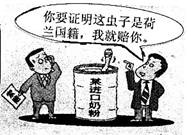 2.要求退换,店员态度恶劣。
3.提出合理解决办法。
参考词汇:进口奶粉 imported powdered milk 虫子 worm
ear manager,
Much to my regret, I write this letter to have a complaint against one of your shop assistants concerning bad service in the course of shopping yesterday.
———————————————————————————————————________________________________________________________________________________________________________________________________________________________________________________________________________________________________________________________________________________________________________________________________________________________________________________________________________________________________________________________________________________________________________________________________________________________________________________________
Yours respectfully,
A faithful
It is the education ____ he received when studying abroad ____has made him such an excellent manager.
A. which, that B. which, which
C. that, which D. that, where
—I’d like a table for six.
—Sorry,sir,but we don’t have any table ______ tonight.
A.usable B.suitable C.available D.comfortable
In my living room, there is a plaque(匾) that advises me to “Bloom(开花) where you are planted.” It ___21___ me of Dorothy. I got to know Dorothy in the early 1980s,when I was teaching Early Childhood Development through a program with Union College in Barbourville, Kentucky. The job responsibilities required occasional visits to the ___22___ of each teacher in the program. Dorothy ___23___ in my memory as one who “bloomed” in her remote area.
Dorothy taught in a school in Harlan County, Kentucky, Appalachian Mountain area. To get to her school from the town of Harlan, I followed a road ___24___ around the mountain. In the eight-mile journey, I crossed the same railroad track five times, giving the possibility of getting ___25___ by the same train five times. Rather than feeling ___26___ by this drive through the mountains, I found it depressing. The ___27___ level was shocking and the small shabby houses gave me the greatest feeling of ___28___ .
From the moment of my arrival at the little school, all gloom(忧郁) ___29___ . Upon arriving at Dorothy’s classroom, I was ___30___ with smiling faces and treated like a queen. The children had been prepared to show me their latest projects. Dorothy told me with a big smile that they were ___31___ poke greens salad and cornbread for “dinner” (lunch). In case you don’t ___32___ , poke greens are a weed type plant that grows wild, especially on poor ground.
Dorothy never ___33___ reports of exciting activities of her students. Her ___34___ never cooled down. When it came time to ___35___ for the testing and interviewing required to receive her Child Development Associate Certification, Dorothy was ___36___ . She came to the assessment(评价) and ___37___ in all areas. Afterward, she ___38___ me to the one-and-only steak house in the area to ___39___ her victory, as if she had received her Ph.D. degree. After the meal, she placed a little box containing an old pen in my hand. She said it was a family heirloom (传家宝), but to me it is a treasured symbol of appreciation and pride that cannot be ___40___ with things.
21. A. convinces B. reminds C. informs D. warns
22. A. classroom B. family C. office D. dormitry
23. A. hangs out B. moves out C. stands out D. turns out
24. A. winding B. hiding C. jumping D. swinging
25. A. forgotten B. abandoned C. picked D. caught
26. A. tired B. excited C. scared D. regretted
27. A. education B. wealth C. health D. poverty
28. A. happiness B. shame C. hopelessness D. regret
29. A. disappeared B. deepened C. increased D. flooded
30. A. comforted B. satisfied C. greeted D. encouraged
31. A. serving B. smelling C. stealing D. tasting
32. A. care B. know C. eat D. like
33. A. kept a record of B. complained of C. took notice of D. ran out of
34. A. anxiety B. enthusiasm C. sympathy D. depression
35. A. search B. sit C. pay D. look
36. A. nervous B. shy C. ready D. careful
37. A. passed B. failed C. picked D. falled
38. A. attracted B. forced C. invited D. introduced
39. A. show B. celebrate C. declare D. decide
40. A. packed B. made C. broken D. matched
In modern society there is a great deal of argument about competition. Some value it highly, believing that it is responsible for social progress and prosperity; others say that competition is bad because it sets one person against another and because it leads to unfriendly relationship between people.
I have taught many children who held the belief that their self-worth relied on how well they performed at tennis and other skills. For them, playing well and winning are often life-and-death affairs. In their single-minded pursuit of success, the development of many other human qualities is sadly forgotten.
However, while some seem to be lost in the desire to succeed, others take an opposite attitude. In a culture which values only the winner and pays no attention to the ordinary players, they strongly blame competition. Among the most vocal are youngsters who have suffered under competitive pressures from their parents or society. Teaching these young people, I often observe in them a desire to fail. They seem to seek failure by not trying to win or achieve success. By not trying, they always have an excuse: “I may have lost, but it doesn’t matter because I really didn’t try.” What is not usually admitted by themselves is the belief that if they had really tried and lost, that would mean a lot. Such a loss would be a measure of their worth. Clearly, this belief is the same as that of the true competitors who try to prove themselves. Both are based on the mistaken belief that one’s self-respect relies on how well one performs in comparison with others. Both are afraid of not being valued. Only as this basic and often troublesome fear begins to dissolve (缓解) can we discover a new meaning in competition.
32. What does this passage mainly talk about?
A. Failures are necessary experiences in competition.
B. Competition can help people to set up self-respect.
C. Opinions about competition are different among people.
D. Competition is harmful to personal quality development.
33. Why do some people favor competition according to the passage?
A. It pushes society forward. B. It builds up a sense of duty.
C. It improves personal abilities. D. It encourages individual efforts.
34. The underlined phrase “the most vocal” in Paragraph 3 means ________.
A. those who try their best to win
B. those who value competition most highly
C. those who depend on others most for success
D. those who are against competition most strongly
35. What is the similar belief of the true competitors and those with a desire to fail?
A. One’s success in competition needs great efforts.
B. One’s success is based on how hard he has tried.
C. One’s achievement is determined by his particular skills.
D. One’s worth lies in his performance compared with others.
假定你是李华,你校外教David对中国传统文化很感兴趣。学校邀请著名书法家沈鹏到校举行书法讲座。请给David发一封电子邮件,邀请他来参加并介绍讲座的有关事宜。
1)讲座时间:5月15日(星期日)上午8:00—11:00;
2)讲座地点:艺术楼演讲大厅;
3)活动安排:听讲座,讨论及提问,观摩名家即兴创作等。
注意:
1)词数100左右;
2)可以适当增加细节,以使行文连贯;
3)开头和结尾已为你写好。
参考词汇:calligraphy书法;improvise v. 即兴表演
Dear David,
I’m writing to invite you to the lecture on Chinese calligraphy, ________________________
_______________________________________________________________________________________________________________________________________________________________________________________________________________________________________________________________________________________________________________________________________________________________________________________________________________________________________________________________________________________________________________________________________________________________________________________________________________________________________________________________________________________________________________________________________
Yours,
Li Hua
France is Europe’s third largest country, ______ the United Kingdom ______ the English Channel.
A. facing; through B. faces; cross C. facing; across D. faced; across
One day,when 12-year-old Sean Redden went to a popular chat room on the Internet, he saw the name of someone he’d never seen there before, Susan Hicks. Her message was “ Would someone help me? I can’t breathe. Help me! I can’t feel my left side.”
At first, Sean thought it was a bad joke and he told his mother Sharon Redden. But she asked, “ It’s not just some game, is it?
The message was not a joke. “ Susan Hicks” was actually 20-year-old Taija Laitinen, a student working late at night at a college library near Helsinki, Finland---almost 7,000 miles away from Sean’s home in Texas. While searching the Internet, she began to feel terrible pain all through her body. The library was empty and the nearest phone was outside in the hallway. She couldn’t move that far because any movement caused the pain to get worse. Then as the pain became worse, she began typing her message for help in the chat room.
“I don’t think it’s a joke, mom,” Sean said. He typed, “ Where are you? The letters appeared, “Finland.” Sean and Sharon couldn’ t believe it. Not knowing what else to do, Sharon called the local police and explained the situation to officer Amy Schmidt. Schmidt told Sharon to try to get the sick girl’s phone number and address.
Meanwhile, the Texas police called the international telephone operator and asked to be connected to the proper agency(机构) in Finland. The Texas police explained the situation and gave Susan’s address to the Finnish operator. When Sean heard that, he typed, “Help is on the way.”
In the few minutes, the library door opened. Doctors and three policemen ran in. Taija turned once more to the computer, “ They are here. Thanks. Bye-bye.”
4. At first when receiving the message for help, Sean__________.
A. didn’t believe it B. took no notice of it
C. called the police at once D. had a joke with the person
5. What was the problem with the person who asked for help?
A. She lost her phone. B. She couldn’t finish her work
C. She was locked in the library. D. She felt pain and couldn’t move.
6. What can we learn from the text?
A. The policeman Sean’s mother called was in Finland.
B. Susan Hicks was a friend of Taija Laitinen.
C. Sean and his mother offered help in time.
D. Sean had seen Taija Laitinen before.
7. What does the underlined phrase “ on the way.” refer to?
A. There is a way B. to be arriving soon
C. have a long way to arrive D. to have almost finished
I had an experience once which taught me something about the ways people made a bad situation worse by blaming themselves. One January, I officiated (主持) at two funerals for two elderly women. Both died a natural death. At the first home, the son of the deceased (已故) woman said, “If only I had sent my mother to Florida and gotten her out of this cold and snow, she would be alive today. It’s my fault that she died.” At the second home, the son said, “If only I had not insisted her going to Florida, she would be alive today. That long airplane ride was more than she could take. It is my fault.”
When things don’t turn out as we would like them to, we tend to assume that had we done things differently, the story would have had a happier ending. Any time there is a death, the survivors will feel guilty. Because the course of action they took turned out bad, they believe that the opposite course, for example, keeping mother at home, would have turned out better. After all, how could it have turned out any worse?
There seem to be elements involved in our readiness to feel guilty. The first lies in our belief that the world makes sense—there is a reason for everything that happens.
The second is the thought that we are the cause of what happens, especially the bad things that happen. The roots of this feeling may lie in our childhood. A baby comes to think that the world exists to meet his needs, and that he makes everything happen in it. He wakes up in the morning and calls the rest of the world to its tasks. He cries, and someone comes to attend to him. When he is hungry, people feed him, and when he is wet, people change him. Very often, we do not completely abandon that childish thought that our wishes cause things to happen.
28. What is true about the two deceased elderly women?
A. They died from accidents.
B. They both died of old age.
C. They died due to lack of care by family members.
D. They weren’t accustomed to the change in life.
29. People feel guilty for the death of their loved ones because .
A. they cannot find a better way to express their sorrow
B. they don’t know that natural course of events
C. they believe that it is their fault
D. they don’t know things often turn out in the opposite direction
30. The underlined word “they” in Paragraph 2 probably refers to .
A. the things B. the stories C. the opposites D. the survivors
31. What is the main idea of this passage?
A. Two sons blamed themselves for their mother’s death.
B. Things don’t always go well as we expect.
C. Two factors account for guilty sense.
D. Baby’s wishes lead everything to happen.
“Another bad day at school?” my father asked as I came into the room.
“How could you tell? I didn’t shut the door heavily or anything,” I replied. Over the past two months I had either done this or thrown my backpack across the room every time I came home from school. Papa thinks it has something to do with moving to a new house.
“I know this move has been hard on you. Leaving your friends and cousins behind is tough,” Papa said, as he put his arm around my shoulder. “What you must remember is that, with a lot of hard work and some time, you will make new friends.”
“You don’t know how hard it is. This year my baseball team would have won the championship. They won’t even give me a chance to pitch (投球) here. All I get to play is right field, and that’s the worst!”
Papa turned toward me. “Things will get better, I promise you. Let me ask you, do you know why you were named David Lorenzo?”
“Yes, your name is David and grandfather’s name is Lorenzo.”
“Very good, and what makes your grandfather so important?”
“He was the first in the family to come to this country and all that,” I answered.
“That is only partly correct. Your grandfather was a very great man. In Mexico, he had been a teacher. When he came to America he could only get low-paid labor jobs because he didn’t speak the language. It took him two years before he spoke English well enough to be allowed to teach here, but he did it. He never complained because he knew change could be difficult. Did he ever tell you that?” my father asked. I looked down at my feet, ashamed at my behavior. “No. That must have been hard,” I said sheepishly.
“Your grandfather taught me that if you let people see your talent, they will accept you for who you are. I want you to always remember what my father taught me, even if it takes a few years for people to see who you are,” said Papa.
All I could say was, “Okay.” Then I asked, “What should I do now?”
Laughing, Papa said, “How about you pitch a few to me? You need some work.”
9. Why was the author unhappy that day?
A. Because he moved to a new country.
B. Because his baseball team lost the game.
C. Because he wasn’t offered a chance to pitch.
D. Because he quarreled with his friends at school.
10. The father successfully changed his son’s mood by ______.
A. asking him to train harder B. telling his grandfather’s story
C. playing baseball with him D. introducing him some new friends
11. The underlined word “sheepishly” probably means ______.
A. cautiously B. patiently C. rudely D. shyly
12. What can we infer about the author?
A. He thinks his father lives in the past.
B. He’d rather live with his grandfather.
C. He will continue to dislike school and everything.
D. He will try his best to adapt to the new environment.
While CCTV’s educational show Animal World is well known, few big screen wildlife documentaries have been made by China’s film industry.
But Born in China, which came out on Aug 2, may be important for Chinese filmmakers who want to get into nature -themed films. The movie, directed by Chinese filmmaker Lu Chuan, was shot in the Qinghai-Tibet Plateau and shows the animals’ lives during different seasons.
Born in China not only brings to audiences the lives of animals that are rarely seen in the wild—giant pandas, snow leopards, and golden monkeys, but also shows Chinese traditional culture.
A symbol of China, the giant panda is both black and white. Its body is thought to show yin and yang, which ancient Chinese ideas were based on. The panda’s gentle nature shows how yin and yang lead to peace. It can be seen in the film when a panda mother guides her baby to look for independence and explore the world.
Unlike the shy pandas, monkeys always have strong personalities. The Monkey King in China’s most famous novel Journey to the West has many conflicting traits(特点). It stands for not only impatience but also cleverness and energy. Born in China follows a 2-year- old golden monkey who leaves his family, but then returns and understands the meaning of responsibility.
Just as the golden monkey, a mother snow leopard also faces difficulty in raising her babies in the wild. The leopards, known for their rapid attacks and quick footwork(脚步), have inspired a form of pictographic(象形拳) in Shaolin martial arts(武术).
“Born in China is a means to show off Chinese traditional culture,” director Lu told the reporter. “Chinese people have learned a lot from wild animals since ancient times. This is why I shot this nature -themed documentary.”
1. How is Born in China special according to the article?
A. It shows Chinese traditional culture through the lives of animals.
B. It’s considered the best nature-themed film to come out of China.
C. It’s the first big screen wildlife documentary ever made in China.
D. It shows audiences the lives of rare animals.
2. We can learn from the article that in Born in China, _______.
A. the story of the giant pandas shows the importance of exploring the world
B. the story of the golden monkeys was inspired by the Monkey King
C. the stories show how animals grow up to be independent
D. the story about snow leopards shows what people can learn from animals
3. What may be the best title for the text?
A. The stories of 3 animal families B. Symbols of China
C. Wildlife born in China D. Nature shows culture
My wife is addicted to shopping on the Internet. 61 seems that she can’t control herself well, just clicking constantly with the mouse. Let me tell what happened last night. It was the fourth time she 62 (shop) online for hours. I had already reminded her 63 (think) twice before buying anything, but my wife ignored what I said and replied confidently, “With the New Year 64 (approach), preparation is necessary. Besides, I haven’t bought things on the Internet for a WHOLE week.” Hearing her words, I was really 65 (speech). In most cases, the things she bought aren’t good value for money. Maybe she just enjoys 66 process of buying online.
Nowadays, 67 the development of technology, online shopping is becoming more and more convenient. Those 68 stay at home can buy whatever they want. In the meanwhile, it causes a series of 69 (problem). One of them is more spending, because people are 70 (easy) attracted by the discount. So how to keep a good state of mind in front of temptation is an important lesson many people need to learn.
If Confucius(孔子)were still alive today and could celebrate his September 28 birthday with a big cake, there would be a lot of candles. He’d need a fan or a strong wind to help him put them out.
While many people in China will remember Confucius on his special day, few people in the United States will give him a passing thought. It’s nothing personal. Most Americans don’t even remember the birthdays of their own national heroes.
But this doesn’t mean that Americans don’t care about Confucius. In many ways he has become a bridge that foreigners must cross if they want to reach a deeper understanding of China.
In the past two decades, the Chinese studies programs have gained huge popularity in Western universities. More recently, the Chinese government has set up Confucius Institutes in more than 80 countries. These schools teach both Chinese language and culture. The main courses of Chinese culture usually included Chinese art, history and philosophy(哲学).Some social scientists suggest that Westerners should take advantages of the ancient Chinese wisdom to make up for the drawbacks of Westerners philosophy. Students in the United States, at the same time, are racing to learn Chinese. So they will be ready for life in a world where China is an equal power with the United States. Businessmen who hope to make money in China are reading books about Confucius to understand their Chinese customers.
So the old thinker’s ideas are still alive and well.
Today China attracts the West more than ever, and it will need more teachers to introduce Confucius and Chinese culture to the West.
As for the old thinker, he will not soon be forgotten by people in the West, even if his birthday is.
4. The opening paragraph is mainly intended to ________
A. provide some key facts about Confucius
B. attract the readers’ interest in the subject
C. show great respect for the ancient thinker
D. prove the popularity of modern birthday celebrations
5. We can learn from Paragraph 4 that American students______
A. have a great interest in studying Chinese
B. take an active part in Chinese competitions
C. try to get high scores in Chinese exams
D. fight for a chance to learn Chinese
6. What is the best title for the passage?
A. Forgotten Wisdom in America B. Old Thinker with a Big Future
C. Chinese Culture for Westerners D. Huge Fans of the Chinese Language
7. The passage is likely to appear in ___________.
A. a biography B. a history paper C. a newspaper D. a philosophy textbook
Learning Chinese Online!
Chinese passport.com hosts all kinds of online courses about Chinese language, Chinese culture and China.
Join the free courses written and compiled by experienced Chinese language teachers.
We also host internal courses for schools and companies. Users will find your courses in the course catalogue or log in to the course through the link provided by your teachers or tutors.
You can get new friends in the community, with voice and text chat!
Sign up today! Get a Chinese passport with your Chinese name! Prepare yourself for China!
Teaching Chinese Online!
Chinese passport.com offers free LMS (learning management system) and web spaces for online education. Our platform is powered by EDUIT—one of the most popular LMS system in China. What’s more, Chinese passport.com has been mentioned and praised three times in HMCI’s famous schools lists.
Besides its common functions for any web courses, it has special functions for Chinese language learning and course making, including dictionaries, sound files for common words, and flash cards for Chinese characters!
For teachers or anyone who would like to make a Chinese course, we have the platform and web space for you. You can make an open course or just a course for your own students in your school.
Just type in Chinese characters, click, click, and you get pinyin ready, very easy to use.
Sign up today, and start to share your knowledge online!
21. Which of the following is NOT true about the internal courses on the web?
A. They are designed by excellent Chinese language teachers.
B.. They charge students who want to learn
C. They include many sides about China
D. They can be made by yourself if you want to make a course.
22. Which of the following can you NOT do in the Chinese passport.com?
A. Making friends. B. Talking with friends.
C. Learning English. D. Having a platform and web space for you
23. HMCI is probably the name of _______.
A. a school leader B. an educational organization
C. a political party D. a news reporter
–I’m sorry that I’ve spilt some coffee on the table cloth.
–_ . It will wash out easily.
A. No hurry. B. Take it easy. C. Never mind. D. Be careful.
- 请以“生活”为话题,按照下面的文字进行仿写。 生活是一部大百科全书,包罗万象;生活是一把六弦琴,弹奏出多重美妙的旋律;
- I.语音知识(共5小题,每小题1分,满分5分) 从每小题中的A、B、C、D四个选项中,找出所给单词的正确读音。
- 俗话说:“要长寿,吃羊肉”。2013年因牛羊肉市场需求量大,羊肉价格一路飙升,一年涨近四成,网友戏称“牛魔王”“羊贵妃”
- 下列句中划线的词语与现代汉语的意思相同的一项是( ) A 臣之辛苦,非独蜀之人士及二州牧伯所见明知 B 岂敢盘桓,有所希
- 《中共中央关于制定国民经济和社会发展第十一个五年规划的建议》指出:要“统筹国内发展和对外开放,不断提高对外开放水平,增强
- I hate people ______ talk much but dolittle.A. who B. which
- 2011年12月13日,在黄埔区纪委的一台公车监控电脑上,记者能随机调出任一公务车的用车信息,用车人信息、行驶轨迹、原
- 如图表示先天性行为与学习行为的相同点和不同点,其中阴影部分表示相同点.下列哪一项可以写在阴影部分()A.生来就有 B.由
- 读亚洲图,回答下面问题。(每空1分,共8分)“我们亚洲,山是高昂的头;我们亚洲,河像热血流…… ”听到这首《亚洲雄风》的
- 下列词语中划线字注音全部正确的一项是(3分)A.聒噪(ɡuā)抽噎(yē)味同嚼蜡(jué)B.亵渎(xiè)嗔怒(ch
- 如图所示电路中,电源电压为4.5V,滑动变阻器的规格为“30Ω 1A”。(1)小丽想用该电路研究“电流与电阻的关系”,请
- 十七大报告首次将“基层群众自治制度”纳入中国特色政治制度范畴。在我国,实行村民自治和城市居民自治是 ①基层民主中公民参与
- 若不等式组的解集为﹣1<x<1,则(a﹣3)(b+3)的值为() A.1 B.﹣1 C.2
- 与毕加索的名画《格尔尼卡》反映的主题最贴近的历史事件是 A.中途岛海战 B.南京大屠杀 C.珍珠港事件 D.慕尼
- 在下列变化中,既属于化合反应,又属于氧化反应的是( ) A.电解水 B.石蜡在空气中燃烧 C.
- ________ecommerce worries some merchants,itcontributes to t
- 不等式组 的解是( )A. B. C.
- 阅读下面一段文字,按要求回答文后问题。 微风中的芦苇姿态优美,柔曼妩()媚,向世界展示生命的万种风情。微风啊,你是生命的
- 阅读下面两篇文言文选段 【甲】臣本布衣,躬耕于南阳,苟全性命于乱世,不求闻达于诸侯。先帝不以臣卑鄙,猥自枉屈,三顾臣于草
- ......


