自然地理类 知识点题库
|
fall turn to with high little explore cover those |
The Antarctic is actually a desert. It is the only continent on the earth a river or a lake. The Antarctic is with ice all the year round. The temperature ever recorded there is zero at South Pole. used to think that a place so cold would have a heavy snowfall. But less than ten inches of snow falls there each year. That is less than half an inch of water. It's even much than of Sahara. The little snow that in Antarctica never becomes water. It continues to pile up deeper and deeper year after year and century after century. When the snow gets to be about eighty feet deep, it will be ice by the weight of the snow above it.
Hello, everyone. Welcome to our city-Gaomi. This is a map of it, There are about 90000 people in our city. People here are very friendly. There are many tall buildings here. There. ____________________ (be) a police station, a post office, three hospitals and a lot of schools in the city. The police station is near the post office. The People's Hospital is on the left of a school. ___________________ (在……的中央) our city, there is a nice river-the Xiaokang River. The river is between a theatre ____________________ (连词) a library. There are many fish in it. There are many boys and girls playing near the river.
-
(1) 猜测文中画线单词的意思A . 朋友 B . 友好的 C . 难以相处的 D . 冷酷的
-
(2) 用be的适当形式填空:
-
(3) 写出画线句子的同义句:
-
(4) 根据汉语提示写出短语:
-
(5) 填入适当的连词
Do you know what the world's highest waterfall (瀑布) is? You may say that they are Niagara Falls. Niagara Falls are really beautiful, but in terms of the height, the most fantastic one in the world are Angel Falls. They are deep in the jungles(丛林) of Venezuela.
Few people have ever seen Angel Falls. It's very hard to get there. If you go there on foot, you have to travel for weeks through thick jungles. If you go by plane from Caracas, a city on the southern coast, it will take about four hours.
One of the most interesting facts about Angel Falls is how they were found. They were named after an American pilot. His name was Jimmy Angel. In 1937, his
plane crashed(坠毁) near the top of the falls. That's how he found them.
Angel Falls drop nearly a kilometer from a table— top mountain. The water seems to be dropping straight out of the clouds. The height of the falls is very great.
By the time the water reaches the ground it has already turned into fog(雾).
-
(1) Niagara Falls arc very _______ according to the passage.A . small B . big C . dangerous D . beautiful
-
(2) Few people have ever seen Angel Falls becauseA . the tickets are very expensive B . it isn't easy to get there C . there aren't enough hotels to live in D . visitors can only get there on foot
-
(3) If you want to visit Angel Falls, you'll spend _______ getting there by air from Caracas.A . four hours B . forty hours C . several days D . several weeks
-
(4) Who found Angel Falls?A . A pilot from Caracas. B . A man in Venezuela. C . An American pilot. D . An American visitor.
-
(5) What is the best title for this passage?A . The Most Interesting Place B . How to Visit Angel Falls C . Who Found Angel Falls D . The World's Highest Waterfall
Sometimes we wish we could stop time and go back in time. Well, twice a year, some countries actually decide to1the time.
As summer begins, some countries, like the US, UK and most of other countries in the EU, move the time forward one hour: 12 o'clock becomes 1 o'clock. This is to give people one more hour of 2. This is called "daylight saving time (夏令时时间)".
But as winter arrives, you'll notice the darkness stays with us3. The sun doesn't enjoy being out as often as in the summer. To deal with this, these countries turn the clocks4one hour: 1 o'clock goes back to 12 o'clock.
Countries have done this for about 100 years. At some point, most of the world has tested with it. In fact, from 1986 to 1991, China used daylight saving time.
By having another hour of sunlight, you can save5by not needing to turn the lights on. Also, it can help the economy (经济), as people enjoy shopping when it is brighter. But people think it disrupts (打乱) sleeping habits. And because mornings are darker, the6of people getting to work and school is a problem.
If you go to the south of England, you should see Stonehenge (巨石阵).
Stonehenge is a group of big, standing stones. There are 38 of them and most are as tall as 4 meters. Experts (专家) believe it was there around 5,000 years ago.
But who built Stonehenge? How did they carry the big and heavy stones by hand?
Why did they build the stones? No one is sure. Some say that the Druids (德鲁伊教团员) built Stonehenge. They were an ancient people. Maybe they used the stones as a temple to the sun.
-
(1) Stonehenge is in the north of England.
-
(2) Stonehenge is a group of stones.
-
(3) Stonehenge has a history of 5,000 years according to the experts.
-
(4) People know all about the stones nowadays.
-
(5) Maybe the Druids used the stones as a temple to the sun.
Giraffes 1 my favourite animals. They have big eyes on a small head and they can see very well. They are very tall so they can eat from tall trees. They can run fast with their thin legs but they 2 run for a long time. They often 3 for long hours to find food in places far away.
China's Yangtze River, the world's third longest river, is home to 378 known species(物种) of fish. But the Chinese paddlefish(白鲟), once a common freshwater fish in the river, is no longer a member of it. Although few paddlefish were seen after 1995, they didn't completely become extinct until between 2005 and 2010; they were last seen in 2003. According to a recent study, human activities drove the nearly 200-million-year-old animals to extinction.
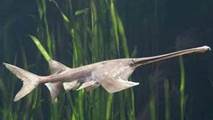
The Chinese paddlefish, also known as the "panda of Yangtze", was one of the world's largest freshwater fish species. It could grow as long as 7 meters and weigh up to 450 kilograms.
While the Chinese paddlefish was listed as a nationally protected animal in the 1980s, overfishing in the 1970s caused great influence to their population. National Geographic reports that about 25 tons of paddlefish were caught each year during that period. And in 1981, the building of the Gezhouba Dam divided the paddlefish population into two parts, which broke migration patterns(洄游模式)and prevented producing young upstream. This caused the paddlefish to be short of numbers to reproduce.
The problem is that more will be like this, but the hope is that in order to save other endangered Yangtze species, many quicker efforts are being made. Also China introduced a 10-year commercial(商业的) fishing ban(禁令) over 300 parts along the Yangtze River in order to protect endangered Yangtze species.
-
(1) What does the underlined part "become extinct" mean in Chinese?A . 繁殖 B . 变异 C . 灭绝
-
(2) What DOESN'T the passage mention about the paddlefish?A . Its length. B . Its height. C . Its weight.
-
(3) According to Paragraph 3, what caused the extinction of the paddlefish?A . Humans' overfishing and being separated by a dam. B . Living in a bad environment and being separated by a dam. C . Humans' overfishing and living in a bad environment.
-
(4) What can we learn from the last paragraph?A . The commercial fishing ban was made to protect paddlefish only. B . Action is being taken to save freshwater fish species. C . The Chinese paddlefish is the only freshwater fish in the Yangtze River.
-
(5) In which part of a newspaper can we see the passage?A . NATURE B . SCIENCE C . HISTORY
Most people have heard of the Great Wall of China, but not many foreigners know about the Grand Canal. This man-made waterway—known in China as DaYunhe —is 1,700 kilometers long and some parts of it are more than 2,000 years old. It 1the north of China with Hangzhou, a city in the southern part of the country. It's the longest man-made waterway in the world.
It was built as a2to transport grain from the rich agricultural land in China's south to cities in the north. In fact, it's not one canal, but a system of canals and rivers linked3. It's still an important part of the transport system in China. Thousands of boats use it every day to transport grain and many other types of cargo.
Now the Chinese government is doing new work on the Grand Canal. It is making parts of it4, so bigger ships can use it. The canal will also help to move water. There is a lot of 5in the south of China, but not (as much) in the north. The canal will carry millions of liters of water from the south to the north.
The Grand Canal is much6than the Great Wall, and not very many tourists visit(it). But it's possible to go on a cruise along some of the oldest parts of the canal. Passengers on these cruises see beautiful parts of China that other visitors don't see.
Nature's warnings
When the sky suddenly turns dark and the wind is strong, beware (当心) ! A dangerous storm might be coming. Storms are frightening. Watch for flashes of lightning. Listen for thunder. If nature sends these warnings, don't wait for rain. Act right away to keep safe.
Steps to keep safe
At the first flash of lightning, quickly get inside a building or a car. Do not go into a shed or baseball dugout. They are not closed like a building, so they are not
Even after you are indoors, be careful. It is not smart to go near doors or windows. They can blow in or break. A room with no windows is the safest pace to
Do not wash your hands during a storm. Do not use anything that runs on electricity either. Water and electrical lines are like roads for lightning. Even if you really want to play computer games, don't! It is better to be bored than to risk getting hurt. Try reading a book instead. Reading is more interesting than playing
If you can't get anywhere safe, stay out in the open. You may feel safe under a tree, but that is not a good place to be. Lightning pulls toward tall poles and trees. Stay down low in an open space and cover your ears to protect them. Loud thunder can damage your hearing.
|
How to be safe in a storm |
|
|
Nature's warnings |
When the sky suddenly turns and the wind is strong, a dangerous storm might be coming. If nature sends these warnings like thunder and flashes of lightning act right away to kep safe instead of for rain. |
|
to keep safe |
At the first flash of lightening, get a building as soon as possible. Be after you are indoors. The safest place is a room windows. Keep away from . Do not use anything that runs on electricity either. instead of playing computer games. If it is to get somewhere safe, stay down low in an open space and cover your ears to protect them. |
|
Conclusion |
If you follow these rules, you can stay safe during a . |
|
friendly have service seats worst best cheapest freshest although and with plays |
Dear Anna,
I'm glad to hear that you are coming to my hometown for a trip. My hometown is a good place to fun. You can visit some places in my hometown. For example, all the bookstores are good, but Book City is the in our town. It has the most books and the friendliest . And it also has the most comfortable . However, in Xingzhi Bookstore you can buy the books. The best clothing store is Lucy's Clothes Store. It has clothes of the best quality. Star Clothes Store is the . It has really bad service. As for restaurants, most people think Miaoxiang is really great. It the most interesting music and has the food. Of all the cinemas, Cinema City is the best cinema because it has the best sound and you can also sit most comfortably there, the movie tickets are the most expensive. I hope you can go to the movies me when you visit me.
Yours,
Li Hua
In Taichung, there is a small village called Rainbow Village. On the walls of every building in the village, you can see all kinds of pictures. He bought a house there more than 30 years ago. In 2010, the government (政府) wanted to take down(拆除)the village. Later the village became a popular place to visit. And Yung-fu Huang also got a new name :Grandpa Rainbow.
Grandpa Rainbow paints things he likes. You can also see paintings of people. Some of the most popular paintings are of great people, such as Andy Lau and Jeremy Lin. Grandpa Rainbow also writes Chinese sayings along the walls.
In the village, there is a nice shop. It sells lots of delicious foods. You can read the story behind these special tea eggs on the wall of the shop.
|
A. You can see paintings of flowers and animals. B. A talented man named Yung-fu Huang painted (绘画) them. C. One you must try is tea eggs called Grandpa Thunder's Eggs. D. Now many people want to visit him and his wonderful home. E. To save his home, Yung-fu Huang painted pictures on the walls of every building. |
Monarch butterflies from eastern Canada make the most amazing journey in the insect world. Each year, this butterfly travels about 3000 miles to its winter home in central Mexico(墨西哥). How can it fly so far? And why does it make this long and dangerous trip? Scientists still don't have an answer.
For many years, people in Mexico wondered where the orange-and-black butterflies came from every winter. Then, in 1937, a scientist started to follow and study the butterflies. For the next 20years, he discovered that one butterfly started its journey in Canada. Four months later, it arrived in Mexico.
The length of the butterflies find their way back to the same place?Another amazing thing is that the butterflies always return to the same area in central Mexico.
How do the butterflies find their way back to the same place? This is an interesting question because only every fourth generation(代)makes the trip south. In other words, the butterfly that travels to Mexico this year is the great-great-grandchild of the butterfly that traveled there last year.
Each year, four generations of a Monarch butterfly family are born. Each generation of the family has a very different life. The first generation is born in the south in late April. It slowly moves north, reproduces(繁衍), and then dies. On the trip north, two more generations are born, reproduce, and die. Each of these generations of butterflies is born. This generation has a much longer life. It lives for about eight months. This generation of butterflies makes the amazing journey back to the winter home of its great-great-grandparents. The butterflies spend the winter there, and in the spring they reproduce and then die. Their offspring will be the first generation of the next circle of life.
Today, people are still studying the Monarch butterfly. But they are not clear about everything.
-
(1) The best title of the passage can be_____.A . Family of Monarch butterflies B . Mystery of Monarch butterflies C . Monarch butterflies' birthplace D . Monarch butterflies'winter home
-
(2) It took the scientist_____to find out that monarch butterflies came from Canada.A . 20years B . four months C . five weeks D . eight months
-
(3) We know that the______generation of Monarch butterflies travel back to central Mexico.A . first B . second C . third D . fourth
-
(4) The underlined word "offspring" in the passage is closest in meaning to_____.A . seasons B . butterflies C . children D . parents
-
(5) Which statement is true according to the text?A . Monarch butterflies spend winter in eastern Canada. B . The four generations have the same length of life. C . Some generations die on the way north to Canada. D . Scientists are clear about everything of the butterflies.
There are four seasons in a year. Every season has its own colour. What is every season's colour?
Spring is green. When spring comes, trees begin to bud(发芽)and grass begins to grow. It's a really green world, and it's also the colour of hope. Green is good for eyes. When we see green, we usually feel relaxed and are full of energy. Spring is the best season for going out. People like to take a trip in spring with friends or family.
Summer is different. It's usually very hot, so the season is red. In summer, the flowers look so active. Crops grow fast. Some people like summer because they can keep cool by swimming. Swimming is the most popular activity in summer.
Different from summer, autumn gets cool. The rice in the fields and fruits on the trees are signs of autumn. Its colour is gold. In the season, farmers are usually busy. Of course, they are excited, too. It's also a good season for exercising. Parents often take their children to go hiking and teachers can take their students for a school trip.
What about winter? When it snows, everything becomes white. So it is a white season. Winter is usually cold and long. But snow surprises and excites us. People enjoy skating or making snow﹣men in winter.
-
(1) How do people feel when they see green according to the writer?A . Relaxed. B . Warm. C . Quiet. D . Bored.
-
(2) Why do some people like summer according to Paragraph 3?A . Because they can have a long holiday in this season. B . Because crops and flowers grow well in this season. C . Because they can go swimming to be cool in this season. D . Because it has a very different colour from any other seasons.
-
(3) What does the underlined word "they" refer to?A . Students. B . Children. C . Parents. D . Farmers.
-
(4) What's the passage mainly about?A . Different sports in different seasons. B . The colour of different seasons. C . How people spend their time in different seasons. D . The weather in different seasons.
You may think there is only sand in the desert of the world,1it is not true. In the desert, as we know, there is a little2, but it is not3for most plants. Still we can see some plants live in the desert.
There is4in some places in the desert. We call these places oases. In the oases, there are villages and towns. People grow all kinds of crops in the fields there.
People5live outside the oases. They have camels, sheep and other animals. These animals depend on the desert plants for their food and do not need6water.
The animals are useful to the desert people in many ways. They eat the meat and drink the milk of the animals. They use the camels for carrying water, food, tents and something else.
The people of the desert have to keep moving from place to place. They must always7grass or desert plants for their animals. When there is no more food for their animals, they move to8place. The desert people are9. No man in the desert would ever10to help the people in trouble and give them food and water.
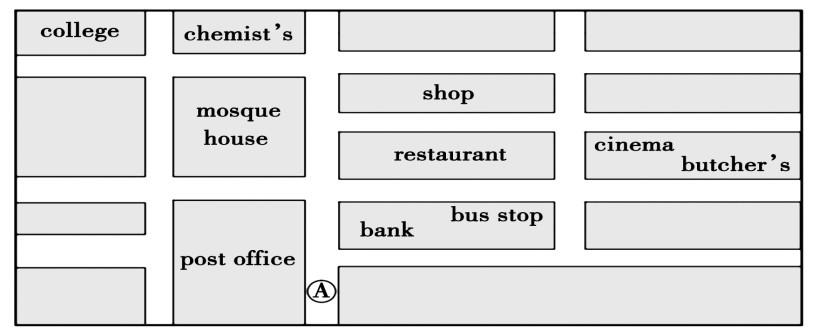
-
(1) Walk up the street and turn left at the first crossing. Then turn left again at the next crossing. The ______ is a few meters on your left.A . bank B . college C . post office D . shop
-
(2) Walk up the street only a few meters. Take the first turning on the right. The is on your left.A . post office B . bank C . house D . restaurant
-
(3) Walk up the street and take the second turning on the right. The is on your right half-way down this street.A . cinema B . bus stop C . mosque house D . chemist's
-
(4) Take the first turning on the right. Then take the next left and walk up the street. The is on the right just after the second crossing.A . house B . bank C . butcher's D . cinema
-
(5) Turn right first. Then turn left. Walk up this street and turn left at the third crossing. The is half-way down the street on the left.A . shop B . bank C . cinema D . house
It's hard to turn down a tasty banana. They taste good and you don't have to wash them before eating them. However, British scientists say that the fruit may disappear by 2050.
One reason for this is climate (气候) change. Scientists at the University of Exeter collected data (数据) from 27 countries that produce 86 percent of the world's bananas. They found that climate change has improved growing conditions in 21 of these countries. In the past 60 years, the average yield (平均产量) has reached 1.37 tons of bananas per hectare (公顷).
However, if temperatures keep rising, this advantage will disappear. Ten of the countries, including India, the world's biggest producer of bananas, will produce fewer bananas. By 2050, the fruit may die out.
Shouldn't bananas grow more easily if it's hotter outside? In fact, the perfect temperature range (范围) for growing bananas is between 24℃ and 32℃. If temperatures get too high, they will stop growing.
Diseases are another danger to bananas. Unlike other plants, the bananas we grow come from shoot cuttings (茎段) rather than seeds (种子). This means that all banana plants have the same genotype (基因型). In other words, if a disease is able to kill one plant, it could kill them all.
One serious disease is called Panama. Caused by fungus (真菌) in the soil, it spreads easily. It has spread across South Asia, Africa, the Middle East, and Australia. If one banana plantation suffers from the disease, it will take 30 years until it is able to grow bananas again. Scientists have yet to find a cure for this disease.
-
(1) What does the underlined word "this" in Paragraph 2 refer to (指)?A . A banana tastes great. B . A banana will die out in 30 years. C . A banana is convenient to be eaten.
-
(2) From the passage, we can learn that __________.A . in the last few years, the average yield of bananas has increased B . panama has killed all the bananas in some areas like South Asia C . the higher the temperature is, the better bananas will grow
-
(3) What does the passage mainly talk about?A . The difficulties of growing bananas. B . The perfect conditions of growing bananas. C . The reasons for the disappearance of bananas.
-
(4) How is the passage organized?A .
 B .
B .  C .
C . 
Rainforests are very large, they can be found close to the equator(赤道), in South East Asia, West Africa and Central and South America. They have very high temperatures and it rains all year round. In a year it can rain as much as 260 cm!
The rainforest is divided into three layers(层). The canopy(树冠)is the top layer of the trees where most of the animals live. These trees can be more than 30 meters high and it is the noisiest layer of the rainforest. The middle layer is under the canopy and has some shorter trees. The third layer is the forest floor. It has very little sunlight and is the quietest layer of the rainforest. It can take ten minutes for a falling raindrop to travel from a rainforest's thick canopy to the floor.
Rainforests help to protect the Earth's climate(气候)because they take in CO2, a greenhouse gas from the air, and give out O2. Many things we need such as medicines and food come from the rainforests, too.
Unluckily, these rainforests are disappearing. Every second an area the size of a football field is either cut down for wood, to make furniture(家具), to build houses or to be cleared for farming animals. Action needs to be taken to protect the rainforests now!
-
(1) In rainforests, it can rain in a year.(完成句子)
-
(2) The forest floor has very little sunlight and is .(完成句子)
-
(3) Why do rainforests help to protect the Earth's climate? (简略回答问题)
-
(4) 找出并写下第二段的主题句
-
(5) 将文中画线句子译成汉语
|
Anna Walker (A tour guide in Chester): Close to the English and Welsh border, the city of Chester has a long history. It's filled with buildings of historic sites, including some historic city walls in the county. For tourists who plan a visit to Chester this year, there's plenty on offer, including a new, free, self-guided tour that lines the city's four main streets. Chester's Rows are unique(独特的) in the world, which form a second row of shops above those at street level. Nobody is quite sure why they were built this way But the new tour offers an insight into their fascinating history and the shaping of Chester. |
|
Brian Clarke (A boat driver in Chester): I was born in the small village of Mancot, six miles from Chester, and once I moved here,I have simply never wanted to leave the city. The city itself has so much to offer but most of all I love the beautiful River Dee. My favorite spot in Chester is the tee-lined banks of the River Dee. I walk into work at Chester Boat every day and it's great to be able to walk through Grosvenor Park and come out at Oueens Park Bridge. Chester Boat business began in Chester over 100 years ago. I started as a boat driver in 1979 and have had a wonderful life. |
|
Katrina Kerr (An old lady in Chester): I'm a Londoner but in 1998 my husband and I moved to Chester. It was the perfect location and we really felt we had “escaped to the country". It looks different from other cities so many black and white buildings. During the summer it is busy with tourists and race-goers, and in the winter, you can enjoy comedy clubs, jazz and Folk bars. Chester is right on the border with Wales, so for centuries it has been a bit English and a bit Welsh. Now a new generation have started businesses in travel and finance(金融). And the city now feels young and buzzy. |
-
(1) The three speakers in the passage are mainly talking about _______.A . London B . Chester C . Mancot D . Welsh
-
(2) According to the passage, you can get some advice on a tour fromA . Anna Walker B . Brian Clarke C . Katrina Kerr D . Katrina Kerr's husband
-
(3) You can best describe the city with the words“A . big and noisy B . modern and peaceful C . young and rich D . ancient and wonderful
Bears are found in Asia, Africa and America. They are very strong, with short tails and thick legs. Bears eat almost everything. They seem to enjoy meat, fruit, milk and rice.
Bears are not quite dangerous as people imagine (想象) them to be. Like most animals, they will try to stay away from human beings. However, for they can be very dangerous.
Bears have a good sense of smell but they have poor eyesight. They are also hard of hearing but they are very clever. They feed mainly on roots (根), frogs, fish and also small insects. They will sometimes kill deer (鹿), but they seem to like small animals better.
In the cold area, bears hibernate (冬眠), or go to sleep from October to April. Before they start to hibernate (存储) fat. The mother bear has its babies, usually two (爪). You would have to teach a dog such a trick but the bears learn this by themselves.
-
(1) Like most animals, bears try to .A . kill hunters B . store fat after hibernation C . stay away from people D . be friendly with people
-
(2) People imagine bears to be .A . quite harmless B . very dangerous C . very safe D . very clever
-
(3) A mother bear usually gives birth to .A . many babies B . only one C . some of babies D . two babies
There are eight species (物种)of bears. They are in different colors and sizes. They live indifferent parts of the world. Read the following to learn about three bear species.
|
Panda |
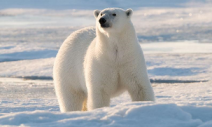
Polar Bear |
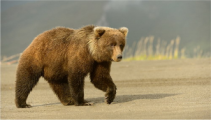
Brown Bear |
|
|
FOOD |
Bamboo |
Seals and small whales |
Roots. berries, nuts, and fruit |
|
SIZE |
Up to six feet (英尺) tall |
Up to eight feet tall |
Up to nine feet tall |
|
НОМЕ |
Bamboo forests in the mountains of China. |
Sea ice and coastal (沿海的) land in the Arctic. |
Forests and mountains of North America, Europe, and Asia. |
|
FACT |
Pandas use their large teeth and strong jaws to chomp (大声地咬)on bamboo. |
Polar bears have a thick layer of fur v毛皮) and fat. This helps them keep warm in their cold home. |
Brown bears are in many colors. Some are nearly black. Others are blond. |

-
(1) Panda live in the of China.A . farms B . bamboo forests C . rivers
-
(2) Which of the three bear species can grow up to nine feet tall?A . Pandas B . Polar bears C . Brown bears
-
(3) Which of the following is one of Polar bear's food?A . Small whales B . Roots C . Fruit
-
(4) We can find brown bears in the following places EXCEPT (除了) .A . North America B . Africa C . Europe
-
(5) Which of the following is TRUE according to the passage?A . Pandas use their small teeth to eat bamboo. B . The sea ice is so cold that polar bears can't live on it. C . Brown bears are in different colors.
- 唐朝时期,管辖今伊犁地区的最高统治机构是 A.西域都护府
- (4分)钳型表的工作原理如图所示。当通有交流电的导线从环形铁芯的中间穿过时,与绕在铁芯上的线圈相连的电表指针会发生偏转。
- 13.不等式x+x3≥0的解集是 .
- 合理解决分配问题,要处理好效率和公平的关系。关于效率和公平的关系,认识正确的是
- 2、下列各组词语,没有错别字的一项是( ) A 战栗 辫子 抱歉
- 以下现象与电化学腐蚀无关的是()A.黄铜(铜锌合金)制作的铜锣不易产生铜绿B.生铁比软铁芯(几乎是纯铁)容易生锈C.铁质
- 下图中甲是“太阳光照射地球示意图”、乙是“二分二至日地球公转示意图”,读图完成图甲所示时间下列地理现象叙述正确的是A.巴
- 阅读下面这首宋诗,然后回答问题。 壬辰寒食① 王安石 客思似杨柳,春风千万条。更倾寒食泪,欲涨冶城②潮。 巾发雪争出,镜
- 阅读下面两首唐诗,然后回答问题。(6分) 台 城 韦庄 江雨霏霏江草齐,六朝如梦鸟空啼。 无情最是台城柳,依旧烟笼
- 书面表达假设你叫王红,你的好友李扬在学习英语时遇到一些困难,请根据表格内容给李扬写一封70词左右的信。信的格式和开头已给
- Don’t watch TV. It’s too late. Please _____ and go to bed ri
- 下列各句中,标点符号使用正确的一句是 ( ) A.中国古代的书、画艺术,在中国文化史
- 函数的定义域是 (A.) ( B.) (C.) (
- 有一无色溶液,可能大量含有K+、A13+、Ba2+、NH4+、Cl-、SO42-、SO32-、HCO3-中的几种。为确定
- Fora while, my neighborhood was taken ever by an army of jog
- 下列关于浓硫酸的叙述中,正确的是( )A.浓硫酸具有吸水性,因而能使蔗糖炭化B.浓硫酸在常温下可迅速与铜片反应放出二
- 已知M是△ABC的BC边上的中点,若向量=a,= b,则向量等于( ) A.(a-b) B.(b-a) C
- 人的下丘脑受损,一般不会影响 ( ) A.内分泌活动的协调B.体温恒定的维持 C.条件反射的建立
- 某同学为了使反应2HCl +2Ag=2AgCl + H2↑能进行,设计了下列四个实验,如下图所示,你认为可行的方案是
- ---We can use QQ to talk with each other on the Internet.


