推理判断题 知识点题库
For Chinese, it's a time for dragon boat racing and Zongzi (粽子). But across the Yellow Sea, South Korea, wrestling (摔跤) and swing play are the highlights. However, both events go by the same name—the Dragon Boat Festival—which falls on May5 of the lunar calendar.
One festival, two cultures: does one nation have the right to call its own? It has been reported that South Korea will apply (申请) to the United Nations Educational, Social and Cultural Organization (UNESCO联合国教科文组织) to make the celebration its cultural heritage (文化遗产). If successful, people from other countries may see the Dragon Festival as a Korean creation.
As the birthplace of the yearly event more than 2, 000 years ago, China is not happy with the situation. "It would be a shame if another country successfully made a traditional Chinese festival part of its own cultural heritage ahead of China," said Zhou Heping, deputy culture minister. The Ministry of Culture is even thinking of making its own application to UNESCO, covering all traditional Chinese festivals, including the Dragon Boat event.
Over the years, the Dragon Boat Festival has spread throughout the world. In Japan and Viet Nam, as well as South Korea, the festival has mixed with and become part of local culture. With this in mind, some experts say that it is meaningless to argue about which country the festival belongs to. "No one can deny that it came from China," said Long Haiqing, an expert from Hunan Province. "But if all the countries involved can protect culture heritage together, they will all benefit."
-
(1) The underlined word "highlights" can be probably replaced by "________".A . most exciting events B . highest lights on the building C . brightest lights at night D . most famous festivals
-
(2) It can be inferred that South Korea ________.A . has proclaimed (宣布) the Dragon Boat Festival as a part of its cultural heritage B . has the exactly same Dragon Boat Festival as China C . has no idea that China has such a festival D . is paying more attention to its cultural heritage than China
-
(3) China is not happy with the situation because ________.A . it created the festival B . it is also making an application C . South Korea has no right to call the festival its own D . UNESCO may approve (批准) South Korea's application
-
(4) If South Korea's application to UNESCO is successful ________.A . China will also make its own application to UNESCO B . it will be meaningless to celebrate the Dragon Boat Festival C . people from other parts of the world will think South Korea created the festival D . the Dragon Boat Festival will become part of local culture
-
(5) The author would probably support ________.A . a move by South Korea to cancel its application B . China getting UNESCO's approval of the festival first C . the opinion of Zhou Heping D . China paying more attention to its cultural heritage
There are many places to go on safari (观赏野生动物) in Africa, but riding a horse through the flooded waters of Botswana's Okavango Delta must rank as one of the world's most exciting wildlife journeys.
Several safari camps operate as the base for this adventure, providing unique rides twice a day to explore deep into the delta. The camps have excellent horses, professional guides and lots of support workers. They have a reputation for providing a great riding experience.
The morning ride, when the guides take you to beautiful, shallow lakes full of water lilies, tends to be more active. It is unlike any other riding experience. With rainbows forming in the splashing water around you and the sound of huge drops of water bouncing off your body and face, it is truly exciting. You are very likely to come across large wild animals, too. On horseback it is possible to get quite close to elephants, giraffes and many other animals. The sense of excitement and tension levels rise suddenly though, as does your heart rate, as you move closer to them.
In the evening, rides are usually at a more relaxed and unhurried pace, with golden light streaming across the grassy delta and the animals coming out to eat and drink. Sedate though they are, rides at this time of day are still very impressive. As the sun's rays pass through the dust kicked up by the horses, the romance of Africa comes to life.
Back at the camp you can kick off your boots and enjoy excellent food and wine. Looking back on your day, you will find it hard to deny that a horseback safari is as close as you will ever come to answering the call of the wild.
-
(1) What is the purpose of the text?A . To warn B . To entertain C . To introduce D . To educate
-
(2) What does the author find most exciting about a horseback safari?A . Seeing and feeling the real African life. B . Enjoying good food and wine at the camp. C . Hunting large animals just as our ancestors did. D . Being part of the scene and getting close to animals.
-
(3) The author introduces the riding experience in the Okavango Delta mainly by .A . following space order B . following time order C . making classifications D . giving examples
In the near future, IoT (Internet of Things) will drive huge innovation (革新) in the way our food is grown. Plants will have a "voice", not a human voice, but a voice based on data that can tell people, computers, and machines when, for example, they are thirsty, or need more sun, medicine, etc.
Take vertical (垂直的) farms, for example. Farming is moving indoors where the growth of plants can be monitored and controlled. The facilities are built vertically, so growing areas can be put in piles. This greatly reduces the amount of land needed for farming.
From an IoT point of view, vertical farms are connected in two ways. First, small sensors (传感器) in the soil or connected to plants tell a control system exactly how much light, water, and nutrients are needed to grow the healthiest crops. Sensors will also tell vertical farmers when crops are nearing their peak for harvesting at just the right time to make sure it's still fresh when it reaches its final destination.
Second, vertical farms will be connected to other networks and information systems, including databases that track local demand. For example, local restaurants may input when they need fresh food supplies. And vertical farmers could get that information so they know which crops to grow in what quantities. This type of IoT system would have been unimaginable a generation ago.
Today, vertical farms are being experimented. Yet, the numbers point to a bright future for the industry, especially as the world's population continues to grow. For example, Green Sense Farms in Chicago is able to harvest crops 26 times a year using 85 percent less energy, one-tenth the water, and no pesticides. A side benefit of lower energy use is lower CO2 output of two tons per month, with the added benefit of creating 46 pounds of oxygen every day.
-
(1) What is the main idea of the text?A . Voice machines help plants speak up. B . Farmers are all turning to vertical farming. C . IoT has brought great innovation to our future life. D . Vertical farms driven by IoT are a future for agriculture.
-
(2) How do sensors attached to plants work?A . By recording farmers harvesting crops. B . By monitoring farmers working their fields. C . By analyzing information to preserve crops. D . By passing information on to a control system.
-
(3) According to Paragraph 4, the IoT system can help .A . expand the output of crops B . match supply with demand C . determine the needs of farmers D . move restaurants onto farms
-
(4) What is the author's attitude towards the future of vertical farming?A . Negative. B . Reserved. C . Optimistic. D . Doubtful.
What would it be like to live on Mars? Volunteers are spending eight months in an area that looks much like the surface of Mars. They are isolated(孤立)high on top of Mauna Loa, a volcanic mountain on the Big Island of Hawaii, living on a simulated(模仿的) or make-believe, Mars Base.
The project called HI-SEAS is in the charge of Kim Binsted. She says this wild environment is as close to Mars as you can find on Earth. Because it is so high, the land is not warm or rich with plants, like the rest of Hawaii.
"You will see there is really no visible plant life or animal life. And you have got this wonderful volcanic material."
Mauna Loa, 2,500 meters above sea level, is geologically very similar to Olympus Mons on Mars and almost as tall as the Martian mountain. When measured from its base, deep in the ocean, Mauna Loa is the second largest mountain in our solar system, after the one on Mars.
The six member HI-SEAS crew is mostly self-sufficient. Food and supplies are brought to them. But the individuals bringing those supplies cannot communicate with volunteers inside the habitat, or base.
Kim Binsted says this experiment looks at how the astronauts get along with each other. "We study how well they work together, how we can keep them happy and supported, and not wanting to kill each other over these long durations (期间)."
Crew members communicate with the outside world through e-mail and blogs. They also produce video on the YouTube website, like this one from mission commander Martha Lenio. "I am really enjoying this opportunity to live here and pretend that I'm on Mars and get to learn all sorts of new skills." One of them said. "Whoever gets there first, the trip will not be easy", says Kim Binsted, "It is going to be challenging."
-
(1) What do we know about Olympus Mons?A . It is 2,500 meters above sea level. B . It is geologically similar to Mauna, Loa. C . It is the second largest mountain on the earth. D . It is a mountain on the Big Island of Hawaii.
-
(2) What is the purpose of the experiment?A . To set up a space station. B . To explore new settlement for human. C . To prove human can live in whatever conditions. D . To study how the astronauts treat each other.
-
(3) Which can be the best title for the text?A . Volunteers First Explore Mars B . Volunteers Experience Life in Hawaii C . Volunteers Get Taste of Mars in Hawaii D . Volunteers Study the Environment on Mars
①An increasing number of young people tend to rent clothes recently. Clothing rental is a hot new industry and retailers are entering this in hopes of attracting newly conscientious shoppers. This past summer alone, Urban Outfitters, Macy's, Bloomingdale's, American Eagle, and Banana Republic have all announced rental services—a sure sign of changing times.
②But is renting fashion actually more environmentally-friendly than buying it, and if so, how much more? Journalist and author Elizabeth Cline explored into this question and she concluded that it's not as sustainable as it seems.
③Take shipping, for example, which has to go two ways if an item is rented—receiving and returning. Cline writes that consumer transportation has the second largest carbon footprint(碳足迹)of our collective fashion habit after manufacturing.
④She writes, "An item ordered online and then returned can emit(排放)20 kilograms of carbon each way, and up to 50 kilograms for rush shipping. By comparison, the carbon impact of a pair of jeans purchased in physical stores and washed and worn at home is 33.4 kilograms, according to a 2015 study by Levi's."
⑤Then there's the burden of washing, which has to happen for every item when returned, regardless of whether or not it was worn. For most rental services, this usually means dry-cleaning, a high-impact and polluting process. 70 percent of US dry cleaners used perchloroethylene, a carcinogenic(致癌的)air pollutant, which can produce harmful waste and air pollution .
⑥Le Tote is the only service that uses 'wet cleaning' for 80 percent of its items and strives to avoid dry cleaning unless absolutely necessary.
⑦Lastly, Cline fears that rental services will increase our appetite for fast fashion, simply because it's so easily accessible. There's something called ‘share-washing' that makes people engage in more wasteful behaviors precisely because a product or service is shared and thus is perceived as more eco-friendly.
⑧Renting clothes is still preferable to buying them cheap and pitching them in the trash after a few wears, but we shouldn't let the availability of these services make us complacent(自鸣得意的). There's an even better step --and that's wearing what is already in the closet.
-
(1) Why does the author mention Urban Outfitters, Macy's?A . to prove clothing renting is becoming popular B . to tell us they have joined rental services C . to introduce the topic of the passage D . to show us they are companies of big brands
-
(2) How does the author develop paragraph 4?A . By analyzing data. B . By using example. C . By providing description. D . By making comparison.
-
(3) What can we infer from the passage?A . It's a better way to buy clothes cheap and pitch them in the trash than renting clothes. B . Share-washing is perceived as eco-friendly and won't lead to wasteful behaviors. C . Renting fashion is not as environmentally-friendly as we expect. D . Consumer transportation has the largest footprint of our collective fashion habit.
-
(4) What's the structure of the passage?A . ①②—③④—⑤⑥—⑦—⑧ B . ①②—③④—⑤—⑥⑦—⑧ C . ①—②—③④—⑤—⑥—⑦⑧ D . ①—②—③④—⑤⑥—⑦⑧
One night in April, Corey Simmons got on the New York City subway, heading from Manhattan to Brooklyn to pick up his son from his grandmother. Simmons knew he needed to open the green folder (文件夹) on his legs, because inside lay his son's math worksheets that father and son were supposed to complete together.
His son, who was in third grade, had just failed a test on fractions (分数). Simmons, 40, was never great at math. He wasn't sure he remembered much about fractions. He opened the folder and started on a problem, but wasn't sure if he was doing it correctly.
Just then, a man got on the train and sat next to him.
"He looked like a professor or something," Simmons said. "He looked kind of smart... like he knew something about math."
Like most New Yorkers, Simmons did not often talk to other people on the subway. This time, he shared his problem with the stranger. To his surprise, the man offered to help.
The two men worked through the math problems. The stranger helped Simmons understand how to do the math, so he could later teach his son.
The moment was captured (捕获) by Denise Wilson, who was heading home from her job and saw the pair doing homework. She posted the photo on Facebook. "I really love seeing things like this especially in New York," she wrote. "To be a dad... and put his pride aside and learn from a complete stranger... it was so cool."
Simmons said he wasn't afraid to ask for help so he could help his son. "You have to ask questions to get information. I'm not shy to ask," he said. "I was letting him know 'I need help, you know, your assistance would be great here on the train.'"
The 20minute subway lesson gave Simmons high hopes that his son would pass the next test. "He's going to knock it out of the park," Simmons said.
-
(1) What did Simmons plan to do when he got on the subway one night in April?A . Take a selftest in math. B . Give his son a phone call. C . Do his son's math homework. D . Complete his remaining work.
-
(2) What did Simmons usually do on the subway?A . He took photos of others. B . He offered help to others. C . He solved math problems. D . He avoided speaking with others.
-
(3) How did Denise Wilson feel about what Simmons and the stranger did on the subway?A . Moved. B . Satisfied. C . Surprised. D . Proud.
-
(4) What did Simmons think of the 20minute subway lesson?A . Boring. B . Helpful. C . Shameful. D . Expensive.
Embassy Suites by Hilton Santa Ana Orange County Airport
Neighborhood: John Wayne Airport (SNA), Orange County, 1325 East Dyer Road, Santa Ana, CAOVERALL GUEST SCORE
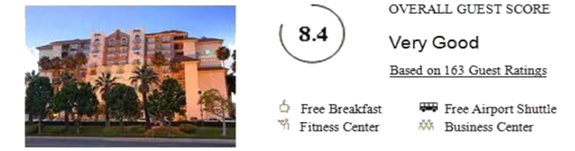
Hotel Description
Being close to the airport and freeway access make the Embassy Suites a top choice for our guests in the area. The 300-room Embassy Suites offers homey comforts for those on business and vacation alike-suites with separate living and sleeping areas, refrigerators, microwaves, coffeemakers, Wi-Fi access and two TVs. Wake up to a free cooked-to-order breakfast and enjoy the indoor pool and fitness center. A two-hour evening reception offers drinks and snacks and the on-site restaurant serves American favorites. The property also has a business center with copy and fax services. Parking is available for an additional fee. Less than two miles from I-405, the Embassy Suites is within a half-mile of various restaurants and just three miles from John Wayne Airport. Our guests say the Embassy Suites 'location, "brilliant" breakfast and "friendly" staff make it one of their favorite Santa Ana properties.
| Guest Ratings |
| Good Feb 8,2017 By: Harold Pros: Loved the breakfast and the friendly, helpful staff. Spacious accommodations made this a very good value. Cons: Didn't love the heating/AC system; room was too cold for comfort. Also was not aware of the parking fee until we checked in. The parking fee was $ 17 a night. |
| Good Jan 24,2017 By: Micaela Pros: Breakfast was amazing with a variety of choices and the staff were helpful. Cons: The room had a very strange old smell when we first got there. I had to open the door to air it out. Very Good Jan 5,2017 By: Bruce Pros: The location was very good for us and the included breakfast was a plus. Cons: The room was not cleaned properly when we got there. The heating system was not working for the hotel as well. |
-
(1) What makes the Embassy Suites a top choice for its guests in the area?A . The business center. B . The friendly staff. C . The convenient location. D . Wi-Fi access.
-
(2) According to the guest ratings, all the guests are satisfied with its .A . heating system B . free airport shuttle C . parking fee D . breakfast
-
(3) This advertisement is made more believable byA . using guests' comments B . interviewing the guests C . offering competitive prices D . providing the exact address
American children are still eating lots of fast food—and in spite of restaurants' promises of healthy options, most kids are sticking with fries over salads. Some infamous chains like McDonald's and Wendy's have promised to offer healthier options on their kid's menus, but they aren't all sticking it, according to a report from the Rudd Center.
In fact, nearly all parents are buying their kids at least one fast food meal a week. Healthy fruits and vegetables may be all the rage among adults, but busy parents still choose quick meals for themselves and their kids. It doesn't look like fast food is going away any time soon.
Scientists at the Rudd Center surveyed about 800 parents in 2010, then again in 2013 and 2016. Things have not improved much over the years. Of the vast majority of parents who had made a trip to McDonald's, Burger King, Wendy's or Subway in the last week, 74% ordered an unhealthy side or drink. The older the children, the more likely their parents were to choose fries instead of a fruit, or a similar less healthy menu item. And about 35% of parents ordered regular adult menu items for their 2 to 11-year-old children, meaning these kids were often getting larger, less nutritious lunches and dinners.
Even as they introduced options like fruit juices, low-fat milk and yogurt to their menus, some restaurants have also added desserts and other calorie-heavy options to their kids' menu items. So despite what's now on offer, kids are getting equally or less nutritious meals, nowadays, which is mostly because fast food restaurants still promote their unhealthy options, and sides like fries are still allowed.
"While most fast-food restaurants do have healthier kids' meal drinks and sides available, many do little to make parents aware of the healthier options or to encourage parents to choose the healthier options instead of unhealthy ones," said lead study author Jennifer Harris. "If restaurants are serious about children's health, they will make the healthiest choice and easiest for parents and the most appealing choice for children."
-
(1) What do the underlined words "all the rage" in Paragraph 2 mean?A . popular. B . necessary. C . potential. D . modern.
-
(2) Which of the following can summarize the parents surveyed in the report?A . Many parents like to eat in McDonald's. B . Many parents think eating fast food is healthy. C . Many parents tend to choose unhealthy food in their daily life. D . Many parents always ignore the healthy food in their daily life.
-
(3) What should kids avoid eating in fast-food restaurants?A . Fruits juices. B . Desserts. C . Low-fat milk. D . Yogurt.
-
(4) What does Jennifer Harris advise most fast-food restaurants to do?A . Offer healthier meals for kids. B . Take children's health seriously. C . Be honest about their business. D . Guide parents how to order a healthy meal.
Though I have twin sisters who are a year younger than I am, I still wanted one more guy in the house when I was 5 or 6. In 2002, my mom and dad went back to the adoption agency (收养机构) in Korea where they got my sisters and me. They came home with George.
He seemed fine at first. But six months later, when he was around l, my mom and dad told us George wouldn't grow up like us. They said George has autism (自闭症) and that he'd have more challenges. One day my parents brought home some sign-language videos. They said we were all going to learn signing together. That was when I knew George might never talk.
Living with George can be a roller coaster ride. He wants to play all the time, which makes him lovable. But he can be aggressive (有攻击性的). If he doesn't get what he wants, he throws a fit. When George acts like this at home, I take him to the couch or the floor and lie with him until he cools off. That's my role. I often have to hold him down when he loses control of himself. I'm the only one in myhome who isstrong enough to handle George physically at this point, which is difficult.
I thought having a brother would mean I'd have someone on my side all the time. I thought that if I had a fight with my sisters, I'd have him at my back. It didn't end up that way. But the people in your life are there for a reason. Having George in the family has made us all closer. He's not only a connection point, but a responsibility that we all share. It has taught us to compromise (妥协).
-
(1) What can we learn about the author's family?A . The family had their first child in 2002. B . The brothers and sisters have no blood relationship. C . There are five people in the family altogether. D . The family communicate with each other in sign language.
-
(2) The underlined part “throws a fit” in Paragraph 3 probably means“______.”A . gets very angry B . turns to others C . does it himself D . keeps silent
-
(3) We can infer from the last paragraph that______.A . George always supports the author B . George has learned to compromise C . the author loves George very much D . the author often fights with his sisters
Visa last year offered up to 50 small businesses a $ 10,000 reward to go cashless. Though it is still too early to know what will happen to the businesses that won the competition (Visa has not announced the winners yet) , the key arguments in favor of cash-abandonment are that it would lead to more efficient service and carry a lower risk of theft. A recent New York Times article covered restaurants in Manhattan that take plastic only, and supporters are looking forward to an entirely cashless society.
Doing away with cash may indeed sound appealing. Supporters often note that China and have already gone further in this direction than the United States. But a few drawbacks are obvious: Card companies such as Visa charge merchants high process fees, the risk of fraud balances out the lower risk of theft, older consumers may not wish to make the change, and consumers will lose yet more privacy (large companies will have the ability to track every purchase made). Perhaps the less obvious one is that a cashless system will exclude the poor and the near-poor, for many poor people don't have credit cards or bank accounts.
Conditions in the US are nowhere near suitable for entering a cashless society; too many people would be left behind. Your young friend may be happy to accept money via PayPal or another app, your cafe may use an iPad instead of a cash register,but landlords in low-income areas still prefer money orders. It's convenient for consumers to charge, say, an outing to the pail salon—but when you add the tip to your credit card bill, it may never make it to the worker.
-
(1) Why did Visa hold the competition?A . To support small businesses. B . To attract more card users. C . To promote cash-abandonment D . To reward successful businesses.
-
(2) What does the underlined phrase "take plastic" in the first paragraph most probably mean?A . Allow credit card payment. B . Use plastic bags. C . Let consumers pay in cash. D . Open bank accounts.
-
(3) Which is NOT the disadvantages of a cashless society according to the author?A . Merchants pay a lot of money for using credit cards. B . Consumers will not have their privacy protected. C . Poor people are not allowed to use credit cards. D . Consumers are likely to suffer financial losses due to fraud.
-
(4) Who would prefer to be paid in cash?A . A landlord in a developed area. B . A cafe owner. C . A young user of PayPal. D . A worker in a nail salon.
Tracking wildlife is a tough job. Take the case of a one-eared leopard named Pavarotti.
Kasim Rafiq, a wildlife biologist at Liverpool John Moores University. "So I used to get up at the crack of dawn, follow his tracks and try and find him. So one day, I went out, and I was looking for him. And his tracks took me off road through this woodland area.…and…"
Before he knew it, the wheel of his Land Rover was stuck in a deep hole. He wasted several hours getting it out. And then, on the way back to camp, he came across some local tour guides and their safari (观赏野兽的旅行) guests, who'd had way better luck spotting Pavarotti. "Basically, they laughed and they talked to me that they'd seen him that morning."
Rafiq then realized that tourist wildlife sightings might be an untapped source of information about wild animals.
So he and his team worked with a safari lodge in Botswana to analyze 25,000 tourist photographs of wildlife. They compared those data to the estimates they made with traditional wildlife biology methods.
It turned out that the estimates from tourists' photos were just as good as those gleaned (四处搜集) from traditional methods. And the tourists were actually the only ones to see elusive (难以捉摸的) leopards — the researchers would have missed the cats without the citizen science data. The results are in the journal Current Biology.
The idea is not to put wildlife researchers out of a job. "The reality is there are so many interesting things we still have to find out about these large carnivores (食肉动物) and so many conservation (保护) projects that need to be carried out that we don't have the time or resources to do them all." And tourist photos might help make sure that all the local carnivores are spotted.
Thanks for listening for Scientific American-60-Second Science. I'm Christopher Intagliata.
-
(1) What happened to Rafiq when he tracked Pavarotti?A . He was lost in the woods. B . He was trapped in a deep hole. C . He found Pavarotti with tourists' help. D . He met Pavarotti on the way back to camp.
-
(2) Why can biologists track animals from tourists' photographs?A . The photos are sources of information about wildlife. B . The photos are mirrors of the wildlife researchers' life. C . The photos taken by tourists are of high quality. D . The photos taken by tourists are especially beautiful.
-
(3) What can we infer from paragraph 6?A . The researchers have missed the data of cats. B . The information from tourists' photos was equally good. C . The value of tourist photos hasn't been proven. D . Only the traditional methods can track wildlife.
-
(4) Where can we find the article?A . On TV. B . In a magazine. C . On a radio. D . In a book.
The last time you got angry, did you stop and listen to what your mind was telling you?
Ryan Martin, psychology professor at the University of Wisconsin, Green Bay, has spent his career doing just that. It turns out, the thoughts that we have in response to the first flare (爆发) of anger are what can send us over the edge—or help us control the emotion for good, Martin says.
Despite the trouble that it can cause, anger is not actually bad for us. From an evolutionary perspective, it plays an important role in our survival, Martin says: "It helps alert us to the fact that we've been wronged." When your heart starts to pound and your face gets hot, that's anger increasing your blood flow in preparation for a showdown (决战). "It's our fight or flight response, used to energize us to deal with injustice," he explains.
Anger only becomes a problem when we can't manage it. Managing your anger, it turns out, is all about managing your thoughts. While anger may inform us of a threat—even if it's just to our reputation—it's the thoughts that determine how we respond. That's why strategies like cognitive behavioral therapy, which teach people healthier thought patterns, can be so successful.
Rather than ignore our anger, Martin wants us to see what our anger is telling us. If anger alerts us to possible injustice, for example, it's not helpful to simply dismiss it. "What I really want is for people to have accurate thoughts, thoughts that accurately reflect what's going on in the world around them," Martin says.
-
(1) What is the purpose of Paragraph 1?A . To introduce a topic. B . To raise a question. C . To make a comparison. D . To put forward an argument.
-
(2) What is the positive side of anger?A . It makes us full of energy. B . It urges us to fight with others. C . It warns us if we are treated unjustly. D . It helps us survive in a dangerous situation.
-
(3) What determine(s) our action when we are threatened?A . Our anger. B . Our thoughts. C . Our determination. D . Our strategies.
-
(4) According to Martin, what should we do when we are angry?A . Seek medical treatment. B . Simply ignore the anger. C . Focus on the world around us. D . Notice the message anger tells us.
Course Advisor 1 Education Sales Executive
Would you be interested in joining a supportive and friendly team with a shared passion for selling their exciting portfolio of courses?
The Organization:
It is an international network that offers a wide variety of programs, including bachelor's degree programs, master's degree programs, professional training, English Language training and corporate & executive education.
When someone chooses to study at one of their institutions—whether on campus in Europe, North America, or even in their own home they're joining a network of over 50,000 students worldwide.
The Role:
Course advisers are responsible for promoting the Company's program portfolio to potential students over the phone and via e-mail, forming a vital and integral part of the sales team. You will have a natural gift for sales and relationship-building, and a hunger to exceed (超出) targets and expectations.
Benefits:
The Company offers excellent opportunities for fast track career progression which is entirely performance driven. They reward top performers giving you the opportunity to earn as well as progress.
Requirements:
Please click on the APPLY button to send your CV and Cover Letter for this role. The Company is an equal opportunities employer and positively encourages applications from suitably qualified and eligible candidates regardless of sex, race, disability, age, or religion or belief. No record of crime is a must.
-
(1) What is one of the benefits of the courses mentioned in the passage?A . They are totally free of charge. B . They have optional campuses. C . They require high intelligence. D . They can be easily promoted.
-
(2) Top performers of the Company may have ________.A . a high salary B . a free tour abroad C . a holiday as a bonus D . a flat as a reward
-
(3) Who is the text intended for?A . Those who want to polish their English. B . Those who try to develop their programs. C . Those who need to advance their degrees. D . Those who are good at promoting products.
Sam was born with a bone disease. He has never walked. His bones are so fragile that they can break if he just coughs or sneezes.
When Sam was young, he was always breaking bones. He never liked fireworks. A sudden loud bang would scare him so much that he could break some bones. Sam's family had to learn how fragile he was. When he was a baby, it was very difficult for them.
No one knew much about what would happen to Sam. His friends grew taller, but he didn't. Sam didn't let how he looked worry him. "How we look on the outside," he said, "is only a small part of who we are."
Sam wanted to do everything that his friends did. Doctors put metal pins in his legs to make them stronger, but the pins didn't help him walk. So Sam needed wheelchairs. Sam had wheelchairs to take him to different places. He had some wheelchairs for going over sand and others that would take him over muddy, rocky places.
Once, Sam's wheelchair got stuck in some mud. There was no one around to help him, so he had to crawl home on his stomach.
Sam has been to many places in the world. He has been down rivers and in rainforests. If he couldn't get somewhere in his chair, people would carry him.
One day, when Sam was in the mountains, his wheelchair broke. He knew a lot about chairs, but he couldn't fix this one. Then, he had an idea. He would invent a new and different wheelchair. So Sam invented a chair that he can do everything in. Sam's wheelchair, the EZi-Riser, can go as high as a bench and as low as the ground. It can move around in small places. Now, many people around the world are using his wheelchair.
Sam will always be small. He will never be able to walk. But he says, "There is always a way to do everything. It may not be the way most people do things. It may take a while to work it out, but there is always a way."
-
(1) What can we learn about Sam?A . He grew taller than his friends. B . He was worried about how he looked on the outside. C . He liked playing with fireworks when he was young. D . He has had serious bone disease since he was born.
-
(2) Sam invented his own wheelchair because_________.A . his wheelchair got stuck in some mud B . his wheelchair broke while in the mountains C . he wanted to go down rivers and rainforests D . he intended to help more people in the world
-
(3) Which of the following words can best describe Sam?A . Helpful and honest. B . Careful and friendly. C . Strong-willed and creative. D . Warm-hearted and humorous.
Football T-shirts are more commonly connected with boys than girls. This can often cause a problem when you want to find a cool shirt for a girl. That is not to say that there are no cool shirts out there for girls to wear. The problem is that they are often harder to find than the ones for boys.
You can get custom (订制的) shirt printed for girls from a number of custom print stores. Of course you have to make sure that they are legally allowed to use the logos (商标) and colours of the team you want to support.
You can also go through official channels to get the shirt you want. The official channels will generally be the large sportswear stores or the official stores of the teams. These stores will be able to use the colours of the teams and even put the name of the person who the shirt is for on it.
If you do not feel like you have to try the T-shirts on, then an online store may be your best choice. The reason for this is that you can visit various stores and find the best ones.
If you want to see what the T-shirt looks like in real life, then going to a store is the best choice. Large sportswear stores often have football shirts. These are the best places to go if you do not live close to an official store. And these stores usually have lower prices than the official stores.
-
(1) According to the text, football T-shirts ________.A . are all made by boys B . are seldom loved by girls C . are only designed for boys D . are difficult to find for girls
-
(2) According to the text, custom print stores ________.A . could use any colours and logos as they like B . should be operated by the football teams C . could print anything that official stores sell D . should legally use your favourite logos
-
(3) What kind of readers is this passage for?A . Football players. B . Clothes store owners. C . Female football fans. D . Physical education teacher
Exciting Adventure Options to Choose From!
BIRD WALK(Any time of year)-Join us for a private bird walk through our sanctuary(保护区). The Bent's grasslands, trees and woods provide great habitat(栖息地)for birds moving from one place to another, such as Warblers, Vireos, Indigo Buntings, Thrushes, Orioles, and more. This walk will be made to the members in your party.
Suitable for ages 5 and up
Program Fee:$150
NATURE HIKE(Any time of year)-Take a private hike with Bent of the River! Your personal guide will show you notable habitats and wildlife around the center trails. Nature is exciting and always changing, so you never know what we will find along the way! This program is ideal for people who want to enjoy beautiful scenery while hiking.
Suitable for ages 8 and up
Program Fee:$150
POMPERAUG RIVER EXPLORATION(June and July only)-Many fascinating creatures live in and around the Pomperaug River! During this recreational(休闲的) program, an Audubon naturalist will share the human and natural history of the river and teach you how to catch fish and animals. The Bent will supply you with necessary tools, such as nets, containers, and field guides. Once the animals are caught, we will observe and identify(确定身份) them and learn how they can help show the health of the river before we put them back to the wild.
Suitable for ages 8 and up
Program Fee:$150
OWL PROWL(January and February only)-Enjoy a special guided adventure in search of one of the most beloved groups of birds-owls(猫头鹰)!We will be prowling for owls on a walk through the grassland and forests in hopes of seeing one of the three owl species known to live in Connecticut: the Great-horned Owl, Barred Owl, or Eastern Screech-Owl.
Evening event
Suitable for ages 10 and up
Program Fee:$225
-
(1) Which of the programs is suitable for the Browns with a girl of five years old?A . BIRD WALK. B . NATURE HIKE. C . POMPERAUG RIVER EXPLORATION. D . OWL PROWL.
-
(2) What will you do with the fish you catch in POMPERAUG RIVER EXPLORATION?A . Find out their health. B . Do a scientific research. C . Cook them as food on the table. D . Set them free back to the river.
-
(3) Whom is this text written for?A . Students. B . Teachers. C . Scientists. D . Adventurers.
Africa is a very diverse land with many different tribes. One tradition that many of these groups share is painting or marking their bodies and faces in color. They do this for many reasons. Some marks are used to identify people as part of the group. Other marks are used for ceremonies such as wedding and during times of war. Let's look at some different examples of body painting.
Red is a common color in body painting because it often represents health and long life. Among the Masai of East Africa, when men are old enough to marry and make decisions for their people, they participate in a special ceremony in which they paint their heads and faces red. This ceremony takes place every seven to fourteen years, so there is not an exact age for participating in it.
The Samburu, also from East Africa, like to paint their faces and hair red because they think it looks pretty.
The Masai men also have a unique way of showing that they are brave. To show that he has killed a lion, a man will paint his body with a natural white material, making special marks to represent this accomplishment. The Masai men also use this white to show that they are no longer boys and are considered adults.
One quite unusual example of face painting is done by the Wodaabe people of West Africa. Once a year, they have a beauty contest for men. The men paint their faces yellow and red. Then they add white and black circles and lines. Black paint is used near the eyes and on the lips to draw attention to the whiteness of their eyes and teeth, which the Wodaabe consider most beautiful. The women then decide which man they like best.
-
(1) How do some African groups recognize their people?A . By the color of the skin and hair. B . By the marks their parents give to them. C . By the different styles of their painting. D . By the different color in their faces or bodies.
-
(2) The Samburu paint their faces red in order to show .A . their braveness B . their growth C . their happiness D . their beauty
-
(3) What color will the Masai men use to show their achievement?A . White. B . Red. C . Yellow. D . Black.
-
(4) Who have the tradition of the beauty contest?A . The Masai people. B . The Wodaabe people. C . The Samburu people. D . The South African people.
The summer before my senior year of high school, I was eating in a cafeteria with some other high school students, and one girl asked me, "Do you live in a teepee(圆锥形帐篷)?" It was such a silly question that, at first, I thought she was joking! I said, "Are you serious?" She said, "Oh, wait, I'm sorry. Is that something I shouldn't ask?" She wasn't trying to be rude, so it didn't bother me. I just said, "No, I have a house with electricity and running water. I'm not disconnected from the world!" But the truth is, I did grow up differently.
I'm a Native American, and I'm from a reservation in California. A reservation is a place that's reserved for Native American tribes(部落) by the federal government.
People often have misconceptions about what living on a reservation means. In reality, though, my life probably looks a lot like yours. But there are ways that my life has been different. The reservation is an hour from town, and there's a big connection to the land. Our house is surrounded by a mountain, a river, and a farm. We have 23 animals including 10 chickens. It's not just for show! We collect eggs from the chickens, use manure(粪肥) from the animals to fertilise soil, and pick fruit and vegetables from our garden.
I've also learned how to hunt and fish. When hunting for deer, my tribe has two rules: ①Never shoot a female deer, because she might be pregnant; ②If you kill a deer, find a way to use all of it.
Going to college has been a big change for me. There were only 25 people in my graduating class, and now I go to school with thousands. On my reservation, I was surrounded mostly by Natives, and at college, the Native population is only 0.07%. It's intimidating but also exciting.
I'm studying to become a vet—there aren't any on my reservation. If an animal gets sick, we have to drive an hour to get them help. My goal is to open a veterinary clinic that will help my reservation develop.
-
(1) Why did the girl ask the author if he/she lived in a teepee?A . Because she was silly. B . Because she liked teepees. C . Because she was just curious. D . Because she was being rude to the author.
-
(2) Life on the reservation where the author grew up is .A . pretty hard B . very boring C . close to nature D . just like the city life
-
(3) What about the rules mentioned in paragraph 4?A . Quite eco-friendly. B . Frequently broken. C . Very unreasonable. D . Difficult to understand.
-
(4) What does the underlined word "intimidating" in paragraph 5 mean?A . Tiring. B . Annoying. C . Interesting. D . Frightening.

One reaction to all the concern about tropical deforestation(森林砍伐)is a blank stare that asks the question, "Since I don't live there, what does it have to do with me?"
The answer is that your way of life, wherever you live in the world, is tied to the tropics(热带地区) in many ways. If you live in a house, wash your hair, eat fruits and vegetables, drink soda, or drive a car, you can be certain that you are affected by the loss of tropical forests.
Biologically, we are losing the richest regions on earth when, each minute, a piece of tropical forest, the size of ten city blocks, disappears. As many as five million species of plants, animals, and insects (40 to 50 percent of all living things) live there, and are being lost faster than they can be found and described. Their loss is immeasurable(不可估量的).
Take rubber for example. For many uses, only natural rubber from trees will do. Synthetics are not good enough. Today over half the world's commercial rubber is produced in Malaysia and Indonesia, while the Amazon's rubber industry produces much of the world's four million tons. And rubber is an important material in making gloves, balloons, footwear(鞋类) and many sporting goods. Thousands of other tropical plants are valuable for their industrial use.
Many scientists strongly believe that deforestation contributes to the greenhouse effect—or heat of the earth from increased carbon dioxide(二氧化碳) in the atmosphere. As we destroy forests, we lose their ability to change carbon dioxide into oxygen.
Carbon dioxide levels could double within the next half-century, warming the earth by as much as 4.5 degrees. The result? Polar ice caps partially melt, raising sea levels as much as 24 feet; even 15 feet could threaten anyone living within 35 miles of the coast. Unbelievable? Maybe. But scientists warn that by the time we realize the serious effects of tropical deforestation, it will be 20 years late.
Can tropical deforestation affect our everyday life? Now, you should have got the answer.
-
(1) What does the underlined word "Synthetics" in Paragraph 4 probably mean?A . Natural rubber materials. B . Tropical materials. C . Man-made materials. D . Commercial rubber materials.
-
(2) In the last paragraph the author tries to .A . tell people how to avoid the tropical deforestation B . persuade people to buy something synthetic C . warn people of the disastrous results of tropical deforestation D . let people understand what tropical deforestation is
-
(3) What's the author's attitude towards the tropical deforestation?A . Neutral. B . Approving. C . Doubtful. D . Disapproving.
When Su Bingtian was first added to the track and field team of his junior high school, what he did most was not training or competing, but carrying bags for his senior teammates and watching them running.
Nobody, including Su himself, would believe the small boy could one day become the first Asian man to reach the 100m final at the World Championships, running side-to-side with the fastest sprinters in the world.
Born in a rural area in China's southeastern province of Guangdong, Su started training in athletics in 2003. After 12 years of fast progress, Su emerged from a bag-carrier to the fastest man in the world most populous country, breaking the national record after he clocked 9.99 seconds at the IAAF Diamond League Eugene leg on May 30. He is the first and only Chinese that have ever dipped under the 10-second barrier. He attributed such progress to a revolutionary technique change starting from last winter.
When Su first began to train in sprinting, he had been using his right foot to start off. But he always found his third step a little bit weak and unsteady which would affect his intermediate running and the whole rhythm. After consulting with his coach Yuan Guoqiang, China's first national record holder, Su has changed his way to start with his left foot going forward first.
"It was like a desperate gamble, a brand new start for me. I knew if it works I would find some room to improve, otherwise it could lead to the end of my career," Su said.
"To be honest, I am not fully prepared for such pressure and intensive media coverage. I will learn to deal with it as soon as possible. But training and competing will always be my priority," said a determined Su. "I hope my story can encourage those young people to believe that Chinese can also run fast. I do not think I am a hero. I am just a step-stone, like my coach Yuan, a step-stone to pave the way for more youngsters to push the speed limit for China."
-
(1) What does the second paragraph imply (暗示)?A . Su Bingtian has a gift for sprinting. B . Su Bingtian achieved success through hard work. C . Su Bingtian seems not be talented in sprinting in his youth. D . Su Bingtian ran the fastest in the world.
-
(2) What is likely the most important factor in Su's success?A . His competitive spirit B . His training strategy C . His family support D . His experience
-
(3) Which of the following best describes (描述) Su Bingtian?A . Determined and modest B . Ambitious and honest C . Competitive and desperate D . Popular and tough
-
(4) Why does Su call himself as "step-stone"?A . He hopes to inspire other young sprinters. B . He is not ready to be a champion. C . He feels regretful for the speed. D . He enjoys training and competing.
- 下图为某商品甲的价格走势图(X轴为时间,Y轴为价格,单位为“元/公斤”)。据此,下列说法正确的有 ①从A点到B点,甲商品
- 下图中AB弧是昏线,BC弧是晨线,据此回答下列各题。此时,下列四个城市中白天时间最长的是
- 质量均为m的A、B两物体分别在水平恒力F1和F2的作用下沿水平面运动,撤去F1、F2后受摩擦力的作用减速到停止,其V-t
- 英国哲学家怀特海在《科学与近代世界》一书中写道:“伽利略说地球是动的,太阳是固定的;宗教法庭则说地球是固定的,太阳是动的
- 网上有人拍卖一块以满、汉两种文字书写着“崇祯三年奉敕立石”的石碑。对于这块石碑,以下判断正确的是 A.明末郑成功部队开设
- 某同学利用光电门传感器设计了一个研究小物体自由下落时机械能是否守恒的实验,实验装置如图所示,图中A、B两位置分别固定了两
- 实验室加热固体制取氧气时,通常加入少量二氧化锰,其目的是.
- 给下面一段话加上标点符号(答案依次写在文后的横线上)。 语言是思维的工具。著名哲学家、物理学家爱因斯坦说__①__一个人
- ---Can you show me your headmaster's office? ---_____. But I
- 在Fe2(SO4)3溶液中,加入ag铜,完全溶解后,再加bg铁,充分反应后得到cg残余固体,且a>c,则下列说法正
- 降钙素是一种多肽类激素,临床上用于治疗骨质疏松症等。人的降钙素活性很低,半衰期较短。某科学机构为了研发一种活性高、半衰期
- 金属镍有广泛的用途。粗镍中含有少量Fe、Zn、Cu、Pt等杂质,可用电解法制备高纯度的镍,下列叙述正确的是(已知:氧化性
- 为研究某铁钉与浓硫酸反应生成气体Y的成分,某学习小组做出假设,认为所得气体中除含有SO2外,还可能含有H2和Q气体,并设
- 判断以,,,为顶点的四边形的形状,并说明理由.
- Children are natural scientists,very interested in the world
- 1938午9月21日,丘吉尔向伦敦新闻界发表声明说:“以为把一个小国投入虎口就可以得到安全,实在是致命的谬见。”这里所说
- 下列电池工作时能量转化形式与其他三个不同的是()
- Do you playbasketball ________ /'ɑ:ft/ school . A.afternoon
- 一做变速直线运动的物体,加速度逐渐减小,直到为零,则该物体的运动情况可能是:A.速度逐渐增大,加速度为零时速度最大
- 如图,在平行六面体ABCD—A1B1C1D1中,M为AC与BD的交点,若=a,=b,=c,则下列向量中与相等的向量是(


