科普类 知识点题库

Canada is one of the few1in the world to have two official languages:English and French. There are 10 provinces(省)in the country but only one of these-Quebec(魁北克)is known as "French Canada". This is because it was founded by French explorers while British CANADA adventurers discovered and governed the rest.
Canada left the British empire in 1867 to become an independent country,and English and French have been recognized as the official language ever since. Most people speak English as their first language and the two2television networks broadcast in English throughout the country. Apart from in Quebec and a few places on the east coast,French television is very rare.
The same goes3traffic signs and menus,for example,outside of Quebec,there are only a few places where you'll see traffic signs in French. And in restaurants. it's4impossible to find French on the menu unless you are in the heartland of French Canada. However,all products sold in Canada must,5 law,have labels and instructions in both languages.
In Canada's English-speaking provinces,official bilingualism(双语)means that students can6to complete a special French course. In this program,they are taught most of their subjects in French.
Have you ever had dreams about building a robot? Or putting together a spaceship? Or even seeing your face made out of chocolate? All you need is a 3-D printer!
The possibilities of 3-D printing seem endless. All the user has to do is to design an object on the computer and choose a material to print in. The printers print in hundreds of different materials including glass, sugar and even skin! When the user presses "print", the 3-D printer spreads the material layer (层) by layer and like magic the object is produced.
The first 3-D printer was invented in 1986 by an American, Charles Hull. But 3-D printing has only become cheap enough recently for most people to use.
Designers now use 3-D printing to create unusual things. The Dutch artist Dirk Vander Kooj prints furniture made from old fridges. And doctors have used 3-D printing to print human body parts! The Telegraph reported in February that scientists from Cornell Medical College even printed a man-made ear.
But like a lot of new technologies, if 3-D printing gets into the wrong hands, it can be dangerous. In 2011 a group of four men in the US used 3-D printing to produce ATM skimmers (提款机盗刷器). These were placed on an ATM and stole over $ 400,000 from users of the ATM. It is terrible to think that criminals like them might one day use a 3-D printer to print a gun.
But for better or for worse, 3-D printing has been put into use. In a few years, you'll probably be wondering how you could ever live without your 3-D printer!
-
(1) invented the first 3-D printer.A . Charles Hull B . Dirk Vander Kooj C . A doctor called Cornell D . Four men in the US
-
(2) What is the correct order for people to use a 3-D printer?
a. Choose a proper material. b. Press the print button.
c. The 3-D printer spreads the material. d. Use a computer to design an object.
A . abcd B . dabc C . acdb D . dcba -
(3) The underlined word "criminals" in the fourth paragraph might mean in Chinese.A . 技术员 B . 军人 C . 罪犯 D . 用户
-
(4) According to the passage, people have NOT yet produced with a 3-D printer.A . some furniture B . a man-made ear C . ATM skimmers D . a gun
-
(5) What does the writer think of the 3-D printer?A . It is necessary only for our work. B . It is helpful but dangerous. C . It is too expensive for most people. D . It is useless in our daily life.
Maybe your maths teacher has already taught you how to find the centre of a circle (圆).It isn't easy to learn and it takes some time to do so. Here's a simple idea. This idea can be easily learned in a few minutes.
Put a corner of a square piece of paper on the circumference (圆周) of a given circle, and you'll see the two sides of the piece of paper meet the circle. And then you'll get two points on the circumference. You may name them Point A and Point A. You may be sure that points A and B are the two ends of the diameter (直径).Draw a straight line through the two points A and B. Then do the same thing a second time in a different place to get another diameter. You'll find the centre at once: the two lines cross at a point and this point is just the centre of the circle.
How about trying to see if it is easy to learn and remember this simple idea of finding the centre of a circle?
-
(1) What should be put on the circumference of given circle if you use the above idea to find its centre?A . The corner of a square piece of paper. B . The two sides of a square piece of paper. C . The four corners of a square piece of paper. D . Two square pieces of paper.
-
(2) Which of the following is the right order to find the centre of a given circle?
a. Bring a square piece of paper.
b. Draw a straight line through the two points A and B.
c. Let the paper meet the circle, and then write down the two points A and
d. Do the same thing again in a different place.
e. The two diameters cross each other at a point.
f. Put the corner of the square piece of paper on the circumference of the circle.
A . a; b; c; e; d; f B . e; a; b; c; f; d C . a; b; f; d; c; e D . a; f; c; b; d; e -
(3) When you use this idea to find the centre of a given circle, you need .A . a pencil, a square piece of paper and a pair of compasses(圆规) B . a pair of compasses, a ruler and a square piece of paper C . a ruler, a pencil and a square piece of paper. D . nothing but a square piece of paper.
Spuddles are small funny creatures (生物) shaped (形状) like potatoes. They have one very sfeatures (特点): every time a baby spuddle is born, depending on what colour it is, the baby's parents grow a new arm of that scolour. That arm is the one the parents will use to look after that b.
One day a blue baby spuddle was born, b its parents didn't grow a blue arm. How could the parents care for their blue baby? They o had the green arm they had used for his elder sister.
The parents didn't know what to do, and they were afraid that their baby might d because they couldn't look after him. But the green brother and the pink sister went to their parents and oto share their special arms! The parents were happy. And from that day on t loved their generous (大方的) elder children even more.
And so much did they love their children, and so kind had the little green and pink spuddles been that the two children esoon grew an amazing multicoloured (彩色的) arm, which they could use to htheir parents care for the baby whenever they wanted.
Mouth is an important part of our body. When we eat food, talk with others, sing and smile, we use our mouth. Also, when learning English, we can find the word "mouth" in many sentences.
In everyday life, if someone says something bad about us, we can say "Do not bad mouth me" to talk back. Sometimes, if we say bad things that make others feel sad, we can say, "Sorry, I really put my foot in my mouth this time." We can also use "I am down in the mouth" to tell others our unhappiness. Sometimes when we talk with a friend and we have the same ideas with him, we can say, "You take the words right out of my mouth!" If some people have lots of money because of their rich families, in English, we can say, "They were born with a silver spoon in mouth." But a person who lives "from hand to mouth" is very poor and only has money to buy some cheapest things in need.
From the above examples, we can see that even the same English word can be used in different situations (情形)to tell others different feelings. English is a great language, isn't it?
-
(1) The writer tells us that we can find the word "_________", an important part of our body, in many sentences.A . nose B . face C . head D . mouth
-
(2) Lily feels_________ because after talking with her friends, she says, "I am down in the mouth."A . happy B . relaxed C . sad D . boring
-
(3) When we have the same idea with a friend, we can say, "_________".A . Do not bad mouth me B . I'm from hand to mouth C . I really put my foot in my mouth D . You take the words right out of my mouth
-
(4) According to the passage, there are_______ examples to show different situations with "mouth".A . five B . six C . seven D . eight
-
(5) The writer wants to tell us________.A . English is a useful language. B . We can use mouth to do many things. C . Mouth is an important part of our body. D . How people use the word "mouth" in different situations.
The Ministry of Industry and Information Technology has issued(颁发)commercial licenses(商用许可证) for 5G on June 6,2019,according to China Central Television.
Four major telecom carriers(电信运营商)- China Telecom, China Mobile, China Unicom and China Broadcasting Network-received the first batch of four 5G commercial licenses, said the report.
In May, Chinese companies own more than 30 percent of all essential patents(专利)relate to international standards for 5G, according to China Daily report.
The next-generation technology is expected to be at least 10 times faster than 4G, and its huge capacity(容量)to connect things will enable smart factories, self-driving vehicles and other ways, the report said.
China's big three telecom carriers are forecast(预计)to spend $134 billion to $223 billion) in total on 5G network construction(建设) from 2020 to 2025, according to a report from the China Academy of Information and Communications Technology.
China is set to become the world's largest 5G market by 2025, with 460 million 5G users, according to a forecast by the Global System for Mobile Communications Association, an industry group.
-
(1) How many 5G commercial licenses have been issued in China?A . One B . Three C . Four D . Five
-
(2) When licenses(商用许可证) for 5G?A . On May 15, 2018 B . On June 6, 2018 C . On May 15, 2019 D . On June 6, 2019
-
(3) "The next- generation tech" in Paragraph4 refers to(指的是) .A . 6G B . 5G C . small children D . young people
-
(4) What's the writer's purpose of writing this passage?A . To make people less interested in 5G. B . To explain why Chinese are so proud. C . To offer information on 4G network construction. D . To introduce China's new development of science and technology.
A kind of little cars may take the place of today's big ones many years later. If everyone drives such cars in the future, there will be less pollution in the air. There will also be more space for parking in cities, and the streets will be less crowded.
The little cars of the future will cost less. Driving will be safer, too, since these little cars can go only 65 kilometers an hour. The cars of the future will be fine for going around a city, but they will not be useful for a long way. Little cars will go 450 kilometers before they need to stop for more gasoline (汽油). If big cars are still used with the small ones, two kinds of roads will be needed in the future. Some roads will be needed for the big, faster cars and other roads will be needed for the small, slower ones.
-
(1) There is much pollution in the air today because __________.A . people drive big cars B . people drive little cars C . small cars will go 450 kilometers before they need to stop for more gasoline D . the usual size of cars today is too small
-
(2) The usual size of cars today is _________.A . much smaller than the future one B . as big as the future ones C . as small as the future ones D . bigger than the future ones
-
(3) Which of the following statements is NOT true?A . Big cars cost more. B . Big cars are not useful for a long way. C . The cars of the future will be smaller than today's ca rs. D . Small cars are slower than big ones.
-
(4) The streets will be less crowded because _________.A . there will be fewer cars in the future B . there will be fewer people in the streets C . three kinds of roads will be built D . future cars will be smaller
-
(5) Two kinds of roads will be needed in the future because________.A . there will be too many cars in the future B . more and more people will go to cities C . big cars run faster and little cars run slower D . it looks more beautiful to have two kinds of roads
"What's the name of the supermarket? I can't remember right now." Have you ever heard your grandparents ask questions like this sometimes? Usually, we think that older people's memory becomes bad because their brains get weak. But now a team of scientists at the University of Tubingen in Germany has a new idea. "The human brain works slower in old age," says Michael Ramscar, the team's lead scientist, "only because it has stored more information over time." The findings are based on a series of computer tests related to learning and memory.
Scientists had the computers read a certain amount of words and learn new things each day. When the computer "read" a small amount of data(数据),its performance on cognitive(认知)tests was similar to that of a young adult . But if the computer took in larger amounts of data, its performance was similar to that of an older adult. Often it was slower, but not because its processing ability had dropped. Rather, increased "experience" had caused the computer's database to grow, giving it more data to process-which takes more time. This is similar to how old people process information.
Imagine that one person knows just two people's birthdays and can get them right each time he or she is asked. Another person knows the birthdays of 2,000 people, but can only match the right person to the right birthday 9 times out of 10. Can you say the first person has a better memory than the second person?
"The larger the library you have in your head, the longer it usually takes to find a particular word," Benedict Carey, a science reporter for The New York Times, wrote in an article about the study.
-
(1) Why is the poor memory of elderly people mentioned at the beginning?A . To lead in the discussion of memory. B . To describe the way elderly people live. C . To express his or her care about the elderly. D . To draw the public attention to elderly people
-
(2) How did the scientists prove (论证)the new idea?A . By telling stories. B . By doing experiments. C . Be making surveys. D . By listing others' opinions.
-
(3) What does the underlined word "it" refer to?A . The data. B . The brain. C . The computer. D . The information.
-
(4) The example in Paragraph 3 shows ___________.A . Memorizing birthdays is easy B . the first person has a better memory C . Who has a better memory is uncertain D . the second person can memorize 10% birthdays
-
(5) What does the text mainly tell us ?A . How computers process data. B . How to improve the memory. C . Old people can remember things easily. D . Much information makes the brain slower.
①Animal behavior (行为) is an interesting and attractive study. Scientists research the ways animals use to look for food. They study how animals protect themselves from their predators, and which animals kill other animals for food. All of this helps us understand how useful animals can be.
②Each country or culture raises some animals for food. In the United States, people mainly eat meat from cows, chickens and pigs. In other countries, people might raise sheep or buffalo for meat. These differences come in part from weather and other environmental conditions, People around the world eat all kinds of fish and shellfish from oceans and rivers. In some countries, people don't always choose some animal groups, such as dogs, for food while in other countries such animals may become people's favorite food.
③ In West Africa, animals provide humans with more than food. They have been helping people do daily work for thousands of years. Horses, oxen, and other work animals pull heavy things. Elephants; camels; and other animals carry people and things from place to place. Carrier pigeons (信鸽) have been used to send messages.
④People also receive health benefits' (利益) from animals. For example, dogs and cats can help calm people down. This is helpful for people fighting illnesses. Animals can also reduce stress, helping people to draw their attention to learning new information, such as reading. When people are walking their dogs or horses, it encourages exercise.
⑤Animals and humans share space on Earth, so keeping a healthy relationship with animals, around us is in our best interest.
-
(1) What is the passage mainly about?A . Where animals live and how they look for food. B . The relationship between animals and humans. C . The different things animals can do in different countries. D . What humans should do when communicating with animals.
-
(2) The underlined word "predators" in Paragraph l probably means _____________.A . neighbours B . friends C . children D . enemies
-
(3) Which of the following is TRUE according to the passage?A . People around the world eat all kinds of fish. B . Horses are helpful for people fighting illnesses. C . Elephants encourage humans to do more exercise. D . Africans mainly eat meat from cows, chickens and pigs.
-
(4) Which of the following is the structure(结构)of the passage?A .
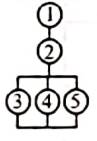 B .
B . 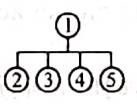 C .
C . 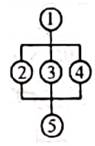 D .
D . 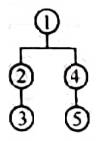
You may think of museums as dusty collections of old objects, but modern museums are different. They are landmarks and showcases of local culture, offering visitors insights (洞悉) into the past.
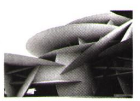
The National Museum of Qatar, which opened on March 28, 2019, is the latest example.
The building's interlocking structure of steel, glass and fiber concrete makes people think of the petals (花瓣) of a desert rose. These "roses" are actually crystallized (结晶的) sand, found just under the desert's surface. "It's surprisingly complex and poetic," the designer Nouvel told UK-based design magazine Dezeen.
This pioneering design also makes the building energy -efficient. They form a sunscreen and cast (投射) protective shadows when the sun hits the building from east or west. "I want to build a structure that keeps in line with the condition of the place, to ensure that it offers maximum (最大化的) protection from the sun and save energy," Nouvel said.
Apart from its unique shape, the museum also includes Qatar' s tradition of both nomads (游牧民) and fishermen. It's committed to preserving and showing the wooden dhows (阿拉伯三角帆船) that were once Doha's lifeblood. These boats enabled fishing, trading and the collection of precious pearls. And visitors can see over 1.5 million of them on the hand-embroidered Pearl Carpet of Baroda, the most extravagant (奢侈的) carpet ever, in the museum.
The museum also seeks to redefine(重新定义) the role of cultural institutions. It's hoped that visitors will not only observe the exhibitions but also immerse (沉浸) themselves in Qatar's history. For this purpose,it features a multilayered , 360-degree environment. For example, on the path to the Gallery of Life in Qatar, viewers see open markets, camels carrying goods, and wealthy pearl traders drinking tea and doing business.
"It creates a dialogue between the past and the future," according to a museum press release. "The scheme will give voice to Qatar's heritage (遗产) while celebrating its future."
-
(1) When did the National Museum of Qatar open?
-
(2) What does the National Museum of Qatar look like?
-
(3) Does the design make the building energy-efficient?
-
(4) Apart from its unique shape, what other features does the museum have?
-
(5) What does the writer think of the museum?
Recently, as more students use computers for a long time to have online lessons, more of them are feeling eyestrain(眼睛疲劳) Just a few hours in front of a computer screen can make a person's eyes feel tired and painful. A lot of eye doctors have studied this problem and have found ways to solve it. Following their advice will help keep computer users more comfortable.
★Lighting
The light in a room shouldn't be brighter than the computer screen itself. Maybe in many students' rooms, however, the lights are far brighter than they should be. Students can block some of this light by wearing baseball caps to protect their eyes.
★The Screen
A special computer screen which has less bright light should be used, because bright light is especially bad for the eyes. Another problem is to avoid the wrong kind of contrast (对比). Many people think that having light letters on a dark background can cause less eyestrain, but they are wrong. In fact, it is best to have dark letters on a light background.
★Angle (角度) of looking at the computer screen
Students should sit in front of the computers so that they are looking down at the computer screens. The top of the monitor(显示器) should not be so high as the top of a student 's head.
Breaks and Blinks (眨眼)
If students spend a long time in front of a computer screen, it can cause eyestrain. Students should take a break by looking away from the screen every fifteen or twenty minutes. During that time they should either close their eyes or look at things far away. Students should remember to open and close the eyes often while in front of the screen.
-
(1) The underlined word "block" in the passage means "___________" in Chinese.A . 阻挡 B . 接收 C . 反射
-
(2) According to the passage, _________ can cause less eyestrain.A . light letters on a light background B . light letters on a dark background C . dark letters on a light background
-
(3) The top of the monitor should ________ the top of a student's head.A . be higher than B . be lower than C . be as high as
-
(4) According to the passage, which of the following is TRUE?A . The light in a room should be brighter than the computer screen itself. B . Bright light isn't good for students' eyes. C . While using the computers, the students should close their eyes and look at things far away.
-
(5) The passage is mainly about ________.A . how to use computers correctly B . how to protect students' eyes while using computers C . students should take a break every 15 or 20 minutes while using computers
On December 17, 2020, China's Chang'e-5 safely returned to the earth. It brought back the country's first samples(样品) of (岩石) and soil it had collected from the moon.
Behind the (成功) of the moon mission(任务) was a team of great scientists. One of them is a young woman named Zhou Chengyu. 24-year-old Zhou has become both the (年轻的) and the first female space commander at the Wenchang Spacecraft Launch Site in Hainan Province.
Zhou's colleagues often call her "Big Sister." That's a sign of (尊重) for her. She has now taken part in five space missions. All of them (需要;要求) the highest level of professional knowledge. For the launch of Chang'e-5, Zhou was in charge of the rocket connector (系统). This was one of the most important roles in the mission.
The Chang'e-5 mission was named after the Chinese moon goddess. Therefore, many people found it fitting that a strong female figure had (获得) international attention. They have spoken highly of Zhou's achievements, regarding her as a role model for Chinese girls to look up to.
However, the young commander has shown no (兴趣) in fame. In fact. Zhou has (拒绝) many requests for interviews. She feels that they will only get in the way of her work.
Zhou's story gives an encouraging (启示): Girls are just as capable as boys in science or aerospace. They can do whatever boys can do.
|
A Fun Plant Experiment to Try at Homel! Without water, plants would die. Do you know how water gets from the roots of a plant to the rest of the plant? The water travels through tiny tubes that from pathways to all parts of the plant. This is similar to how blood flows in our bodies. And here is an experiment to prove it. Materials ●a celery stick ●a sharp knife ●a glass of water ●some red food colour ______ 1)Put a few drops of the red food colour in the glass of water. 2)Cut the bottom of the celery stick and place the celery in the water. 3)Leave the celery stick in the glass of water for several hours. 4)Remove the celery stick and cut it into pieces horizontally, that is, across the stem(茎). Observation Red food colour is present in all cross sections from the bottom of the celery stick right up to the leaves. Explanation The water, along with the red food colour, has been transported up the celery stick through the tiny tubes in it. The experiment, therefore, proves that tiny tubes in plants enable water to reach all parts of the plant. The red food colour shows where the water has travelled to in the celery stick. |
-
(1) The type of the text is ________.A . a review B . an advertisement C . a menu D . an instruction
-
(2) What best fits the blank?A . Form B . Schedule C . Steps D . Tips
-
(3) What do you observe when the celery stick is cut into cross sections?A . The inside of the celery stick is empty. B . The water in the glass has disappeared. C . The celery stick has become bigger. D . All the cross sections have become red.
-
(4) "Blood" in the bodies is compared to "________" in the plant.A . water B . the leaves C . the stem D . the root
-
(5) In the experiment, why is red food colour added to the water?A . It makes the celery stick look nicer. B . The water's path in a plant can be seen. C . The plant needs food colour to survive. D . It helps the plant to transport the water.
-
(6) The experiment aims to show ________.A . how to colour a stick of celery B . that plants would die without water C . how water travels through a plant D . that science experiments are fun to do
①Chemistry is everywhere in our daily life. Sometimes it's easy to see. At other times, it can be very hard to see the everyday chemistry at work, but nearly everything you touch has some chemicals(化学物质) in it.
②Chemistry helps to make products for use. Something as simple as toothpaste has at least three chemicals that keep your teeth clean. Other things in your daily life are created by chemistry, such as hair products and soap. Without chemistry, we would never have known that we need soap to get the oil out of clothes.
③Chemistry also helps us understand the world around us. Thanks to chemistry, we know bleach (漂白剂)can't be mixed with vinegar(醋), because the mixture can produce harmful gas.
④Chemistry plays a big role in food preparation. Cooking food causes it to go through a chemical change. That is why cooked food often tastes different from uncooked food. Too much or too little of any chemical material makes a difference to the result of baking(烘焙). For example, the cake can be too soft or too hard.
⑤Chemistry isn't something that just lives in a laboratory, it's something that you meet hundreds of times in life. Knowing how chemistry works will give you a greater understanding of the life.
-
(1) What can the chemicals in toothpaste help us?A . To keep the teeth clean. B . To make the teeth strong. C . To clean the oil off clothes. D . To make the clothes new.
-
(2) From the third paragraph, we know that________.A . we can mix bleach with vinegar B . the mixture can produce useful gas C . we can't mix bleach with vinegar D . chemistry can't help us make products
-
(3) Which of the following shows the structure of the passage? (①= Paragraph 1)A .
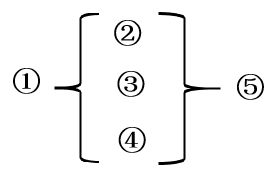 B .
B . 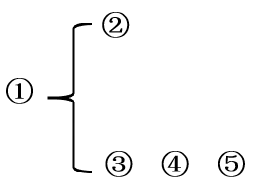 C .
C . 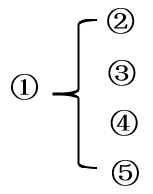 D .
D . 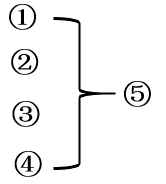
-
(4) What's the main idea of the passage?A . Chemistry and food. B . Chemistry around the world. C . Chemistry and products. D . Chemistry in everyday life.
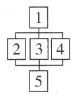
We like to believe that before we make a decision, most of the time, we take time to consider all the facts carefully. However, Experts believe that only 5 % of our decisions are based on a rational(理性的) thought process. So, what influences our decision-making process?
We often leave decision-making to our instincts(本能). Scientists have found out that if we had the choice, we like to avoid pain rather than get something. In fact, we're twice as happy when we try to avoid a bad situation than when we experience a good one. This is why when companies send ads, they use phrases like "How to avoid…", "Don't miss out!", etc.
There are also physical reasons that affect our decision-making. Psychologist (心理学家)John Bargh carried on an experiment where people were asked what they thought of a fictional person, while holding a cold or a hot cup of coffee. Those holding the hot cup believed the person to be warmer and more sociable than those holding the cold cup. So, when temperatures rise, the more likely we are to believe in strangers.
Stress is another thing which affects our decisions. Different situations are more or less stressful for different people. Researchers have found, though, that women are more conservative(保守的)about decisions when stressed, while men are to make riskier choices.
It may come as a surprise but every day from the minute we get up, we have to make countless decisions, like what to wear, what coffee to have and so on. Each choice makes our brain a little bit more tired, and this affects our decision-making. That's why important people, like presidents wear the same three suits all the time, wanting to limit the small choices and spend more brain power on the bigger ones.
-
(1) Which of the following shows the structure of the passage?A .
 B .
B . 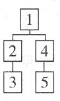 C .
C . 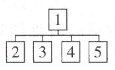 D .
D . 
-
(2) What is the main idea of the last paragraph?A . Every day we have to make lots of big decisions. B . People sometimes judge a person by what he wears. C . What people wear influences their decision-making. D . Making fewer decisions helps to save brain power.
-
(3) What can we learn from the passage?A . We make most of the decisions after our careful thinking. B . People are likely to be happier to avoid something bad. C . As the temperature is low, we are likely to believe in others. D . People usually have risky decisions under heavy pressure.
-
(4) The purpose of the passage is toA . tell us what influences decision-making B . advise people to make rational decisions C . warn people not to make risky decisions D . show disadvantages of rational decisions
In a small village, there is a house with 1, 000 mirrors(镜子).
A little dog learns about this place and plans to visit it one day. When he gets there, he is very happy and goes into the house. He looks into the mirrors with his ears up high and his tail wagging as fast as it can. It is strange for him to see 1, 000 other happy little dogs with their tails wagging just as fast as his. He smiles and 1, 000 great smiles smile back to him, they are warm and nice. As he leaves the house, he thinks to himself, "This is a good place. I will come back and visit it often. "
In this same village, there is another little dog who often gets angry. The dog wants to visit the house too. He goes into the house with his head down. When he sees 1, 000 angry dogs looking back at him, he growls at them and is afraid to see 1, 000 little dogs growling back at him. As he leaves, he thinks to himself:" What a terrible place. I will never go back there again. "
Mirrors can't change, but faces can. What kind of face do you have today?
-
(1) There are _________ mirrors in the house in the story.A . 100 B . 1, 000 C . 5, 000 D . 10, 000
-
(2) The first dog wants to visit the house again because _________.A . he likes the beautiful house B . he feels warm and nice there C . he wants to take the mirror home D . he wants to bring more friends
-
(3) What does the underlined word" terrible" mean in Paragraph 3?A . right B . high C . safe D . bad
-
(4) Which of the following is TRUE according to the passage?A . The second little dog is usually sad. B . There are many mirrors in a big village. C . The first little dog is happy to see the mirrors. D . The mirrors can often change to different faces.
-
(5) Which of the following can be the best title for the passage?A . A Sad Little Dog B . Face the World with a Smile C . A Happy Little Dog D . Strange Mirrors in the Village
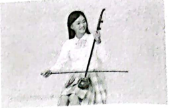
The erhu is a traditional Chinese musical instrument. It is the most popular of the huqin family. In the Song Dynasty, musicians began to use this type of huqin to perform different kinds of music, and it became quite a popular instrument. With the rise of some forms of folk art, the art of the erhu developed quickly during the Ming and Qing Dynasties. It became an important accompanying (伴奏) instrument in different folk music. Now it is used in both traditional and modern music. It has even become a solo (独奏的) instrument. One of the most famous musical pieces played on the erhu is Erquan Yingyue by Abing.
The erhu used to be mainly played by common people, As the playing skills were passed down by oral (口传) tradition, there are few written records about the erhu that can be found. To study the history and the development of the erhu, historians usually turn to ancient paintings, sculptures and murals (雕塑和璧画). The earliest pictures of this instrument were found in Yulin Caves and Eastern Thousand Buddha Caves in Gansu Province.
Because of so many people's effort, the erhu becomes more and more popular around the world. In fact, we can hear the familiar sound of the erhu in many Hollywood productions, such as Kungfu Panda in 2012 and most recently, the Oscar nominated(提名)film Up in the Air(《在云端》). When people watch these movies, they also enjoy the special music of the erhu. The erhu is also called "Chinese violin" by many westerners, but in many ways, they are quite different.
-
(1) What can we know from the first paragraph?A . Erhu is one of the instruments of huqin. B . Erhu became less popular during the Ming Dynasty. C . Erhu only widely used in traditional music.
-
(2) Why do historians do researches on ancient paintings, sculptures and murals?A . To find more written records about the erhu. B . To study the history and the development of the erhu. C . To make the art of the erhu passed down.
-
(3) In the writer's eyes, what is the most important for the development of the erhu music?A . Many people's hard work. B . Famous films made in Hollywood. C . The similar instrument violin.
-
(4) What's the purpose of the last paragraph?A . To give examples of famous erhu pieces. B . To compare the differences between the erhu and violin. C . To show the popularity of the use of the erhu music.
Tea and coffee are two of the most popular drinks in the world. However, people usually like one more than the other. These drinks also have very different uses.
Tea drinking started in China over 4,000 years ago. Tea is made from leaves. These days, some people drink tea for health, using it to help with stress(压力) or losing weight. However, most people in tea-drinking countries think of tea as more than just a healthy drink. In fact, tea drinking in some countries is a part of the culture. In Turkey(土耳其), tea is always there when people meet. Whether in someone's home or a company, tea is always offered as a way of welcoming. In the UK, homes and offices usually have tea time. Tea and other dishes are served at tea time in the afternoon. It is a way of relaxing with friends or co-workers(同事).
Coffee came much later than tea, just over 1,000 years ago. Coffee is made from beans. Something in the coffee beans makes a person feel active. Most people do not drink coffee to relax. Instead, they drink coffee to get going. Many people drink coffee in the morning to help them wake up. Others will also drink coffee during short breaks in the afternoon to keep going through the working day. Some people may visit coffee shops just to meet and talk with friends. However, many people in coffee shops drink coffee while working on their computers.
Is tea or coffee more common in your country? Between the two, which do you like to drink more?
-
(1) Where did tea drinking start?A . In Japan. B . In China. C . In Turkey. D . In the UK.
-
(2) We can learn from Paragraph 2 that people in the UK ______.A . drink tea to get fat B . offer tea to say goodbye C . think of tea as a bad drink D . have tea to relax themselves
-
(3) What is coffee made from?A . Leaves. B . Sugar. C . Dishes. D . Beans.
-
(4) Which of the following is NOT true according to Paragraph 3?A . Coffee came much earlier than tea. B . Many people drink coffee to wake up. C . Many people work on their computers in coffee shops. D . Some people meet and talk with friends in coffee shops.
-
(5) What is the best title of the passage?A . The Smells of Tea and Coffee B . The Prices of Tea and Coffee C . The Different Cultures of Tea and Coffee D . The Different Ways of Making Tea and Coffee
Dogs are the best pets of humans. They come in all sizes. Some dogs are as small as a football, and others are as tall as a desk. Dogs' fur(毛) is different, too. It can be long and soft, or smooth and hard. People don't mind the kind of fur, because all dogs are good to hug.
Dogs need to be taken care of. Short-haired dogs are the easiest to look after. But all dogs need a bath once in a while. Giving a dog a bath is a lot of fun. After you give a bath to your dog, it shakes the water off its body. Be careful, or you will get wet!
Dogs like to make their owners(主人) happy, so dogs are easy to train. They can follow simple orders.
Dogs are really amazing animals. Some dogs pull sleds(雪橇) across icy places. Some save people who fall into the river. Other dogs do tricks(表演绝技) in movies. A dog has even flown in a rocket(火箭) to space.
Why not keep a dog as a pet?
-
(1) Some dogs are a football, and others are as tall as a desk.
-
(2) People don't mind the kind of dogs' fur, because .
-
(3) When you finish giving a bath to your dog, it its body.
-
(4) Dogs like to make their owners happy, so dogs to train.
-
(5) The writer advises people to as a pet.
Each year the number of cars on roads and streets is becoming larger and larger. Millions of new cars are produced. One out of every six Americans works at putting together the parts of cars, driving trucks, building roads or filling cars with gas. Americans won't live without cars!
Most Americans find it hard to think what life would be without a car. However, some have realised the serious problem of air pollution caused by cars. The polluted air is poisonous and dangerous to health.
One way to reduce the polluted air is to build a new kind of car. Some large car factories are trying to do. But to build a clean car is easier said than done. It develops very slowly.
Another way is to take the place of the car engine (发动机) by something else. Engineers are now working on some new cars. It will take years to develop it.
To prevent the world from being polluted by cars, we'll have to make some changes in the way of life. Americans, for example, have to cut down the number of their cars. They are encouraged to travel and go to work by bike. Riding a bike is thought to help keep the air clean.
But this change does not come easily. A large number of workers may find themselves without jobs if a car factory closes down. And the problem of air pollution would become less important than that of unemployment (失业).
Although cars have brought us a better life, they have also brought us new problems.
-
(1) Which of the following is the most important transport in people's daily life in America today?A . A bus. B . A car. C . A motorcycle. D . A bicycle.
-
(2) Some large car factories in the USA are trying to build a new kind of car. The car .A . can clean itself B . is used to clean streets C . does not pollute the air D . is easier to make
-
(3) What's the most serious problem to American workers if the number of cars is cut down?A . They may have no work to do. B . The environment will be worse. C . The factories will be poorer. D . Many people will have to go to work by bike.
-
(4) The writer wants to tell us .A . man won't live without cars B . cutting down the number of cars is the best way C . riding a bike is the best way D . cars can bring us a better life but they can also bring us serious problems
-
(5) According to the passage, which of the following is TRUE?A . It isn't easy for Americans to change the way of life. B . Americans haven't realised the serious problem of air pollution caused by cars. C . The best way to reduce the polluted air is to build a new kind of car. D . Americans are encouraged to travel and go to work by car.
- 治淮是历届党和国家领导人的夙愿,新中国成立之初,我国就发出了“一定要把淮河治好”的号召。河南出山
- 将①、②两个植株杂交,得到③,将③再作进一步处理,如下图所示。下列分析错误的是()A.由③到④过程一定发生了等位基因分离
- 为迎接2014年8月即将召开的青奥会,响应“给力青奥,绿色出行”的号召,南京市投入使用了公共自行车. (1)自行车坐垫
- 下列化学用语表达正确的是 A.一氯乙烷的结构式为CH3Cl B.丁烷的结构简式为CH3(CH2
- 月色的朦胧、娇美曾引发历代文人雅士的无限遐想,“嫦娥奔月”便演绎了一则美妙的神话。从哲学上看,“嫦娥奔月”的神话故事
- 一种新型材料B4C,它可用于制作切削工具和高温热交换器。关于B4C的推断正确的是( ) A.B4C是一种分子晶
- 已知函数f(x)=x3-ax-1. (1)若f(x)在实数集R上单调递增,求a的取值范围; (2)是否存在实数a,使f(
- 拿破仑继承法国大革命初期的传统,废除雇佣兵制,代之以征兵制,该做法产生的影响是 A.法国军队的人数大大增加 B.士兵的来
- 一个正数的平方根为、,则=
- 全钒液流储能电池(VBR)广泛应用于风能、太阳能发电系统的储能系统。电池反应为VO2++V2++2H+
- 时期两宋 明清项目 50%以上的进士 43%的进士 任官前出身 平民 贫寒家庭 阅读下列根据《中国古代职官》编制的表格,
- 用托盘天平和量筒测量小石块的密度,天平平衡时,放在右盘中的砝码和游码在标尺上的位置,如图甲所示,则小石块质量是_____
- 材料一:2008年10月9日,央行公布的金融机构人民币存款基准利率调整表。 注:随着央行的再次降息,居民个人投资出
- 蛋白质是细胞膜的重要组成成分,下列不能体现膜蛋白功能的是( ) A.根细胞膜上的载体 B.A型血的人红细胞表面的凝
- 东莞在改革开放和社会主义现代化建设中,坚持从实际出发,走出了一条适合自己发展 的路子。这些成功的做法和经验,成为中国改革
- 如图甲所示,在一对平行光滑的金属导轨的上端连接一阻值为R=4 Ω的定值电阻,两导轨在同一平面内.质量为m=0.1 kg,
- 某种电缆在空中架设时,两端挂起的电缆下垂都近似成抛物线的形状,现按操作要求,电缆最低点离水平地面不得小于6米. (1)如
- 下面是美元对人民币汇率中间价简表,回答下面试题。日期 2008年6月16日 2009年6月15日 100美元兑人
- 无线通讯技术直接受惠于哪项理论成果( ) A.电磁波 B.电磁感应 C.电子计算机 D.电子
- 如图所示,已给出了入射光线和出射光线,请在方框内画出合适的透镜. .


