4.4.2 while循环的应用 知识点题库
Const n = 6
Dim a(1 To n) As Integer, f(1 To 10) As Boolean
Dim tmp As Integer, i As Integer, j As Integer, t As Integer
′f数组各元素的初值置为False,代码略
For i = 1 To 
t = Int(1+Rnd * 10)
If Not f(t) Then
a(i) = t : f(t) = True
For j =
If a(j) < a(j-1) Then
tmp = a(j): a(j) = a(j-1): a(j-1) = tmp
End If
Next j
Else
End If
Next i
上述程序段3个方框处的表达式分别为( )
m=5
sum=0
while m<10:
sum=sum+m
m=m+1
print(sum)
程序运行后输出的结果为:( )
x=0
while(x!=4): #当x=!4时,执行循环
print('1. 添加订单')
print('2. 发货')
print('3. 查看订单列表')
print('4. 退出')
x=int(input("输入你的选择:")) #输入选择项
if ① :
y=input("输入订单编号:") #输入订单编号
② #在列表listque中添加订单号
elif x==2:
③ #如果订单列表为空
print("订单列表为空")
else:
print("发货单号:"+listque.pop(0))
elif x==3:
print("等待发货:",listque) #查询列表listque中的订单号
print()
input("运行完毕,请按回车键退出...")
-
(1) 此列表,定义的是列表。(从“空、非空” 里选填)
-
(2) 补充划线处的内容。
① ② ③
i=1
s=1
while ① :
s=s*i
i+=2
print(s)
当输出结果为105时,则①处应填入( )
for i in range(1,5):
n=n*i
print(n)
程序运行后,其输出结果为
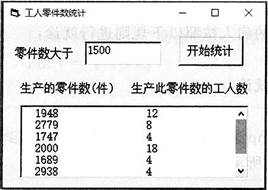
| 数组元素 | 数组元素的含义 |
| tj(1) | 存储查找到第1个大于da的零件数 |
| tj(2) | 存储生产了tj(1)个零件的工人数量 |
| … | |
| tj(2*i-1) | 存储查找到第i个大于da的零件数 |
| tj(2*i) | 存储生产了tj(i)个零件的工人数量 |
| … |
例如:tj(1)=1948,tj(2)=12。这对数据的含义为:共有12个工人生产了1948个零件。
实现以上功能的VB程序如下,请回答下列问题:
-
(1) 根据程序运行界面的数据及数组tj中各元素的含义进行分析,数组元素tj(8)的值是(填数值)。
-
(2) 请在画线处填入合适的代码。
Private Sub Command1_Click( )
Dim bf(1 To 1000)As Integer
Dim maxn, d, k, sa As Integer
Dim I, j, flag As Integer
da=Val(Text1.Text):maxn=0:k=1
For j=1 To n
If xs(j)>=da Then maxn=maxn+1
bf(maxn)=xs(j)
Next j
For i=1 To maxn
flag=0
For j=1 To i-1
If bf(i)=bf(j) Then flag=1
Next j
If flag=0 Then
①
d=1
For j=i+1 To maxn
If bf(i)=bf(j) Then ②
Next j
tj(2*k)=d
k=k+1
End If
Next i
k=k-1
For j=1 To ③
List1. Addltem Str(tj(j))+" "+Str(tj(j+1))
Next j
End Sub
以上程序段运行时,为了实现上述功能,画线处应填入的代码分别为:①;②;③。
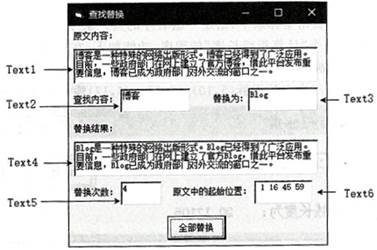
实现上述功能的VB程序如下,但加框处代码有误,请改正。
Private Sub Command1_Click( )
Dim s As String,result As String,pos As String
Dim count As Integer,i As Integer
i=1:count=0
result="":pos=""
Do While i<=Len(Text1.Text)
s=Mid(Text1.Text,i,Len(Text2.Text))
If s=Text2.Text Then
result=result+Text3.Text
count=count+1
pos=  ‘①
‘①
i=i+Len(Text2.Text)
Else
 ‘②
‘②
i=i+1
End If
Loop
Text4.Text=result
Text5.Text=Str(count)
Text6.Text=pos
End Sub
以上程序段运行时,为了实现上述功能,加框处代码应改正为:①;②。
string-input("输入字符串:")
c=1
p=1
while p <= len(string)-1:
if ①
c+= 1
else:
s += str(c)+string[p-1]
②
p+=1
print("压缩后数据为:" ,s)
-
(1) 请在程序划线处填入代码。
① ②
-
(2) 小钱运行程序后结果出错,如图所示,请帮他修改代码并说明原因。
错误结果
修改代码并说明原因
输入字符串:RRRRRGGBBBBBB
压缩后数据为: 5R2G
-
(3) 将上述while语句改写为for语句。
如字符串“ABDAC”与字符串“AABCD”可以归为同一类,与“AABBC”不可以归为同一类。图图编写了一VB程序,功能如下:在文本框Text1中输入字符串s1,在文本框Text2中输入字符串s2,单击“判断”按钮Command1,在标签Label1中显示是否可以归为同一类的结果。部分运行界面如图所示。
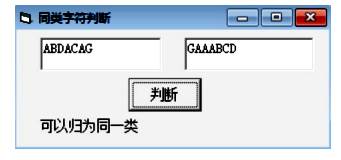
请回答下列问题:
-
(1) 要使窗体的标题栏文字显示为“同类字符判断”,则应设置窗体的 属性(单选,填字母:A .Text / B .Name /C .Caption)。
-
(2) 实现上述功能的 VB 程序如下,请在划线处填入合适的代码。
Private Sub Command1_Click()
Dim a(1 To 100) As Boolean
Dim i As Integer, j As Integer
Dim flag As Boolean
s1 = Text1.Text
s2 = Text2.Text
flag = True
For i = 1 To Len(s2)
Next i
If Len(s1) <> Len(s2) Then
flag = False
Else
For i = 1 To Len(s1)
c =
j = 1
Do While j <= Len(s2)
If
 Then
Thena(j) = False
Exit Do
End If
Loop
If j = Len(s2) + 1 Then flag = False
Next i
End If
If flag Then
Label1.Caption = "可以归为同一类"
Else
Label1.Caption = "不可归为同一类"
End If
End Sub
-
(3) 程序中加框处代码有错,请改正。
S=0
For i=1 To 14
x=2*i-1
If x Mod 3 =0 Then s=s+1
Next i
For A=1 To 200 Step 4
S=S+A:
Next A
Print S
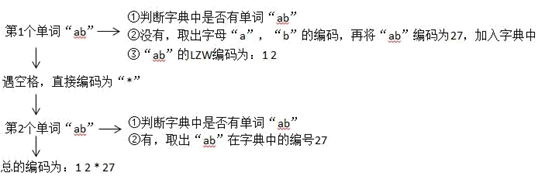
1)初始时,建立一个空字典,把26个小写字母加入字典中。26个小写英文字母编码为1-26,字母“a”的编码为1,字母“b”的编码为2,其它字母的编码依次增加。
2)从字符串第一个位置开始扫描,若遇到空格(空格用“*”表示),则得到一个单词,截取该单词并存入变量中。
3)若该单词在字典中,则取出该单词在字典中的编码值;否则,依次取出该单词中各字母在字典中的编码值,(编码值之间用一个空格分隔),同时产生该单词的编码(编码为字典中的最大编码值加1),加入字典中。
4)继续扫描字符串,截取单词,并按照步骤(3)的方法进行处理,直至整个字符串编码完毕。字符串“abab”LZW编码过程如图所示。
-
(1) 如果字符串为“ab bb bb”,则其LZW编码为。
-
(2) 请在划线处填入合适的代码。
Dim pos As Integer, a(1 To 100)As String
Private Sub Form_Load( )
'将字母“a”至“z”依次存入数组元素a(1)到a(26)
End Sub
Function judge(ss As String) As Integer '判断字典中是否有ss这个单词
Dim i As Integer judge = 0
For i = 27 To pos
If a(i) =Then judge = i
Exit For
End If
Next i
End Function
Private Sub Command1_Click( )
Dim s As String, i As Integer, j As Integer, k As Integer, ch As String, word As String, result As String, Dim id As Integer, idletter As Integer
s = Text1.Text pos = 26: i = 1
Do While i <= Len(s)
j = i
Do While Mid(s, j, 1) <> " " j = j + 1
If j > Len(s) Then Exit Do
Loop
word = Mid(s, i, j - i)
If Len(word) = 1 Then '单个字母的单词
result = result + Str(Asc(word) -Asc("a") + 1)
Else
id = judge(word)
If id = 0 Then '新的单词
For k = 1 To Len(word) '依次处理该单词中的各个字母编码
ch = Mid(word, k, 1)
Next k
pos = pos + 1 '对该单词编码
a(pos) = word
Else '词典中存在该单词
result = result + Str(id) End If
End If
If j < Len(s) Then result = result + " *"
Loop
Text2.Text = result
End Sub
-
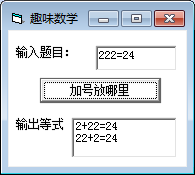
(1) 标题要显示“趣味数学”,需修改窗体的属性。
-
(2) 实现上述功能的VB程序如下,请在程序划线处填入合适代码。
Private Sub Command1_Click()
Dim s As String, s1 As String, s2 As String
Dim c As Integer, k As Integer, i As Integer, flag As Boolean
flag = False
s = Text1.Text
For c = 1 To Len(s)
If Then Exit For 'Exit for退出循环
Next c
s1 = Mid(s, 1, c - 1)
s2 = Mid(s, c + 1,len(s)-c)
k =
For i = 1 To k - 1
If Val(Mid(s1, 1, i)) + Val(Mid(s1, i + 1,c-i-1)) = Val(s2) Then
List1.AddItem Mid(s, 1, i) + "+" + Mid(s, i + 1,len(s)-i)
End If
Next i
If Not flag Then List1.AddItem "等式始终无法成立!"
End Sub
s=1
i=1
while i<=5:
s=s*i
i=i+1
print(s)
x=int(input("Enter a number: "))
s=
fori in range(1,x+1):
if ==0:
s=
print(s)
ma=a[0];mb=a[0];pa=0;pb=0
for i in range(1,10):
if ma < a[i]:ma = a[i];pa=i
if mb > a[i]:mb = a[i];pb=i
下列关于该程序段功能描述正确的是( )
Dim xm(1 to 1000) as string '存储学生姓名
Dim cj(1 to 1000) as integer '存储学生成绩
Private Sub Form_Load() '该处具体代码省略
'从数据库读取两批学生数据第1批学生的人数rs1,按成绩从高到低的顺序将成绩存入cj(1)、cj(2)…cj(rs1)中,姓名存入xm(1)、xm(2)…xm(rs1)中,第2批人数rs2,按成绩从高到低的顺序将成绩存入cj(rs1+1)、cj(rs1+2)…cj(rs1+rs2)中,姓名存入xm(rs1+1)、xm(rs1+2)…xm(rs1+rs2)中
End Sub
Private Sub Command1_Click()
i=1
j=rs1+1
'以下程序开始按成绩高低逐个输出,每次输出前后两段中,尚未处理的学生中成绩最高的n=1 '①
Do While i<=rs1 And j<=rs1+rs2 '两段都有未输出的情况,输出两段中最大值
n=n+1
If cj(i)>=cj(j) Then
k=i:i=i+1
Else
k=j: j=j+1
End If
List1.AddItem(″第″+Str(n)+″名″+xm(k)+″成绩:″+Str(cj(k)))
Loop
Do While i<=rs1 '剩下第一段还有未输出的,逐个输出
n=n+1
List1.AddItem(″第″+Str(n)+″名″+xm(i)+″成绩:″+Str(cj(i)))
i=i+1
Loop
Do While j<=rs2 '②若第二段还有未输出的,逐个输出
n=n+1
List1.AddItem(″第″+Str(n)+″名″+xm(j)+″成绩:″+Str(cj(j)))
j=j+1
Loop
End Sub
① ②
n=int(input(“n=”))
s=0
for i in range(2, n):
if n%i==0:
s=
if :
print(n,“是素数”)
else:
print(n,“不是素数”)
n =357859604
Do While n>0
c=n Mod 10
If c>5 Then c=5
count (c) = count(c) + 1
n=n\10
Loop
数组元素count (0)到count (9)的初始值均为0,执行该程序段后,则count (5)的值为( )
- 明末清初学者唐甄在《潜书》中说:“两千年来皇帝皆盗贼。”唐甄这种政治思想反映的社会现实是 ①封建制度日趋腐朽
- 1.下列各句中加横线成语的使用,全部正确的一项是( )①要知道生之可贵,但不可苟且偷安。要知道死不足惧,但不轻易
- 基因D、d和T、t是位于两对同源染色体上的等位基因,在不同情况下,下列叙述符合因果关系的是 A.进行独立遗传的DDTT和
- 某溶液可能含有Cl-、SO42-、CO32-、NH4+、Fe3+、Al3+和K+。取该溶液200 mL,加入过量NaOH
- America’s First Black President Ten-year-old Barack Obama
- 下列词语中加点的字,注音有错误的一项是( ) A.璀璨(càn) 憧(chōng)憬 饮鸩(zhèn)止渴 B.凝
- 下列物质中,不属于高分子化合物的是( ) A.淀粉 B.油脂 C
- The villagers foodfor the soldiers. A.providedB.supp
- 喷泉广场上组合喷泉的喷嘴竖直向上。某一喷嘴喷出水的流量Q=300 L/min,水的流速v0=20 m/s。不计空气阻力,
- 经过磋商和沟通,包括中国在内的29个国家共同签署了“莫斯科宣言”,各国将通过法律禁止本国航空公司参与欧盟碳排放交易体系,
- 如图,在四边形中,点是线段上的任意一点(与不重合),分别是的中点.(1)试判断四边形的形状并说明理由;(2)在(1)的条
- 下列有关实验操作、现象和解释或结论都正确的是选项 实验操作 现象 解释或结论 A 过量的Fe粉中加入稀HNO3,充分反应
- p{font-size:10.5pt;line-height:150%;margin:0;padding:0;}td{f
- 造化钟神秀,_________________。(杜甫《望岳》
- 下列叙述不正确的( ) A. 金属材料分为黑色金属材料和有色金属材料 B. 活泼金属在空气中易与氧气反应,表面生成一层氧
- 阅读下面的文字,完成下列各题(9分,每小题3分) 科学家们在对科学界的一个奇怪的“左侧现象”进行研究时,偶然发现
- 近代某条约规定:英人华民交涉词讼,英人如何科罪,应由英国议定章程、法律,发给管事官照办。当时作为清朝谈判大臣的耆英得意洋
- 已知是圆心在坐标原点的单位圆上的两点,分别位于第一象限和第四象限,且点的纵坐标为,点的横坐标为,则=
- 我国山区面积广大,下列关于如何实现山区社会、经济和生态可持续发展的叙述,错误的是( ) A.山区风景秀丽,
- 下列划线词语解释全部正确的一组是( ) (2分) A.有仙则名(出名)是马也,虽有千里之能(虽


