本单元综合与测试 知识点题库
— Yes, sure. We are in ________ agreement.
He said he didn't want to his teachers and parents.
A little girl was born in a very poor family. Her name was Wilma Rudolph. When she was four years old, she had pneumonia(肺炎) and it left her with a paralyzed(瘫痪的) left leg. She had to wear an iron leg brace(支架). Her mother told her that she could do whatever she wanted to do.
So at the age of nine, the little girl took off the leg brace, and she tried her best to walk. In four years, she could walk for some steps, which was a medical wonder. Then this girl had a dream that she would like to be the world's greatest woman runner.
At the age of 13, she entered every race in high school, and in every race she came in last. Everyone asked her to stop! And then there came a day when she won a race. From then on, she won every race that she entered.
She went to university, where she met a coach. The coach trained her so well that she went to the Olympic Games. She went to her first Olympic Games when she was sixteen years old. There she was racing against the greatest woman runner of the day, a German girl named Jutta Heine. Nobody had ever beaten Jutta. But in the 100-meter race, she won. She beat Jutta again in the 200-meter race. She had two Olympic gold medals.
Finally came the 400-meter relay(接力赛). It would be Wilma against Jutta once again. When the third runner handed the baton(接力棒) to Wilma, she was so excited that she dropped it. It was impossible that anybody could catch Jutta. But Wilma did just that! Wilma had earned three Olympic gold medals.
They called her “the Black Pearl”. Wilma Rudolph received a lot of attention from the public, but she did not forget her teammates. She said that her favorite event was the relay, because she could share the victory with her teammates.
-
(1) What happened to Wilma Rudolph when she was four years old?A . She had a bad cold. B . She had a terrible illness and couldn't walk. C . An accident claimed his left leg. D . She had pneumonia and it left her with a paralyzed left leg.
-
(2) How did Wilma's mother encourage her daughter?A . By taking her to many hospitals. B . By telling her to do whatever she wanted to do. C . By teaching her to walk carefully. D . By talking to her a lot.
-
(3) When did Wilma take off the leg brace and try to walk?A . At the age of 9. B . In high school. C . At the age of 16. D . In the university.
-
(4) Wilma won the 400-meter relay very easily in the Olympic Games,didn't she?A . Yes, she did. B . No, she did. C . No, she didn't. D . Yes, she didn't.
-
(5) What do you learn from Wilma's success story?A . Without teammates she couldn't get success. B . Where there is a will, there is a way. C . Unable man must make success. D . The reason why Wilma Rudolph was called “the Black Pearl”.
-
(1) What does the girl want to do?A . Change her job. B . Live with her friends. C . Leave the city.
-
(2) What is the girl's father's idea?A . He aggress with her. B . He disagrees with her. C . He misses her.
Have you found this? Sometimes, on grey, rainy days, your mood level is lower than on bright, sunny days. Is this a coincidence(巧合), or is there some science behind this? Would you like to know more about how the weather can affect how you feel?
According to a recent study, there is a connection between weather and moods. Going to a warm place in the middle of winter can make our moods better. Pleasant weather has been proved to improve moods and memory. However, extremely hot weather can actually make us feel more tired and bored, spoiling our moods.
In the study, people who spent time outdoors in warm weather were happier than those who spent all day inside.
The best temperature for humans is about 22.2℃. That explains why people in southern California are happy all the time. To improve his or her moods, a person must spend at least 30 minutes outside in warm, sunny weather. Spending time indoors when the weather outside is so nice tends to lower moods.
Maybe just the activities connected with being outside affect our moods. Warm weather is connected with the beach, fun outdoor sports and so on. It brings back childhood memories of playing outside all day. Who doesn't love that?
Of course, we can wake up every day and decide how we will feel that day. If it's rainy, that won't necessarily make us unhappy. We'll just have to bring our umbrellas out and cheer up those who are feeling sad!
-
(1) According to the study, we may feel on extremely hot days.A . happier B . more bored C . more excited D . more pleased
-
(2) Warm weather can help improve our moods and according to the passage.A . sight B . memory C . height D . hearing
-
(3) Why are people in southern California happy all the time?A . Because the weather there is always cold. B . Because people there don't like doing sports. C . Because the temperature there is the best for humans. D . Because the weather there is extremely hot all the year round.
-
(4) What is the best title for the passage?A . Rainy Days Make Us Sad B . The Best Temperature for Humans C . Go Outside on Sunny Days D . How the Weather Affects Our Moods
Half a year ago, I took part in an English (演讲) competition. The experience taught me how important it is to stay calm and (做) myself.
When it was my time to give the speech, I became very (紧张). I could even feel my heart beating very fast. A girl beside me noticed how I was feeling. With a smile she said, "Come on, just be yourself." "But, " I said, "all the speakers here are much better than me and I don't think I can beat (他们)." "So what?" she shouted. "You haven't even tried. So how do you know you're a loser?"
Yes, maybe she's right. I took a deep (呼吸) and stepped onto the stage to begin my speech. Everything seemed to go (顺利地) while suddenly I stopped. My mind went completely black. I just stand there (没有) saying a word.
"What should I do?" I asked myself. "Run away or continue?" Just then, the girl's words came back to me. "Be yourself." Yes, she is right. Her words gave me (勇气). I can't give up. I won't let her(失望).
Then I went on with the (剩余) of my speech with a cheerful voice. Little by little, the audience seemed to be interested in my story. My speech turned into an easy chat. I had found myself again.
-
(1) Why didn't Lucy want to stay in the Rock Club?A . Because she didn't like music. B . Because the loud music made her bored. C . Because the loud music made her tense.
-
(2) What did Nancy eat in the Blue Moon Restaurant?A . Noodles. B . Ice cream. C . Sandwiches.
-
(3) What kind of movie did they see?A . A comedy. B . A thriller. C . A documentary.
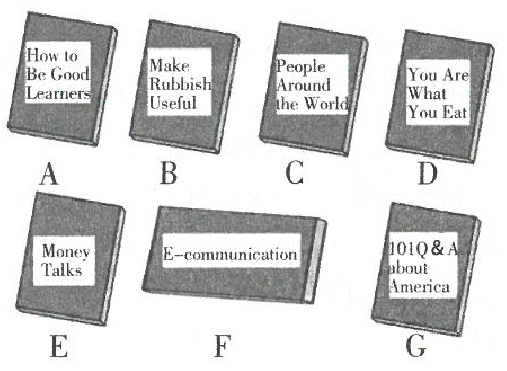
-
(1) Today people write to, even talk to others on the computer. Nancy wants to learn more about it.
-
(2) Mary is a good mother. She believes eating proper food is important. She likes to help her children grow better with proper food.
-
(3) Jack often sits at the desk studying all night, but he still gets poor grades. He hopes to do better in the tests.
-
(4) Bob's sister wants him to move to New York. But he isn't sure whether that is a good idea. He needs to know more about the country.
-
(5) Jenny is confused because there are too many used plastic bags and old newspapers at home. She doesn't know what to do with them.
Peter was the best table tennis player in his school and hardly ever lost a match. He hated losing anything. When he (win), he would feel really good. If he lost, he would feel terrible. It seemed to Peter that losing was the (bad) thing in the world.
A new kid, Albert, came to Peter's school. He was good at table tennis, too. Soon there would be a match Peter and Albert. Peter worked hard to get ready for the match, but Albert didn't seem (think) much of it. When the match began, Albert was a real player. There was always a smile on his face, while Peter looked serious all the time. Peter thought it was so important to win the match he even wanted to cheat(作弊), but he lost in the end.
"You played very well, Peter. I think we can play again sometime," said Albert. But Peter didn't feel happy and couldn't fall (sleep) that night.
One day, Peter saw Albert playing basketball. he lost again and again, the happy smile never left his face. Peter found Albert was great at table tennis, but bad at basketball. However, he enjoyed of them.
Whether he won or lost the game, Albert enjoyed it. Peter came to realize that enjoying a game was much more important than winning or (lose) it. He felt (happy) than ever before.
要点:1)What's the thing? 2)When,where and how did it happen? 3)How did it make you feel? 4. What did you learn from the thing?
要求:不少于100词,可适当发挥。
- 水生植物丽藻的细胞液中K+浓度比它们生活的池水高1065倍,丽藻细胞对K+的吸收必须具备哪些基本条件?( )①载体
- 在动物进化的历程中,从水生的无脊椎动物发展到了原始的节肢动物,可以充分说明动物的进化( ) A.从简单到复杂
- (9分)如图,在中,是边上的一点,是的中点,过点作的平行线交的延长线于,且,连结.(1)求证:是的中点;(2)如果,试猜
- 如图所示,一个理想变压器,O点为副线圈的中心轴头,电路中的两个电阻的大小相同。设开关K闭合前后原线圈的电流分别为I1和I
- 据不完全统计,从1689年到1839年,清朝官方正式记载的涉外司法诉讼约有39起,这些案件多数由中国政府依照本国法律审理
- 2.已知神经细胞膜两侧离子分布不平衡是一种常态现象,细胞不受刺激时,膜外有较多的正电荷,而膜内相反,如右图所示。如果在电
- (10分)下列物质中:⑴Na ⑵ Br2 ⑶NaCl溶液 ⑷CO2 ⑸蔗糖 ⑹NH3 ⑺Na2O ⑻
- 2007年1月29日新华社受权全文播发《中共中央国务院关于积极发展现代农业扎实推进社会主义新农村建设的若干意见》。这一重
- 草履虫体内既含DNA,又含RNA.将草履虫体内的遗传物质彻底水解可以得到() A.一种五碳糖 B.
- There’s talk today about how as a society we’ve become separ
- 已知集合M={x|x<3},N={x|log2x>1},则M∩N= ( ) A.
- 铁锈的主要成分是 (写化学式).将一根生锈的铁钉 插入足量的稀硫酸中,首先看到、,反应方程式为 ,一段时间后,又看到,反
- 在平直的公路上,自行车与同方向行驶的一辆汽车同时经过某一路标,它们的位移x(m)随时间t(s)的变化规律为:汽车x=3
- 图是制作临时装片的步骤,正确顺序是( ) A、 ①②③④⑤⑥ B、 ②③⑥④⑤①C、 ④②①③⑤
- 下图为利用生物技术获得生物新品种的过程.据图回答:(1) 在基因工程中.A→B为____________技术。利用的原理
- 光纤通信发展很快,全世界总量超过1亿千米。我国在这方面起步并不算晚,1995年一年铺设了130万千米,全国已形成八横八纵
- 小明用甲图所示的装置探究“水沸腾规律”。 请回答下列问题: (1)实验中观察到水沸腾的现象是
- 如图4-12所示,在O点正下方有一个有理想边界的磁场,铜摆在A点由静止释放向右摆至最高点B.不考虑空气阻力,则下列说法正
- 方程2|x|+x=2的实根的个数是________.
- 下列关于无氧呼吸的叙述中,不正确的是() A. 无氧呼吸过程释放的能量少 B. 无氧呼吸的场


