高三英语试题
In the 1600's when the Spanish moved into what later was to become the southwestern United States, they came across the ancestors of the modern-day Pueblo, Hopi, and Zuni peoples. These ancestors, known variously as the basket makers, the Ancient ones, had lived in the area for at least 2000 years. They were an advanced agricultura people who used irrigation to help grow their drops.
The Anasazi lived in houses constructed of earth and wood. Anasazi houses were originally built underground and were entered from the roof. But around the year 700 A. D., the Anasazi began to build their homes above ground and join them together into multistoried complexes, which the Spanish called villages. Separate underground rooms in these villages—known as kivas or holy places—were set aside for religious ceremonies. Each kiva had a fireplace and a hole that was believed to lead to the underworld. The largest villages had five stories and more than 800 rooms.
The Anasazi family was ruled by women. The sacred objects of the family were under the control of the oldest female, but the actual ceremonies were conducted by her brother or son. Women owned the rooms in the village and the crops, once they were harvested. While still growing, crops belonged to the men who, in contrast to most other Native American groups, planted them. The women made baskets and pottery; the men wove cloth and made jewelry.
Each village had two chiefs. The village chief dealt with land arguments and religious affairs. The war chief led the men in fighting during occasional conflicts that broke out with neithboring villages and directed the men in commnity building projects. The political and social organization of the Anasazi made it almost impossible for outer groups to conquer them.
-
(1) The Anasazi people were considered agriculturally advanced because of the way they ______ .A . stored their crops B . harvested their crops C . watered their crops D . planted their fields
-
(2) Who would have been most likely to control the sacred objects of an Anasazi family?A . A 20- year – old man B . A 20- year – old woman C . A 50- year – old man D . A 50- year – old woman
-
(3) What can we infer from the passage?A . The presence of the Spanish destroyed Anasazi society. B . The Anasazi benefited from trading relations with the Spanish. C . Anasazi society exhibited a clear division of labor. D . Conflicts between neighboring Anasazi villages were easily solved.
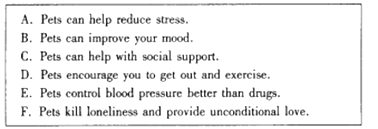
Research shows that pets help reduce stress.Do you know why and how?
For those who love animals, it's virtually impossible to stay in a bad mood when a pair of loving puppy eyes meets yours, or when a super - soft cat rubs up against your head. Research supports the mood - enhancing benefits of pets.A recent study found that men with AIDS were less likely to suffer from depression if they owned a pet. According to a study, men with AIDS who had pets were only about 50 percent more likely to report symptoms of depression, compared to men with (AIDS who didn't have pets.)
While ACE inhibiting drugs can generally reduce blood pressure, they aren't as effective on controlling spikes in blood pressure due to stress and tension.However, in a recent study, a group of patients who got dogs or cats were found to have lower blood pressure and haut rates than those having no pets.When they heard of the results, most of those in the non - pet group went out and got pets !
Whether we walk our dogs because they need it, or are more likely to enjoy a walk when we have companionship, dog owners do spend more time walking than non - pet owners, at least if we live in an urban setting.Because exercise is good for stress management and overall health, owning a dog can be credited with increasing these benefits.
When we're out walking, having a dog with us can make us more approachable and pave people a reason to stop and talk, thereby increasing the number of people we meet, giving us an pop corduroy to increase our net - work of friends and acquaintances, which also has great stress management benefits.
Peels can be there for you in ways that people can't.They can offer love and companionship, and can also enjoy comfortable silence, keep secrets and are excellent companions.And they could be the best killer to loneliness.In fact, research shows that nursing home residents reported less loneliness when visited by dogs than when they spent time with other people ! All these benefits can reduce the amount of stress people experience in response to feelings of social isolation and lack of social support from people.
简要描述事情的经过 | 打篮球、碰撞、争执,等等 |
分析发生冲突的原因 | |
1). 遇事不够冷静 | |
2). …… | |
谈谈避免冲突的做法 | (请考生根据自己的经历或感想,提出至少两种做法) |
注意:1. 对所有要点逐一陈述,适当发挥,不要简单翻译。2. 词数150 左右。 开头已经写好,不计入总词数。3. 作文中不得提及有关考生个人身份的任何信息,如校名、人名等。
Conflicts with others are common in everyday life.
Kunta wondered why the white people had done this to him. Born a free man, he was now in chains. Heavy iron chains around his feet and hands were fixed to a metal bar that ran round the hall about ten centimeters off the ground. He was just able to lie down on the ground, but could not stand up.
Kunta had been seized in the forest and then hit on the head with a hard object. When he woke up, his hands and feet had already been tied together. What shocked him most was that the men who carried him were black. He reasoned with them, and tried to persuade them to set him free. But they would not listen to him. When they came to the river, a white man was waiting in the boat for them. There was an argument about money, so it seemed, in a language that Kunta did not understand. Finally, Kunta was thrown into the bottom of the boat and covered with an old smelly cloth. The men took him in their boat to the castle on the coast where he was now held prisoner.
Another thing which shocked Kunta was that women were held in the castle too. He could hear their crying, also children's voices. What was to become of them all, he wondered. For all his life, he had known that people suddenly disappeared from their villages. He had known that it was not safe to travel alone in the forest near the coast. But why did white people want to catch Africans and put them in chains? Would they be killed or even eaten? The situation seemed hopeless and he knew his life was in danger.
Worse was to come. A few days later about 140 black people were taken and put on a tall sailing ship waiting off the coast. Once on the boat, they were taken below and their chains were fixed to two bars that ran the length of the ship. Their feet were fixed to one bar and their hands to another bar. Thus they lay on hard wooden boards, unable to stand up or move around.
The sea journey lasted over sixty days and nights. They had rough weather and Kunta's back bled from rolling over on the hard wooden boards. Many of the men fell sick with fever. They sighed and cried out for more water, but food and water were only given out once a day. Once in a while sailors came down, Kunta thought, to carry sick men upstairs for treatment. When the ship finally arrived in a port, the wooden cover was opened wide and Kunta could see in daylight for the first time across the part of the ship where he had been chained. About a third of the people who had been chained up below at the beginning of the journey were missing.
-
(1) Where was Kunta seized?A . In the forest. B . In the bush. C . On the shore. D . In the castle.
-
(2) Why was Kunta caught by the black people?A . He would be made a servant. B . He would be sold for money. C . He would be used to work on the farm. D . The white people forced them to.
-
(3) Which of the following is NOT TRUE?A . The castle on the coast was used for a place where black people were held prisoners. B . Women and children were also caught to have more slaves. C . The sea journey was about two months. D . Only one third of the people were still alive at the end of the journey.
-
(4) What happened to the sick people who were carried upstairs?A . Many people were dead. B . Many people escaped. C . Many people were saved. D . Many people were set free.
—Yes,and what a pity!It will be a long time ________ we see each other again.
— It was on the very farm ___ we once worked.
People do not analyze every problem they meet.Sometimes they try to remember a solution from the last time they had a1problem.They often accept the opinions or ideas of other people.Other times they begin to act without 2; they try to find a solution by trial and error.However, when all of these methods 3, the person with a problem has to start analyzing.There are six 4 in analyzing a problem.
First the person must recognize that there is a problem.For example, Sam's bicycle is broken, and he cannot ride it to class as he usually does.Sam must 5that there is a problem with his bicycle.
Next the person must 6 the problem.Before Sam can repair his bicycle, he must know why it does not work.For example, he must 7 the parts that are wrong.
Now the person must look for 8that will make the problem clearer and lead to9 solutions.For example, suppose Sam 10 that his bike does not work because there is something wrong with the brakes.At this time, he can look in his bicycle repair book and read about brakes, talk to his friends at the bike shop, or look at his brakes carefully.
After 11 the problem, the person should have 12 suggestions for a possible solution.Take Sam as an example 13, his suggestions might be: tighten or loosen the brakes, buy new brakes and change the old ones.
In the end, one 14 seems to be the solution 15 the problem.Sometimes the16idea comes quite 17because the thinker suddenly sees something new or sees something in a 18way.Sam, for example, suddenly sees there is a piece of chewing gum stuck to a brake.He immediately hits on the solution to his problem: he must 19the brake.
Finally the solution is 20.Sam does it and finds his bicycle works perfectly.In short, he has solved the problem.
—Sooner or later he will be fired by the employer.
Absence
If a student is absent, parents are asked to contact the school and report that absence. Simply ring the school and you will be directed to the absence phone system. You should then give the name of the student and their tutor teacher.
Attendance
School hours are 08:35 to 15:00. If a student is late, they must sign in at the Student Office.
School times are as follows: Monday, Tuesday, Thursday and Friday.
08:35 - 09:35 Period 1
09:35 - 10:35 Period 2
10:35 - 10:50 Tutor Time
10:50 - 11:10 Interval
11:10 - 12:05 Period 3
12:05 - 13:00 Period 4
13:00 - 13.45 Lunch
13:45 - 14:05 School-wide reading
14:05 - 15:00 Period 5
Wednesday Only
09:00 - 09:55 Period 1
09:55 - 10:50 Period 2
Rest of the times are the same as for the other days.
Cellphones
The current cell phone policy is that, although permitted at school, they must not be used or turned on during class time.
-
(1) If a student is absent, ______ should call the school and report the absence.A . the student's parents B . the student himself C . the student's tutor D . the student's teacher
-
(2) The school doesn't have Tutor Time ______.A . on Monday and Friday B . on Tuesday C . on Thursday D . on Wednesday
-
(3) Students can use their cell phones at ______ every day.A . 09:00 B . 10:00 C . 11:00 D . 12:00
-
(4) Which of the following is true?A . When you report an absence, you speak directly to the Student Office. B . You are not late if you go to your classroom at 8 o'clock on Thursday. C . You must ring the school if you are late. D . Wednesday afternoon is free.
- (1) 为了探索弹力和弹簧伸长量的关系,李卫同学选了甲、乙两根规格不同的弹簧进行测试,根据测得的数据绘出如图所示图象。
- 11.繁华的上海在旧中国有一段被殖民侵略的辛酸历史。上海被辟为通商口岸与下列哪一个不平等条约有关系( ) A
- 科学家发现由C60制取的化合物M有抑制艾滋病毒的作用,下列叙述不正确的是【 】 A.厦大化学家制得了C50,它与C
- 下列说法正确的是() A.活化分子间的碰撞一定发生化学反应 B.吸热反应只有加热才能发生 C.有能量变化的一定是化学反应
- On May 5,2005,at ___World Table Tennis Championship ,Kong Li
- 下列标志既是轴对称图形又是中心对称图形的是( ) A B
- Wanna hear a joke? This nifty(俏皮的) little robot’sgot a few--
- 在一真空密闭容器中,通入一定量气体A在一定条件下,发生如下反应:2A(g) B(g) + xC(g),反应达平衡时,测
- 下面是一肽链结构示意图,下列有关叙述不正确的是 A.该肽链由4种氨基酸脱水缩合而成 B.图中含有的R基是②④⑥⑧
- 如图所示,把重20N的物体以v=0.3m/s的速度匀速向上提起,弹簧测力计的示数为12N,若不计绳重及磨擦,则绳端移动的
- 过点A(-2,4)引倾斜角为135°的直线l交抛物线y2=2px(p>0)于P1、P2两点,若|AP1|、|P1P2|、
- 1975年,访问法国时指出:“中国是坚决支持西欧联合的。我们认为,西欧国家为维护独立和保证自己的安全,在联合的道路上不断
- 如图直线l1//l2,AB⊥CD,∠1=34°,那么∠2的度数是 .
- --____have you stayed in New York? --For about two weeks .A.
- Heseems _________ because he passes the test. A.happy
- (08广州模拟)在25℃时将pH=11 的NaOH 溶液与pH=3 的CH3COOH溶掖等体积混合后,下列关系式中正确的
- 曾经有人把工业用盐,如亚硝酸钠(NaNO2)误作食盐,用于烹调,引发中毒事件。在亚硝酸钠中氮元素的化合价是 A.-3价
- 人在发高烧时,常常不思饮食,其根本原因是() A.消化道内的食物尚未消化 B.发
- 探究下表中的奥妙,填空并完成下列题目 一元二次方程 两个根 二次三项式因式分解 1.如果一元二次方程()有解为,请你把二
- 玉门,一个因油而生的城市,现在又要因油而痛。这里是诞生中国第一口油井的地方,这里是诞生中国第一个油田的地方,这里是诞生中


