期末专区(九年级上) 知识点题库
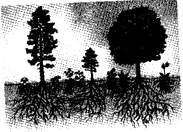
Would it surprise you to learn that, like animals, trees can communicate with each other and pass on their wealth to the next generation--their young trees?
Suzanne Simard, forest ecologist at the University of British Columbia, explains how trees are much more complex than most of us ever imagined. Simard and her colleagues have made the major discovery that trees and plants really do communicate and interact with each other.
Trees live on through their group work and support, passing around the resources such as nitrogen and carbon “depending on who needs it by miles of underground fungi(真菌) networks. This makes sure that all trees in the forest ecological system give and receive just the right amount to keep them all healthy. This system works in a very similar way to the networks of neurons(神经元) in our brains, and when one tree is cut down, it affects all.
Simard talks about "Mother Trees". These are the largest, oldest trees that rise above the forest, a concept explained in the movie Avatar. These “Mother Trees" are connected to all the other trees in the forest by this network of fungi, and may manage the resources of the whole trees and plants in the forest. She explains how these trees pass on the wealth to the next generation, transporting important resources to young trees so they may continue to grow. When humans cut down "Mother Trees" without paying attention to these highly complex "tree societies” or the networks on which they feed, we are losing the chances to save the whole forest.
"We didn't take any notice of it,” Simard says sadly. “Mother Trees move nutrition into the young trees before dying, but we never give them a chance.” If we could send this message to the forestry industry, we could make a huge difference towards our environmental protection efforts for the future.
-
(1) Trees can share resources with other ones by .A . the help from animals B . underground fungi networks C . the communication with people D . neurons in the system of brains
-
(2) "Mother Trees" are very important because they .
A . bring wealth to the scientists B . pass on nutrition to young trees C . get more from the complex “tree societies” D . seem more likely to be cut down by humans -
(3) The underlined word “it” in the last paragraph refers to .A . how trees grow old B . how "tree societies" work C . how young trees are saved D . how forestry industry develops
-
(4) What would be the best title for the passage?A . Trees Are Rich in Resources B . Trees Are Good for Our Society C . Trees Are in Need of Protection D . Trees Are More Complex Than We Think
Hearing is very important to all of us. We can hear beautiful music, nice songs of birds, the laughter of people or other different (kind) of sounds in the world with our ears. How (wonder) it is to have a good hearing! So we must try to protect our ears. The following will tell you to protect ears.
It's reported that (listen) to loud music a lot can be bad for ears, especially when headphones (耳机) (use). So turn them down when you're wearing headphones try not to wear them. You should let your ears have rest if you really like wearing them. If you are going to a concert, wear earplugs(耳塞)to protect your ears the terrible music! In fact, earplugs are special can be made for you if you go to concerts a lot or if you are a musician yourself. If your ears hurt, it's necessary(see) a doctor. Follow the advice above and you won't be saying "What?" when you are getting old.
 B .
B .  C .
C . 

Brian was a 9-year-old boy from a small village. He got very pleased knowing that he was accepted by a very famous school in a city.
Today was his first day of school. When seeing his simple clothes and knowing that he came from a small village, other students started making fun of him. The teacher soon arrived and asked everyone to keep quiet. She introduced Brian to the class and told them that he would study with them from that day on.
Then the teacher told the students to be ready for the surprise test. She told everyone to write down the Seven Wonders of the world. Everyone started to write their answers quickly. Only Brian thought for a while, then began to write. After everyone handed in their answer papers, the teacher started to read everyone's answer and most of the students answered correctly. Their answers included the Great Wall of China, Great Pyramid(金字塔塔), Taj Mahal(泰姬陵) and so on.
The teacher was happy as the students still remembered what she had taught them. In the end, she picked up Brian's paper and started reading, "The seven wonders are-to be able to see, to be able to hear, to be able to feel, to laugh, to think, to be kind and to love!"
The teacher stood there without any word and the whole class was in silence. Today, the boy from a small village reminded them about the valuable gifts that God has given them, which are true wonders.
-
(1) —Why did the other students make fun of Brian?
—Because of his ______.
A . Pronunciation B . mistakes C . carelessness D . clothes -
(2) Who introduced Brian to the whole class?A . A classmate. B . His parents. C . The teacher. D . His friend.
-
(3) The students were asked to be ready for ______.A . the surprise test B . the ball game C . the new lesson D . the class meeting
-
(4) In Brian's opinion, the true wonders are ______.A . the gifts that God has given us B . the wealth that people have made C . the buildings that people have built D . the inventions that scientists have invented
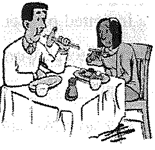
Welcome to our charming city, Ningbo and you will surely have a great time here. Probably you will come across some culture differences, especially the table manners. While having meals, the main difference on the Chinese dinner table is chopsticks instead of a knife and fork, but that's only superficial (表面的) -Besides, in the more upscale (高级的) restaurants, you can always ask for a knife and fork, if you find the chopsticks unavailable. The real difference is that in the West, you have your own plate of food, while in China the dishes are placed on the table and everyone shares. If you are being treated to a formal dinner and particularly if the host thinks you're in the country for the first time, he will do the best to give you a taste of as many different types of dishes as possible.
The meal usually begins with a set of at least four cold dishes, to be followed by the main courses of hot meat and vegetable dishes. Soup then will be served (unless in Guangdong style restaurants) to be followed by staple food (主食) ranging from rice, noodles to dumplings. If you wish to have your rice to go with other dishes, you should say so beforehand提前) ,as most of the Chinese prefer to have the staple food at the end of the meal or have none of at all.
Perhaps one of the things that surprises Western visitors most is that some of the Chinese hosts like to put food onto the plates of their guests. At formal dinners, there are always "serving" chopsticks and spoons for this purpose, but some hosts may use their own chopsticks. This should be taken as a sign of true friendship and politeness.
It is always poise to eat the food. If you do not want to eat it, just leave the food on the plate.
People in China tend to over-order food, as it is embarrassing to the host if all the food is finished.
When you have had enough, just say no. Or you will find yourself always overeating!
-
(1) The passage above mainly tells about culture differences in .A . table manners B . cooking dishes C . serving guests D . making friends
-
(2) The food at a Chinese home will be served in the order of .
a. a set of four cold dishes
b. staple food, such as rice noodle or dumplings
c. the main courses of hot meat and vegetable dishes
d. serving soup
A . acbd B . cabd C . acdb D . cadb -
(3) What may surprise the western visitors most is that .A . Chinese hosts like to over-order the food B . there are few serving chopsticks and spoons C . Chinese hosts like to leave food on the table D . Chinese hosts often put food onto their guests' plates
-
(4) This article is probably written for .A . Chinese hosts B . Ningbo family C . western visitors D . culture researchers
-
(1) How old is the girl?A . Fifteen. B . Sixteen. C . Seventeen.
-
(2) What does the girl think of the study of English?A . She thinks English is very interesting to learn. B . She thinks English is very easy to learn. C . She thinks English is very hard to learn.
-
(3) What does the girl enjoy most?A . Practicing singing songs. B . Listening to the radio. C . Talking with foreigners.
Courtesy in English
Courtesy(礼貌) is an art form that shows our moral character. China's history is one of a civilization(文明) with a highly developed sense of etiquette(礼仪); therefore, we should speak English as politely as possible when we go abroad.
Being polite when you ask for something is very important. Beginning your request with "May I...?""Could I...?" is considered polite. For example, "May I have a latte". It is also politer to say "I'll have..." or "I'd like..." instead of "I want...". Because it will be considered less direct.
We should say "Excuse me" or "Do you mind if I ask you something?" We should not ask our questions directly. Instead, for example, we should say "Could you tell me where the restrooms are?"
Local people in other communities sometimes speak really fast, so it can be hard for us to catch all the words. In such a situation, we can say "Pardon me?" to ask them to repeat what they said. In my opinion, saying "Can you please repeat that? I didn't follow" is the politest way.
It is also important to know how to refuse someone's invitation. If we really can't make it, we can first say "I'd like to." and then say "but l have to work late" for example. Or "I'm afraid I can't" or even "That sounds great, but ...".
We can use sentences like "I see what you're saying, but I think..."or "You could be right, but don't forget that..."or even "Yes, that's true, but I'm not sure that...".These are great ways to express disagreement politely by being less direct.
A. Refusing an invitation.
B. "Please" and "thank you" go along way when we speak to each other.
C. Asking for help.
D. Ordering meals.
E. Expressing disagreement.
F. Can't catch what's been said?
Twenty-two-year- old Sarah James went hiking with her dog, Duke, in Banff National Park, Canada. She was walking along the side of a deep valley (山谷) when she1. She hurt herself badly in the fall, breaking her left leg.
Sarah tried to stay2, telling herself that she would be saved soon. She shouted for help more loudly than she had ever shouted before, but it was no 3. She was trapped(受困), more than forty kilometers from the nearest town. Duke stood above her, barking4. He tried over and over again, 5he couldn't climb down to be with her.
That night was too cold for Sarah to go to sleep, she stayed6and worried. Duke was worried too. Two days later, at noon, she realized her only7 was to get Duke to go for help. She8instructions up to him and with a comforting bark, he ran off. 9Duke was hungry and thirsty. He walked for twenty kilometers and saw no one. Could he find anyone to help Sarah?
On the fourth day, Sarah drank the last of her water and cried. She was sure she was going to 10. But somehow she found herself still alive the next morning. A few hours later she heard a 11"woof". "That must be Duke", she cried and12 to see Duke standing above her! He wasn't by himself. He had found a couple who were on holiday from Japan. He13on the man's trouser leg and ran forwards and backwards until they followed him.
The couple gave Sarah water and called for help. Duke couldn't follow Sarah to the14, but the Japanese couple 15 him until he could be with Sarah again! That must be an indelible memory of life.
- 完形填空 (共20 小题,每小题1.5分,满分30分) 阅读下列短文,掌握其大意,然后从各题所给的四个选项中,选出最佳选
- 一些地方运用中国民间画的形式把社会主义核心价值观具象化(下图),加大了宣传和培育的实效性。可见,培育社会主义核心价值观①
- Jack likes playing_______ football and I like playing ______
- 若x=1是方程2x+m﹣6=0的解,则m的值是______
- 阅读下列材料,请完成(1)~(2)题。 “国不农,则与诸侯争权不能自持(自保)也,则众力不足也。故诸侯挠其弱,乘其衰……
- 马丁·路德主张一切宗教仪式从简,每个基督教徒都有权阅读和理解《圣经》,人人都可以直接与上商沟通。这种主张要欧洲历史上产生
- 2009年诺贝尔生理学或医学奖授予因发现端粒和端粒酶的三位科学家。端粒酶是一种自身携带模板的核糖核酸蛋白酶,能够利用自身
- 第三届山东文博会于2010年9月27日至30日在济南举行。本届文博会充分发挥了齐鲁文化的资源优势,全省共征集各类文化产业
- 阅读下面的两首唐诗及相关材料,然后回答问题 寒食 孟云卿 二月江南花满枝,他乡寒食远堪悲。 贫居往往无烟火,不独明朝为子
- 下列各溶液中一定能大量共存的离子组是( ) A.碳酸钠溶液中:K+ 、NO3- 、Cl- 、OH- B.使酚酞试液
- 25.下面是“2016年杭州G20峰会”会徽的主体图形,请写出构图要素,并说明图形寓意,要求语意简明,句子通顺,不超过8
- 第七届中国国际航空航天博览会于2008年11月4日~9日在广东省珠海市航展中心隆重举行。在航展上我国第一种自行设计并装备
- 如图8-4-7所示,完全相同的A、B两物块随足够长的水平传送带按图中所示方向匀速运动.AB间夹有少量炸药,对A、B在炸药
- 老骥伏枥现在是一个成语,它是什么意思?
- 下图是关于电阻A、B的I-U图像。由图可知,电阻值较大的电阻是__Ω。若将A、B两电阻 并联后接在电压为2V的电源两端,
- 水稻的有芒(A)对无芒(a)为显性,抗病(B)对易感病(b)为显性,这两对基因自由组合。现有纯合有芒易感病株与纯合无芒抗
- 长周期元素周期表共有18个竖行,从左到右排为1~18列,即碱金属是第一列,稀有气体是第18列。按这种规定,下面说法正确的
- 2001年,日本科学家发现了便于应用、可把阻抗降为零的由硼和镁两种元素组成的超导材料。这是27年来首次更新了金属超导体的
- “甜粽子、咸粽子哪个更正宗?”成了今年端午期间网友的热议话题。总的来说,南方人更偏爱咸粽子,北方人则青睐甜粽子。这从一
- 下列是通过减少生长素产生量而发生的是 A.修剪树篱,降低其高度,可以使其枝繁叶茂 B.稻农将水稻种子置于流动的河水中一段


