本单元综合与测试 知识点题库
- _____
你的朋友Jack由于长时间玩电脑游戏,现在头痛、眼睛不舒服、腰背酸痛,并且睡不好觉。写一篇短文介绍一下他的情况,并给出你对他的建议。
要求:1内容包含所提供的信息,可适当发挥;
2书写认真,句子通顺;
3词数:80词左右。
B
Is there something strange high up in the world's tallest mountains? If so, is it a big bear(熊)? Is it a monkey? Or is it a kind of man?
No one knows.This mystery(谜)has puzzled(困惑)the world(世界)for years.
In 1887, a mountain climber found large footprints(脚印)in the snow.They looked like the footprints of a very large man. But men don't walk without(无、没有)shoes in the snow!
In 1906, another climber saw more than footprints. Far off, he saw a very large animal standing on two legs. When he watched, it ran very quickly.
Fifteen years later newspapers had new stories about the “something”. A mountain climber said he had seen the “Snowman” walk slowly across(穿过)the snow, far below him. He said it looked like a very large man.
From then on, more and more people had stories to tell. But not until 1951 did a mountain climber bring back pictures of large footprints. The pictures showed that the Snowman walked on two legs. So it was not a bear or a monkey. Could it be an ape(猿)man? The mystery grew! And the mystery keeps growing. Someday we may find out just what it is that makes the large footprints.
-
(1) The passage is about .A . some mountain climbers B . some strange animals C . some large footprints D . the mystery of the Snowman
-
(2) A mountain climber took the pictures of large footprints in .A . 1887 B . 1906 C . 1921 D . 1951
-
(3) Why did the mystery grow when a mountain climber brought back pictures of large footprints?A . They were footprints of an ape man. B . They were footprints of a snow man. C . The pictures showed clearly how the Snowman walked. D . The pictures showed clearly how an ape man walked on two legs.
-
(4) Since(自从) a mountain climber first found the large footprints in the snow,the mystery of the Snowman has puzzled the world for about years.
A . one hundred and twenty-nine B . ninety-five C . eighty D . fifty -
(5) Why were people interested(感兴趣)in the footprints?A . They were footprints of a large bear. B . They looked like the footprints of a large man. C . People found them in the snow. D . People found them in the world's tallest mountains.
C
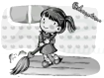
Many parents make their children do chores around the house.For some families, teaching children what to do and how to do chores is easy.But in other families, getting children to do some housework can be a very big problem.
It is a good idea for parents to teach their children at an early age.All family members must work together to make the house clean, and each person must do his or her share(份) of the work.We can do this by starting a plan of chores and responsibilities when children are young.
Chores are good for children—even very young ones.Doing chores can teach children many important skills like working together.Jobs also teach children what is fair.The skills and value(价值) from doing chores will be good to children all their life.
-
(1) The first paragraph tells us .A . all the parents make their children do chores B . it's easy to teach children to do chores C . some children think doing chores is difficult D . teaching children to do chores is different among different families
-
(2) The underlined word “responsibilities” means “ ” in Chinese.A . 爱好 B . 琐事 C . 责任 D . 家务
-
(3) It's good to teach to do chores.A . young children B . girls C . parents D . some families
-
(4) Children can learn from doing chores.A . working together with others B . how to write C . what is fair D . A and C
-
(5) Which of the following is TRUE?A . It's a small thing to teach children to do chores. B . Only the children who do chores know what is fair. C . Some children like to do chores but some don't. D . In a family, young children don't need to do chores.
 B .
B .  C .
C . 
-
(1) Who will pay a home visit?A . The boy's math teacher. B . The boy's English teacher. C . The boy's history teacher.
-
(2) Where are they talking?A . At home. B . At a restaurant. C . At school.
-
(3) When will the boy's father be back?A . In 5 minutes. B . In 10 minutes. C . In 15 minutes.
-
(1) What is Mike doing when his mother asks him to clean his room?A . Doing homework. B . Taking out the rubbish. C . Watching TV.
-
(2) Who is coming over in an hour?A . Mike's grandfather. B . Mike's grandmother. C . Mike's uncle.
-
(3) Where will Mike and Bruce meet?A . At Mike's home. B . At the library. C . At the cinema.
—________ his sister.
增加:在缺词处加一个漏字符号(∧),并在其下面写出应该加的词。
删除:把多余的词用斜线(\)划掉。
修改:在错的词下画一横线,并在该词下面写出修改后的词。
Your parents love you and care about you. As a teenager, you should do what you can make them happy. Here is some advice.
Do your chores. Help your parents with when you see them working around the house. Do your chores without being asked to and do so more than you are asked to.
Develop interest something. Find out what you are good at, and join a club that can help you improve you. It's good to have hobbies. Having something that your parents can hang on the walls like a painting will bring them much happy.
Talk with your parents good. Do not talk back to (对……顶嘴) your parents when they understand you. Find a right time talking with them. They will be glad to take time talking with you.
—Oh, she is my cousin.
- 有关蜡烛燃烧的现象描述正确的是( ) A.在蜡烛火焰上方所罩的干而冷的烧杯内壁有白烟 B.蜡烛燃烧放出热量、产生
- “在天之变,日月薄蚀。四十二月一蚀。五十六子月亦一蚀。蚀有常数,不在政治。百变千灾。皆同一状,未必有君政教所致。”下列观
- (潍坊市)我市正在实施一项宏伟的工程----兴建“海上潍纺”,旨在充分开发我市濒临的渤海资源 ,造福潍纺人民。小明同学住
- 如图(俯视),物体静止在光滑水平桌面上,一个水平向东的力F1作用在物体上,但要使物体获得方向东偏北30º的加速度,那么必
- 在(x2+3x+2)5的展开式中x的系数为( )A.160 B.240
- 两个圆的半径分别为3和5,当圆心距d=8时,这两个圆的位置关系是( ) A.内含 B.内
- 已知反应X+Y= M+N为吸热反应,对这个反应的下列说法中正确的是( ) A.X和Y的总能量一定低于M和N的总能量B
- 一架天平的砝码已经磨损,用它测物体的质量,其测量结果( )A. 偏大 B. 偏小 C. 没有
- 力F1单独作用在物体A上时产生的加速度大小为a1=5m/s2,力F2单独作用在物体A上时产生的加速度大小为a2=1m/s
- 家兔有黑毛和白毛之分,控制黑毛的基因是“B”,控制白毛的基因是“b”下图是有关家兔黑毛和白毛的遗传图解,请据图回答:(1
- 等边三角形的边长为6cm,则它的外接圆半径是 cm.
- 右图是土豆电池的示意图。土豆电池工作时, 下列有关说法正确的是 A.Fe用作正极 B.Cu片质量减少 C.电
- Eventually,the President had to leave office __________ publ
- 随着市场对绿色食品的青睐,淮河沿岸地区某村民组在本村稻田里,采用“稻鸭共作”的新型稻田种养模式,水稻和鸭子实现双丰收。据
- 某地一民营企业因对当地经济的发展做出了突出贡献,当地政府对该企业主以重赏,奖励50万元的别墅一套,并宣布此奖免征个人所得
- I________footballquite well,but I haven't had time to play s
- 下列各图表示单克隆抗体制备过程的各阶段图解,请根据图回答下列问题:(1) 请用箭头把代表各图解的字母按单克隆制备过程的顺
- 中子、质子、氘核D的质量分别为mn、mp、mD.现用光子能量为E的γ射线照射静止氘核,使之分解.用核符号写出上述核反应方
- 某中学高一学生,用了一个月时间调查了本市交通拥堵问题、公交专用道整体使用情况,写出报告,提出建议,该报告得到有关专家认可
- 1912年元旦,《申报》刊登了这样一条庆贺标语:“中华民万岁”。《申报》把“国”字改写为“”,主要是表达


