上外版(2020)高中英语必修二Unit 4 Sports单元素养评估测试卷
教材科目:英语
试卷分类:高一上学期
文件类型:.doc
发布时间:2026-07-01
授权方式:免费下载
下载地址:点此下载
以下为试卷部分试题预览
| 1. 语法填空 | 详细信息 |
|
Directions: After reading the passage below, fill in the blanks to make the passage coherent and grammatically correct. For the blanks with a given word, fill in each blank with the proper form of the given word; for the other blanks, use one word that best fits each blank.
Life Doesn't Just Happen to Us Being good at something and having a passion for it are not enough. Success depends mainly on our view of ourselves and of the events in our lives. When twelve-year-old John Wilson walked into his chemistry class on a rainy day in 1931, he had no way of knowing that his life was to change completely. The class experiment that day was to show heating a container of water would bring air bubbling to the surface. Somehow, the container the teacher gave Wilson (heat) mistakenly held something more volatile(易挥发的) than water. When Wilson heated it, the container exploded, (leave) Wilson blinded in both eyes. When Wilson returned home from hospital two months later, his parents attempted to find a way to deal with the disaster that (happen) to their lives. But Wilson did not regard the accident a disaster. He learned braille(盲文) quickly and continued his education at Worcester College for the Blind. There, he not only did well as a student but also became an (accomplish) public speaker. Later, he worked in Africa, many people suffered from blindness for lack of proper treatment. For him, it was one thing to accept his own fate of being blind and quite another to allow something to continue when it be fixed so easily. Wilson did his best to prevent the preventable tens of millions in Africa and Asia could recover their sight. Wilson received several international awards for his great contributions. He lost his sight but found a vision. He proved that it's not what happens to us determines our lives- it's what we make of what happens. |
|
| 2. 选词填空(词汇运用) | 详细信息 | |
|
选词填空
Sports Icons(偶像) Who Lead a Change China's sports industry has entered a new era when the superstars themselves become the absolute focus of public attention. Compared with the gold medals and the Chinese team has received Yao Ming: China's Ambassador(大使) Standing at 2.29 meters, Yao Ming used basketball to become one of the mainstream ambassadors in modern China. He first played for his hometown Shanghai Sharks team in the CBA where he became a CBA champion ad Finals MVP in 2002. Soon afterwards, Yao was chosen by the Houston Rockets as the top overall pick in 2002. Over an eight-year span with the Rockets, Yao became an eight-time NBA All-Star. Besides his in the CBA and the NBA, Yao was also a big reason for China's continued dominance in the Asia basketball scene and their constant presence at world-level competitions. To this day, Yao remains one of China's most sports and cultural icons. Liu Xiang: A Great Breakthrough China's world champion hurdler, Liu Xiang the nation's long-sleeping interest in track and field events after he became the first man to ever win a men's track and field event for China. Before Liu won a gold medal in the men's 110m hurdle race at the Athens 2004 Olympic Games and set a world record two years later, Chinese people had never shown such a strong interest in track and field events. Liu has become a significant player in China's track and field events and the craze that has followed him is to Yao Ming's influence on China's basketball. Both athletes prove how powerful a super sports star can be on the development of a sport in China. Li Na: New Image of China's Tennis Being the first Asian to win the singles title of a Grand Slam tournament, Li Na opened the door to tennis in China and even Asia. Her victory at the French Open 2011 was like a fairy tale and she has since been as a national sports hero equal to Yao Ming and Liu Xiang. A record-breaking 116 million viewers from China tuned in to watch Li become the French Open champion, marking the start of a women's tennis boom in a country left out of the tennis conversation. |
||
 sports stars play the role of people and improving the status of their sports in China. The following is an overview of those stars who once were, currently are or in the future will become milestones to change China's sports demographics(统计数据).
| 3. 完形填空 | 详细信息 |
|
完形填空
There is a Web site called the "World Database of Happiness." It combines and analyzes the results of hundreds of surveys from around the world that have been conducted on life satisfaction. Most of the findings are 1, but a few are surprising. The database makes it clear that there is not a strong connection between material wealth and general contentment. It is a cliché to say that money can't buy happiness, but the old saying seems to be 2 by research. Many people still cling to the belief that gaining riches will be the answer to all their problems, yet they are probably 3. Studies have been 4on people who acquired sudden wealth, such as lottery winners. In most cases, after the 5 joy had worn off, people were not left with a sense of lasting happiness. In fact, they tended to revert to the way they 6 before they became rich. Previously contented people continue to be contented, 7 those who were miserable before sink back into misery. If material wealth does not bring happiness, then what does? Perhaps happiness has something to do with where you live. The authorities at the World Database on Happiness have surveyed 8 of happiness in different countries. 9, people in America, Canada, and Singapore are very happy; people living in India and Russia, not surprisingly, are not happy. Other surveys consistently 10 the importance of relationships. 11 relationships in particular seem to be the key to long-term contentment. The Web site suggests that falling in love and having children are two of the 12 that bring the greatest happiness. Nowadays people look to technology as an 13 source of satisfaction. People increasingly spend more time alone watching TV or surfing the Internet 14 spending time with family. Can technology truly make people happy? It is too difficult to tell, but one thing is sure: If the Web site's research is accurate, time spent with your family is a better 15 than time spent making money. (1)
A .
different
B .
predictable
C .
satisfactory
D .
unexpected
(2)
A .
challenged
B .
widespread
C .
overtaken
D .
supported
(3)
A .
generous
B .
positive
C .
hesitated
D .
mistaken
(4)
A .
turned out
B .
done with
C .
carried out
D .
put forward
(5)
A .
essential
B .
pleasant
C .
initial
D .
enviable
(6)
A .
felt
B .
had
C .
chose
D .
lived
(7)
A .
as
B .
so
C .
and
D .
while
(8)
A .
levels
B .
standards
C .
senses
D .
examples
(9)
A .
Strangely
B .
Hopefully
C .
Apparently
D .
Surprisingly
(10)
A .
point to
B .
hold up
C .
deal with
D .
depend on
(11)
A .
Partner
B .
Family
C .
Relative
D .
Society
(12)
A .
situations
B .
relations
C .
destinations
D .
references
(13)
A .
convenient
B .
alternative
C .
everlasting
D .
adequate
(14)
A .
as far as
B .
rather than
C .
as well as
D .
in case of
(15)
A .
environment
B .
circumstance
C .
investment
D .
civilization
|
|
| 4. 阅读理解 | 详细信息 |
|
阅读理解
Nervous suspects(嫌疑犯) locked up in Britain's newest police station may feel relieved by a pleasant yellow colour on the door. If they are close to confessing a crime, the blue on the wall might tip the balance. Gwent Police have abandoned colours such as greys and browns of the 20th-century police cell(牢房) and have used colour psychology to decorate them. Ystrad Mynach station, which recently opened at a cost off5 million has four cells with glass doors for prisoners who suffer from claustrophobia (幽闭恐怖症), Designers have painted the frames yellow, which researchers say is a calming colour. Other cells contain a royal blue line because psychologists believe that the colour is likely to encourage truthfulness. The station has 31 cells, including 12 with a "live scan" system for drunken or disturbed prisoners, which detects the rise and fall of their chest. An alarm alerts officers if a prisoner's breathing stops and carries on ringing until the door is opened. Designers and psychologists have worked for years on colour. Blue is said to suggest trust, efficiency, duty, logic, coolness, thinking and calm. It also suggests coldness and unfriendliness.It is thought that strong blues will stimulate clear thought and lighter, soft colours will calm the mind and aid concentration. Yellow is linked with confidence, self-respect and friendliness. Get the colour wrong and it could cause fear, depression and anxiety, but the right yellow can lift spirits and self-respect. Ingrid Collins, a psychologist who specializes in the effects of colour, said that colour was an "energy force", She said: "Blue does enhance communication but I am not sure it would enhance truthful communication." Yellow, she said, affected the mind. Red on the other hand, should never be considered because it could increase aggression. Mrs Collins praised the designers for using colours in the cells. Gwent is not the first British force to experiment with colour to calm down or persuade prisoners to co-operate. In the 1990s Strathclyde Police used pink in cells based on research carried out by the US Navy.
|
|
| 5. 阅读理解 | 详细信息 |
|
阅读理解
Different countries have different tipping customs. When you travel, you need to know how to tip in the country that you're in; otherwise you'll leave servers angry everywhere you go. Here are just a few guidelines to tipping around the world. Brazil There will always be a standard 10% service charge added to your bill, and you won't necessarily have to tip. If you do feel like being generous, an extra 5-10% will really make your server very happy. Just remember to do this as skillfully as possible—Brazilians don't make a big show of this. Dubai In Dubai it's a rule for restaurants to charge 10% tip on all restaurant and bar bills. You can add a couple of dirhams (迪拉姆,货币单位) to this if you feel like it. Waiters are not paid very much in Dubai, so it is always very appreciated. Germany German bars and restaurants will include the tip as part of what you owe, but that's not all you have to pay. It is a custom to round the bill up after that, usually to the euro. This can be anywhere from 5-10%. When it's time to settle up, you won't get a bill: your waiter tells you the total and then you tell them how much you want to pay, including your "tip", and hand over the money. Czech Republic While locals in the Czech Republic don't leave tips, that doesn't mean you're off the hook .Foreign tourists are definitely expected to leave some kind of tip for service—as long as you're in a high tourist traffic area, like Prague for instance. The standard tip is 10%. India If you like the service, go ahead and tip your server 5-10%. You have to adjust that amount though, based on how big the meal you're eating is. If the bill is for a small meal, and totals less than 300 rupees, tip the full 10%. If the bill is higher, tip towards the 5%.
|
|
| 6. 阅读理解 | 详细信息 |
|
阅读理解
"When I was 16 years old, I was diving in Greece, but I was disappointed because I saw more plastic bags than fish." These are the words of Boyan Slat, an engineer who designed the world's first ocean plastic cleanup system.
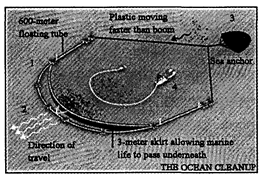
Every year, more than 8 million tons of plastics end up in our oceans, according to the UN Environment Programme. It is predicted that the weight of ocean plastics will match the weight of all the fish in our oceans by 2050. To prevent this from happening, in 2013 Slat created the Ocean Cleanup, an environmental non governmental organization, and put his plan for an ocean cleanup device into action. After years of research and develop ment in the Netherlands, a device called System 001/B successfully started gathering plastics on October 2, 2019. The device uses a 600-meter-long C-shaped tube to gather all the floating rubbish. Unlike other cleanup methods, the system floats freely according to the direction of the waves, which allows waste to flow into and stay within the device. A sea anchor is attached to either end. This slows down the system as it floats through the water and allows the faster-moving rubbish, carried by the waves, to flow into its mouth. System 001/B can also collect waste below the surface using a 3-meter-deep skirt (挡板) attached to the end. After being gathered, the trash will be dragged back to shore by boat and recycled. Right now, the system operates in the Great Pacific Garbage Patch, an area that is 3 times the size of France. Once operational, the Ocean Cleanup expects a full fleet to be able to clear 50% of the Great Pacific Garbage Patch in 5 years. "It remains to be seen whether this dream will become a reality, but it is undeniable that humanity must work together to reduce our plastic use and repair the damage our waste has caused," Slat said. "We are starting to see a young generation that gets it and is excited about a sustainable (可持续的) future, but the question still comes down to: Are we going fast enough, and how much damage will have been done before we get there?"
|
|
| 7. 任务型阅读 | 详细信息 |
|
Directions: Read the following passages. Fill in each blank with a proper sentence given in the box. Each sentence can be used only once. Note that there are two more sentences than you need.
Your Next Nurse Could Be a Robot Dr. De Momi, of the Politecnico di Milano (Italy), led an international team that trained a robot to imitate natural human actions. Over time this should lead to improvements in safety during surgeries because unlike their human counterparts robots do not tire and can complete an endless series of precise movements. The goal is not to remove human skill from the operating room, but to complement it with a robot's particular skills and benefits. "As a roboticist, I am convinced that robotic (co)workers and collaborators will definitely change the work market, but they won't steal job opportunities. " De Momi explains. To conduct their experiment De Momi's team photographed a human being conducting numerous reaching motions, in a way similar to handing instruments to a surgeon. These camera captures were input into the neural network of the robotic arm, which is crucial to controlling movements. Next a human operator guided the robotic arm in imitating the reaching motions that the human subject had initially performed. Although there was not a perfect overlap between the robotic and human actions, they were broadly similar. These observers determined whether the actions of the robotic arms were "biologically inspired," which would indicate that their neural networks had effectively learned to imitate human behavior. About 70% of the time this is exactly what the human observers concluded. These results are promising, although further research is necessary to confirm or refine De Momi's conclusions. If robotic arms can indeed imitate human behavior, it would be necessary to build conditions in which humans and robots can cooperate effectively in high stress environments like operating rooms. De Momi's work is part of the growing field of healthcare robotics, which has the potential to change the way we receive health care sooner rather than later. A. This future may not be as far away as we think. B. Robots can't successfully imitate doctors' motions in the operating room. C. Finally, several humans observed as the robotic arm made numerous motions. D. The nursing assistant for your next trip to the hospital will still be a robot instead of human beings. E. They will just allow us to decrease workload and achieve better performances in several tasks. F. His work indicates that humans and robots can effectively cooperate during high-risk events such as surgeries. |
|
| 8. 翻译 | 详细信息 |
|
你们中有多少人将报名参加下周的校运动会?(sign)
|
|
| 9. 翻译 | 详细信息 |
|
所有在场的人都反对花这么多的钱买这幅画。(object)
|
|
| 10. 翻译 | 详细信息 |
|
他工作了一整天,没有吃任何东西,这使得他筋疲力尽。(which)
|
|
- 人教版(2019)高中英语必修3:Unit 3 Diverse Cultures单元复习
- 人教版(2019)高中英语必修3:Unit 4 Space exploration 单元复习1
- 人教版(2019)高中英语必修3:Unit 4 Space exploration 单元复习2
- 人教版(2019)高中英语必修3:Unit 4 Space exploration 单元复习3
- 人教版(2019)高中英语必修3:Unit 4 Space exploration 单元复习4
- 人教版(2019)高中英语必修3:Unit 4 Space exploration 单元复习(基础巩固&综合能力提升)
- 人教版(2019)高中英语必修3:Unit 4 Space exploration 单元复习(基础过关)
- 人教版(2019)高中英语必修3:Unit 4 Space exploration 单元复习测试
- 人教版(2019)高中英语必修3:Unit 4 Space exploration 单元复习题
- 人教版(2019)高中英语必修3:Unit 4 Space Exploration 单元习题精选
- 人教版(2019)高中英语必修3:Unit 4 Space exploration 单元同步练习
- 人教版(2019)高中英语必修3:Unit 4 Space exploration 复习题精选
- 阅读下文,完成第24—28题(17分) 转身 ①一转身,那个动人的身影就不见了。在人海里,想再次打捞到她,再次与她相遇,
- 盐城为了建设卫生城市,市政府向市民征集到的下列措施中,你认为不可行的是 A.使用清洁能源代替煤和石油
- 在室温下,100mL0.1mol/L的醋酸溶液中,欲使其溶液的pH减小,同时又要使醋酸的电离程度减少,可采取( )
- 下列有关电化学的说法正确的是 A.铜的金属活泼性比铁弱,可在海轮外壳上镶入若干铜块以减缓铁腐蚀 B.原电池中,一定由活泼
- 在酿制果醋果酒的过程中,下列相关说法正确的是()。 A.果醋的制作需用醋酸菌,醋酸菌是兼性厌氧型细菌,需先通一段时间氧气
- 海带中含碘元素,有人设计如下步骤来提取碘:①加入6%H2O2溶液 ②将海带烧成 灰,向灰中加入蒸馏水 ③加入CC
- Ⅳ 写作(共两节,满分40分) 第一节 基础写作(共1小题,满分15分) 以下是一则关于中国政府决定禁烟的报道的主要内容
- 如果A是B的必要不充分条件,B是C的充分必要条件,D是C的充分不必要条件,那么A是D的()A.必要不充分条件B.充分不必
- 某社区的宣传栏安排了我国2009年——2010年发生的以下事情:四川汶川地震一周年纪念、西南旱灾、青海玉树地震、建国60
- 货币充当一般等价物与它出现以前的一般等价物的区别是( ) A.是否是商品 B.是不是由某种商品固定充当
- 直三棱柱ABC﹣A1B1C1中,∠BCA=90°,M,N分别是A1B1,A1C1的中点,BC=CA=CC1,则BM与AN
- 下图是分泌细胞分泌的某种物质与靶细胞结合的示意图,据图回答: ⑴分泌细胞的分泌物与靶细胞相互结合的原因是靶细胞膜上有
- (12分)社会转型是指社会经济结构、政治制度和价值观念等发生整体性、根本性的变迁。阅读材料,回答问题。 材料一 “美金(
- 右图是元素周期表中硫元素的信息示意图,对图中信息解释不正确的是 A.质子数为16
- 下列各句加点词语使用正确的一项是 A.在中国,逢年过节给上司送点礼品,被视为人之常情。而在法制更健全的国家,只要贿赂
- 某生物的基因型为AaBB,通过下列技术可以分别将它转变为以下基因型的生物: ①AABB;②aB;③AaBBC;④AAaa
- 水果中含有能防止和治疗坏血病的物质一一维生素C,其在人体消化管内的吸收部位是( ) A.口腔、胃 B.
- 图15为某流域示意图。读图回答问题。 (1)指出A支流的主要污水来源,并分析这些污水排入河流所产生的危害。 (
- 依次填入下列各句横线处的词语,最恰当的一组是()①如果我们不能在物质文明建设的同时, 出刚健峻拔的民族品格和自信自谦的民
- 通过实验观察,某气体有下列性质:①有刺激性气味;②可使品红溶液褪色;③溶于水其水溶液可使石蕊试液变红;④通入浓硝酸中有红


