教育文化类 知识点题库
Most book reviews start with a headingthat includes all the basic information about the book, like:
Title.
Author.
Place of publication, publisher, date ofpublication.
Number of pages.
Like most pieces of writing, the review usually begins with an introduction that lets your readers know what the review will say. The first paragraph usually includes the author and title again, so your readers don't have to look up to find this information. You should also include a very brief description of the contents of the book, the purpose or audience for the book, and your reaction and evaluation.
Then you move into a section of background information that helps place the book in context and discuss escriteria (准则)for judging the book. Next, the review gives a summary of the main points of the book, quoting and explaining key phrases from the author. Finally, you get tothe heart of your review – your evaluation of the book. In this section, you might discuss some of the following issues:
how well the book has achieved its goal
what possibilities are suggested by the book
what the book has left out
how the book compares with others on the subject
what specific points are not convincing
what personal experiences you've hadrelated to the subject.
It is important to use labels to carefully distinguish your views from the author's, so that you don't confuse your reader.
Then, like other essays, you can endwith a direct comment on the book, and tie together issues raised in the reviewin a conclusion.
There is, of course, no set form, but ageneral rule is that the first one–half to two–thirds of the review should summarize the author's main ideas and at least one–third should evaluate thebook.
-
(1) What is the most important part of a book review?A . The heading. B . The evaluation. C . The conclusion. D . The introduction.
-
(2) It can be confusing to readers if .
A . there is no heading in a book review B . the book has achieved its goal C . the viewer's point of view is not distinguished from the author's D . the book is compared with others on the same subject -
(3) What is NOT suggested for a book review in this passage?A . Quoting from the author of the book. B . Providing some book information. C . Analyzing only the author of the book. D . Comparing the book with others of a similar subject.
-
(4) The best title for this passage is “ ”.
A . Steps to follow B . Tips for writing a book review C . The way to develop your idea D . Things not to be avoided in a book review
If you've ever owned a chimney, you know that it can get pretty dirty. There's a whole lot of soot(烟灰) that gets stuck on the inside. That stuff has to get cleaned, or you could have a serious fire risk. While nowadays we have easier ways of doing this dirty job, in the way back days somebody used to climb up the chimney and clean all that soot. And the thing is, not just anybody could do it.
You had to be really small to fit up in the chimney, so they used to give the task to kids – some as young as four or five years old. They worked for their boss known as a master-sweep. They were often covered in soot, and were very likely to get burned. They often developed what became known as soot wart, a form of cancer.
Are your unfairness bells ringing? William Blake's certainly were. The physical dangers and widespread unfairness of the chimney-sweeping job really stuck in his throat, so much so that he wrote not one, but two poems called “The Chimney Sweeper”.
The first poem (the one we're discussing here)was published in 1789 in a book called Songs of Innocence. These little poems took children and the joys of childhood innocence as their subject. As you've probably guessed by now, many of the poems in Songs of Innocence, like “The Chimney Sweeper”, are about the ways in which childhood innocence is destroyed by unkind old adults. For Blake, innocence is, in many ways, a total joke. It doesn't exist, because it's always taken away by the realistic world – chimney-sweeping, death, poverty, etc.
What does a five-year-old chimney sweeper in 18th-century England have to do with you? More than you might think. It is reported that 150 million kids are in child labor in developing countries. Many of them work long hours and face dangerous health risks. Like Blake's chimney sweeper, these kids are not even given a chance at innocence because experience keeps getting in the way.
-
(1) Which of the following can best describe the chimney-sweeping job?A . Easy and interesting. B . Dirty and dangerous. C . Pleasant and well-paid D . Challenging and creative.
-
(2) Why did Blake write two poems called “The Chimney Sweeper”?A . He was very interested in the job. B . He had much experience in the job. C . He considered the job very important. D . He felt deeply sorry for the kid workers.
-
(3) How did Blake look at the realistic world?A . Thankfully B . Regretfully C . Doubtfully D . Negatively
-
(4) In the last paragraph, the writer explains ________.A . the realistic meaning of “The Chimney Sweeper” B . the great influence of Blake's Songs of Innocence C . why child labor still exists in developing countries D . why chimney-sweeping becomes unnecessary today
New friends. Fresh lifestyle. Better career opportunities…Those are attractions of overseas study for young people in China. “Start early, finish strong,” some of them say.
More than 300 universities from 27 countries and regions were represented at last weekend's international education exposition(展览).
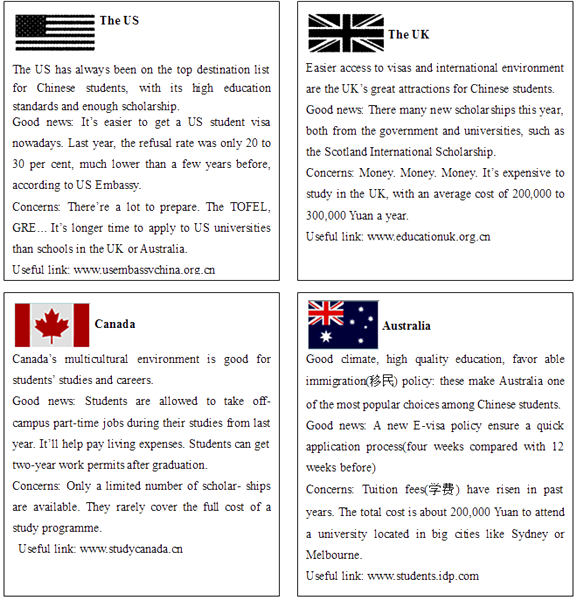

-
(1) If you want to have more chances of getting scholarship to study in a foreign country, you'd better choose .A . Canada B . the Netherlands C . the US D . Australia
-
(2) Many young people go to study in the US because .A . it is not very difficult for them to get a student visa B . it is easier for them to pass the TOFEL or GRE C . they don't spend much time applying to US universities D . they think they can receive good university education
-
(3) According to the passage, which of the following is NOT true?A . Students go to the Netherlands usually for its beautiful scenery B . You can apply for your visa to study in Australia on the Internet C . You may have trouble with language if you study in Italy D . The UK is the country with very high expenses
“Do you have any idea how hard it is to be a kid?!” My 7-year-old once asked me. My initial reaction to her complaint (抱怨) was eye-rolling, along with thinking, “Being a kid is hard? Are you kidding me?” as I mentally counted all the hard things that her grown-up mama did.
However, as I thought about it a bit more, I realized how silly my reaction had been. Yes, as we adults look back on our childhood, being a kid seems carefree and easy and full of fun. Coloring at school! Playing games! Riding bikes! How could that be hard? So I asked my daughter why being a kid was so hard.
“Well, because you don't have your own phone, and you can't eat in the living room,” she said.
I asked if anything else was hard about being a kid. “Someone else is the boss of you,” she replied.
I thought some more. What else is hard about being a kid? Well, sometimes, we don't really take kids seriously.
There are times when I've responded to my children's tears with “It's not bad,” or “You don't need to be upset about that.” Because I believe that a cancelled playdate or a lost toy is no big deal. But for my little ones, it is.
We don't intentionally ignore these opportunities for connection, but sometimes, in busy moments of parenting, we respond unskillfully. We don't put ourselves in our children's shoes, and we miss an opportunity to practice compassion.
Compassion means “to feel with” or “to suffer with” another person. It means seeing something the way they do, and experiencing it with them.
Here's what I've learned about being a more compassionate parent, and I hope other parents can do the same thing.
-
(1) What was the author's attitude towards “being a kid is hard” in the first place?A . Disagreeing B . Agreeing C . Shocked D . Worried
-
(2) The author seemed to .A . do hard things at school B . have a happy childhood C . feel bored in childhood D . love drawing at school
-
(3) The author's daughter complained about .A . attending school B . boring toys C . lacking freedom D . terrible meals
-
(4) According to the author, parents should .A . do the same things as their children B . share their stories with their children C . give more attention to their children D . balance the time spent on work and the family
Schools across the world are trying to come up with solutions to keep students active. Some are replacing traditional classroom chairs with exercise balls or standing desks. At Ward Elementary School in Winston, North Carolina students have adopted a new program that requires riding fixed bikes while reading.
'Read and Ride5 is the creation of school counselor Scott Ertl, who came up with the idea while he was exercising and reading at the gym. Believing it would be a fun way to convince students to become more active, he placed one in the comer of his classroom and encouraged them to use it during independent reading classes.
It was so popular that Ertl decided to add more bikes and offer the Read and Ride program to the entire school. Today Ward Elementary has a dedicated exercise room filled with bikes that can be used by students while completing their daily reading assignments.
Besides making reading more fun, the program also helps students exercise at a comfortable pace without the pressure that comes with regular sports-related activities. It is also a perfect way to release energy during days when the weather is not helpful to outdoor activities.
Most importantly, however, are the program's academic benefits. A year after Read and Ride was introduced at Ward Elementary School, students actively involved in the program demonstrated an astonishing 83% reading proficiency. Those that had not taken advantage of the exercise bikes tested at a much lower, 41%.
Though the substantial improvement in academic achievement cannot all be attributed to programs like Read and Ride, experts believe they are a significant contributor. That's because studies have shown that physical activity stimulates (刺激) brain cells and helps prepare it for learning. As word of the difference made by this easy to execute exercise program spreads, don't be surprised to find schools across the country adopt “Read and Ride” for their students.
-
(1) What is the new program at Ward Elementary School?A . Kids ride bikes as they read. B . Kids excise balls and read at the gym. C . Kids sit at desks for long while reading, D . Kids do outdoor activities during lessons.
-
(2) How do the students at Ward Elementary School benefit from the program?A . They exercise with high pressure. B . They feel reading fun and learn better. C . They improve their sense of competition. D . They are instructed to read at the same pace.
-
(3) What can we learn from the last paragraph?A . The program will be more and more popular. B . Schools doubt whether the program is available. C . Physical activities prevent kids from learning more. D . The school achievement depends wholly on the program.
-
(4) What would be the best title of the passage?A . Standing desks help school kids focus on their studies. B . Traditional teaching should be banned in the near future. C . 'Read And Ride' aims to make students healthier and smarter. D . Kids need to release energy during independent reading classes.
Once an old man rose early to read each morning. His grandson wanted to be just like his grandfather, so tried to emulate him every way he could.
One day the grandson asked, “Grandpa, I try to read just like you do, but I don't understand most of it, and I forget whatever I do understand immediately I close the book. So what good is it for me to read?”
The grandfather, who was putting coal on the fire, said, “Take this coal basket down to the river and bring me back a basket of water.”
The boy did as told to, but the water leaked out before he could get the basket home.
The grandfather laughed, saying, “You'll have to move a little faster.” This time he ran faster, but again the basket emptied. Out of breath, he decided it was impossible to carry water in a basket, and he went to get a bucket(桶). But the grandfather said, “I want a basket of water instead of a bucket of water. You're just not trying hard enough.”
The boy knew what he was trying to accomplish was impossible. However, he decided to show his grandfather a third time.
The boy dipped the basket into the river and ran as hard as he could. With the empty basket, he gasped(喘气说), “See Grandpa? It's useless!”
“So you think it useless?” the old man asked. “Then look at the basket.” To his surprise, the boy found it washed clean of the dirty coal stains and now clean inside and out.
“My child, that's what happens when you read the book. You might not understand or remember everything, but the words will change you inside and out. That is the work of reading in our lives.”
-
(1) Why did the man tell the boy to fetch a basket of water?A . He meant to inspire the boy through an example. B . He intended to train the boy to run faster. C . The work could test how fast the boy ran. D . The work was too much for himself.
-
(2) What does the underline word “emulate” in Paragraph 1 most probably mean?A . encourage. B . admire. C . copy(模仿) D . challenge.
-
(3) Which of the following words can be used to describe the grandfather?A . Healthy and smart. B . Thoughtful and loving. C . Serious and knowledgeable. D . Wise and diligent.
-
(4) What would be the best title for this passage?A . Old Man and His Grandson. B . On Reading Books C . The Power of Reading. D . A Basket of Water.
Some educators told us that more years of school could help students get higher scores on intelligence tests. That was a finding of a study of teenage males in some countries. Now, another research shows that physical activity may help students do better in their classes.
The research comes as educators in some countries are reducing time for activities like physical education. They are using the time instead for academic(学术的) subjects like math and reading. The studies appeared between 2008 and 2014. They included more than 55,000 children, aged 6 to 18.
Amika Singh: "According to the results of our study, we can conclude that being physically active is beneficial for academic performance. There are, first, Physiological explanations, like more blood flow, and so more oxygen to the brain. Being physically active means there are more hormones(荷尔蒙) produced like endorphins(内啡肽). And endorphins make your stress level lower and your mood improved, which means you also perform better."
Also, students taking part in organized sports learn rules and how to follow them. This could improve their classroom behavior and help them keep their mind on their work.
The study leaves some questions unanswered, however  Ms Stash says it is not possible to say whether the amount or kind of activity affected the level of academic improvement. This is because of differences among the studies.
The researchers said they found only two highquality studies. They needed more highquality studies to confirm(证实) their findings. They also pointed out that "results for other parts of the world may be quite different".
Still, the general finding was that physically active kids are more likely to do better in school. Ms Singh says schools should consider that finding before they cut physical education programs. Her paper on "Physical Activity and Performance at School" is published in the Archives of Pediatric and Adolescent Medicine.
-
(1) The passage mainly tells us that .A . a research on physical education has been done by the researchers B . there is a possibility that physical activity leads to higher grades C . the amount or kind of activity directly affects academic level D . the research shows that the children aged 6 to 18 don't do sports
-
(2) Which of the following is TRUE?A . Being mentally active is good for academic subjects. B . The more hormones you have, the more stressed you will get. C . The researchers have found many highquality studies to prove the research. D . The educators in some countries think studies, not exercise, mean much to students.
-
(3) The underlined sentence in Paragraph 6 probably means .A . good marks result from highquality study B . findings are probably different in different areas C . physical activity will spread all over the world D . academic performance depends on the surroundings
-
(4) What's the purpose of writing the passage?A . To call our attention to the sports at school. B . To introduce all types of physical activities. C . To represent the academic performance. D . To improve students' health.
With all the wars, fighting and sadness in the world today, it's not only necessary, but also essential to have a good sense of humor just to help us get through each and every day of our lives. Putting a smile on someone's face when you know they are feeling down in the dump, makes me feel good and warms my heart.
How would you feel if you could not joke around with your wife, husband, child, co- worker, neighbor, close friends, or even just someone that you are standing in line with at your corner store? I am always saying things that make others smile or laugh, even if I don't know the person I'm joking around with. My Grandma always found humor in everything she did, even if it was the hardest job anyone could imagine. This not only relieves stress in any situation, but also is common courtesy (礼貌) to speak to others that are around you.
I know of a few people that don't have a funny bone in their bodies, as they say. Everyone around them could be rolling on the floor after hearing a great joke and they would sit there without the slightest smile on their face. They don't get the joke that makes others laugh. I am busting a gut while they just sit there, looking at me as if I were from outer space. How can people not get a really funny joke?
Laughing is essential to keep your stress levels under control. Without humor we would find ourselves with a lot of psychological problems, or on a lot of medications to keep us from going crazy. There is too much sadness in this present world. It drives people crazy. We all need to find a way to ignore the sadness and bring a little light into our lives. So, I believe our best medicine is to get together and tell some jokes and have some fun laughing together.
-
(1) According to the author, humor is useful in the aspect that ________.A . it can pick up people's spirits B . it makes people more confident C . it can help people get on well with others D . it can help get rid of the cruelty in the world
-
(2) From the second paragraph, we can know that ________.A . the author used to be polite B . the author's grandma is humorous C . we should relieve stress in any situation D . family members should play tricks on each other
-
(3) The underlined phrase "busting a gut" in the Paragraph 3 can be replaced by "________".A . explaining carefully B . speaking loud C . keeping silent D . laughing hard
-
(4) By writing the passage, the author mainly intends to ________.A . talk about his own understanding of humor B . encourage people to be humorous in daily life C . introduce a practical way to get through daily life D . convince people of the power of being optimistic about life
-
(5) What is the author's attitude towards the present world according to the last paragraph?A . Satisfied. B . Positive. C . Critical. D . Indifferent.
It was Christmas Day 1999. On CNN, talk show host Larry King was interviewing Stephen Hawking.
"What, professor, puzzled you the most?" King asked. "What do you think about the most?"
Hawking immediately replied, "Women."
It's a comfort that Hawking, one of the smartest men in the world, is puzzled by the opposite sex. But, that's not surprising, according to Satoshi Kanazawa. Bright people are no better than anyone else at making smart decisions about common things, he says. These include finding a mate, maintaining family relationships, raising children, finding the way home, and dealing with a variety of basic life needs.
That's because there are several kinds of formal "intelligence", Kanazawa argues. Being smart one way does not necessarily mean smart in another way. This view is sure to cause arguments among scientists who think about thinking. That is because it disagrees with the common view that general intelligence is a single thing. In that view, it is not, as Kanazawa and others say, a set of independent mental areas.
Kanazawa says that some kinds of intelligence developed slowly over time. Many people have heard about what is called "emotional intelligence". Now, psychologists(心理学家) have discovered several other types of intelligence. These include the ability to learn a language, find a mate, recognise faces, and locate oneself in a new environment.
But, is there proof to support the theory that intelligence comes in many forms?" Actually, there is quite a lot of proof, " Kanazawa says. "If there were only one type of intelligence, "he adds, "people with high IQs should be ‘smart' in every way. "
In one test, a psychologist took a group of subjects on a hike, walking into the forest. He then told them to find their way back. The high IQ people were no more likely to be able to find out where they were. In another experiment, a researcher asked people to find their way to a specific location in a computer maze(迷宫). Once again, high IQ did not give them any edge.
-
(1) Which of the following statements is TRUE according to the passage?A . It's surprising that the opposite sex puzzles Hawking. B . It's natural that the opposite sex puzzles Hawking. C . People with high IQ have more advantages in daily life. D . People with high IQ have more emotional intelligence.
-
(2) What are smart people like according to Satoshi Kanazawa?A . They are better than the other people at making smart decisions about common things. B . They are as bad as the other people at making smart decisions about common things. C . They are more likely to be able to find the way back than the other people. D . They are more likely to be able to find a friend of the opposite sex.
-
(3) The underlined word "edge" in the last paragraph probably means " ".A . corner B . intelligence C . advantage D . proof
-
(4) What is the function of the last paragraph in the passage?A . Drawing a conclusion. B . Supporting the subject with facts. C . Stating the fact. D . Explaining the subject.
Parents say that honesty is the best policy, but they regularly lie to their children as a way of influencing their behavior and emotions, finds new research from the University of Toronto and the University of California.
Surprisingly little has been published on the subject of parental lying, so Gail Heyman, professor of psychology at the University of California, Diem Luu, a former student of the University of California, and Kang Lee, professor at the University Toronto, set out to explore the under-researched phenomenon. They asked US participants in two related studies about parents lying to their children—either for the purpose of promoting appropriate behavior or to make them happy.
In one of the studies, many parents reported they told their young children that bad things would happen if they didn't go to bed or eat what they were supposed to. Other parents reported inventing magical creatures. One explained, "We told our daughter that if she wrapped up all her pacifiers(橡皮奶嘴)like gifts, the fair would come and give them to the children who needed them."
In the other study, the researchers surveyed college students' recollections about their parents' lying and obtained similar results: parents often lie to their children even as they tell them that lying is unacceptable.
The researchers refer to this practice as "parenting by lying"." We are surprised by how often parenting by lying takes place," said Lee. Though Heyman thinks that there are occasions when it is appropriate to be less than truthful with a child, she urges parents to think through the issues and consider alternatives before using lies.
"Children sometimes behave in ways that are disruptive or are likely to harm their long-term interests," said Heyman." It is common for them to try out a range of strategies, including lying, to stop them. However, parents should be concerned about the possible long-term negative consequences to children's beliefs about honesty."
-
(1) The subject of parental lying .A . was not allowed to be researched in the past B . attracts little attention because it is common C . hasn't got many published results about it D . is becoming more and more popular
-
(2) What does Heyman think of parental lying?A . It is a great parenting strategy. B . Parents should think twice before using it. C . It usually does more good than harm. D . Parents should do something to make up for it after using it.
-
(3) Parents usually when their young children don't go to bed properly.A . turn off the bedroom lights and play some music B . shout at them loudly C . shut the door and let them alone D . make up some magical creatures to let them believe
-
(4) In which part of a newspaper would you most probably find the passage?A . Business. B . Education. C . Technology. D . Fashion.
You wake up in the mornings the day is beautiful and the plans for the day are what you have been looking forward to for a long time. Then the telephone rings, you say hello, and the drama starts. The person on the other end has a depressing tone in his voice as he starts to tell you how terrible his morning is and that there is nothing to look forward to. Are you still in a wonderful mood? Impossible!
Communicating with negative people can wash out your happiness. It may not change what you think, but communicating long enough with them will make you feel depressed for a moment or a long time.
Life brings ups and downs, but some people are stuck in the wrong idea that life has no happiness to offer. They only feel glad when they make others feel bad. No wonder they can hardly win others' pity or respect.
When you communicate with positive people, your spirit stays high and therefore more positive things are attracted. When the dagger (匕首) of a negative person is put into you, you will always feel down.
Sometimes we have no choice but to communicate with negative people. It could be a co-worker or a relative. In this case,say what needs to be said as little as possible. Sometimes letting out your anger back to the negative person may make you feel good, but this will lower you to that same negative level and they won't feel ashamed of themselves about that.
Negativity often affects happiness without even being realized. The negative words of another person at the start of a day can cling to (附着) you throughout the rest of your day, which makes you feel bad and steals your happiness. Life is too short to feel negative. Stay positive and avoid negativity as much as possible.
-
(1) The purpose of the first paragraph is to ________.A . make a comparison B . offer an evidence C . introduce a topic D . describe a daily scene
-
(2) How can negative people affect us?A . By influencing our emotion. B . By telling us the nature of life. C . By changing our ways of thinking. D . By comparing their attitudes to life with ours.
-
(3) According to the passage, to reduce negative people's influences on us, we are advised to _______.A . change negative people's attitudes to life B . show our dissatisfaction with negative people C . make negative people feel ashamed of themselves D . communicate with negative people as little as possible
-
(4) What is the author's attitude towards negative people?A . Favorable. B . Critical. C . Indifferent. D . Supportive.
Life satisfaction is the way persons evaluate their lives and how they feel about their directions and options for the future. It's a measure of well-being and may be evaluated in terms of mood, satisfaction with relations with others and with achieved goals and self-concepts to cope with daily life. It's having a favorable attitude towards one's life as a whole rather than just an evaluation of current feelings. Life satisfaction has been measured in relation to economy, education, experiences, and residence, as well as many other topics.
Life satisfaction can reflect experiences that have influenced a person in, a positive way. These experiences have the ability to motivate people to pursue and reach their goals. As a matter of fact, in these experiences there are two kinds of emotions that may positively influence how people understand their life. Hope and optimism both consist of emotional processes that are usually directed towards the reaching of goals. People who have higher life satisfaction are always full of hope for a better future; additionally, optimism is linked to higher life satisfaction, while pessimism is related to symptoms in depression.
The psychologist, Yuval Palgi, studied the old-old-people who were primarily in their nineties. This subject group was found to have thought highly of their past and present, but they thought lower of their future. A large factor that was talked about in life satisfaction was intelligence. The experiments talk of how life satisfaction grows as people become older because they become wiser and more knowledgeable, so they begin to see that life will be better as they grow older and understand the important things in life more. But when they step into their nineties, future becomes a luxury to them.
According to Seligman, the happier people are, the less they are focused on the negative. Happier people also have a greater tendency to like other people, which promotes a happier environment, which then correlates to a higher level of the persons' satisfaction with their life.
-
(1) What can we learn about life satisfaction from Paragraph 1?A . It can be easily measured through income and education. B . It includes a positive attitude towards people's entire life. C . It merely determines people's attitude towards the future. D . It has nothing to do with the evaluation of current feelings.
-
(2) Which of the following is TRUE according to the passage ?A . The wealthier a person is, the happier he will feel. B . Happy people are more likely to get along well with others. C . Happy people won't be influenced by the negative items in life. D . Intelligence plays a leading role in determining people's happiness.
-
(3) What was the attitude of most old-old towards their future?A . They were less hopeful about it. B . They thought highly of it. C . They felt satisfied with it. D . They were scared of it.
-
(4) What may be the best title for the text?A . Old People Have Much More Life Satisfaction B . Life Satisfaction—the Key to a Happier Life C . Optimism Ensures Life Satisfaction D . Emotions Affect Life Satisfaction
Panic Buying
Shoppers around the world are crazy buying because of fears over the coronavirus(新型冠状病毒), which caused a critical plague in China and even other countries at the beginning of 2020. People in countries such as England, Japan, Singapore and Australia have been emptying supermarket shelves of toilet paper, face masks, hand wash products and dried and canned food. Photos and videos of shoppers in Australia quarreling over the last pack of toilet roll in a supermarket have spread across social media swiftly.
However, governments have advised their citizens that there is no need to "panic buy". They added that panic buying would only reduce the supply of products needed by patients and medical staff, which could exacerbate the problems the COVID-19 virus is causing. Singapore's prime minister comforted Singaporeans that: "We have enough supplies. There's no need to stock up." A week after the panic buying fever, things have calmed down and shoppers have gone back to purchasing items in normal quantities.
Psychologists say panic buying is an "unwise" behaviour that is part of a condition called FOMO - the fear of missing out. Dr. Katharina Wittgens said a herd mentality (从众心理) sets in during disasters that causes people to copy the actions of others. People watch the news of items being bought in quantity and immediately rush out to the stores to do the same. She said people were taking on too much the risks of dying from the coronavirus. She said: "Far more people die in car accidents or household accidents per year but we don't panic about these things in the morning before we go to work."
-
(1) What made shoppers in different countries crazy buying?A . The approach of 2020 New Year's Day. B . The shortage of resources and supplies in their nations. C . Their concern about the virus. D . The discount from supermarkets.
-
(2) What does the underlined word in Paragraph 2 refer to?A . solve B . release C . worsen D . quicken
-
(3) What is the reason for this behavior according to expert?A . People tend to follow others' actions in the period of disaster. B . People are wiser in making decisions. C . People think no one needs the supplies. D . People do not believe what others said.
-
(4) What can be concluded from the last paragraph?A . People should not panic over the virus. B . More people die from car accidents. C . People buy little when they go to the stores. D . We should panic about the situation.
Can you think of a day without music? We can hear music everywhere: in the streets and at home, over the radio and on TV, in the shops and in the parks. People all over the world are fond of music. They listen to music, they dance to music, and they learn to play musical instruments.
Music isn't' only combination of pleasant sounds. It is an art which reflects life. There are lot of different kinds of music. Some of them appeared long ago, and some are modern. Folk music appeared long ago, but it is still alive. Folk songs are very pleasant to listen to. Classical music is often associated with the music of the past. Rap is a modern musical style where the singer speaks or shouts the words in time to music with a steady beat.
Great Britain has produced more popular music stars than any other country. British groups often set new trends in music. New styles, groups and singers continue to appear. Many of the new bands have been able to use changes in technology to develop their music such as computerised drum machines, synthesisers and other electronic instruments.
Tastes differ. So people's musical interests range from pop and rock music to classical music and opera. My favourite style of music is pop music, because it is full of energy. When I listen to pop music it makes me remember happy times and forget the problems of everyday life. I also enjoy listening to classical music. The music I hate is heavy metal, I find it noisy. When I listen to this style of music it presents to my mind pictures of dark days. My mother and father agree with my tastes in music. Though they prefer to listen to classical, they think that modern music is not too bad.
Music appeals to our hearts. It comforts our souls and enriches our minds. Music is beauty in sounds; it is our magic source of inspiration.
-
(1) What is the first paragraph mainly about?A . Several types of music. B . Different musical tastes. C . The development of musical styles. D . The importance of music in our lives.
-
(2) How is the second paragraph developed?A . By giving examples. B . By analysing reasons. C . By describing courses. D . By making comparisons.
-
(3) Why does the author like pop music?A . It is played with electronic instruments. B . It is characterised by a steady beat. C . It is loud and strong. D . It sounds energetic.
-
(4) What is the author's parents' attitude towards his musical taste?A . Doubtful. B . Supportive. C . Dissatisfied. D . Unconcerned.
Betty Schrampfer Azar is a world-famous expert on teaching English grammar. Here are some of her opinions.
Why do students need to learn grammar? When teachers are deciding which grammar points to teach, they should first ask two questions. First, will understanding the point help students be understood and will it help them understand better? Next, will learning the grammar point help students be acceptable as English speakers?
People usually think that grammar is all about memorizing rules. In fact, grammar is not just learning rules. It is a way to help students along the way to communication. Teachers should know that students do not all learn in the same way. Each may have a different learning style when it comes to learning grammar. Some may see a pattern and understand the rule. Others need explanations and more practice. "But to teach grammar as subject matter and test it as though you were testing the memorization of dates in history is sure to bore everybody and not to reach the goals that you are trying to reach—successful communication experiences," she says.
Why do some teachers hate teaching grammar? Many teachers are not comfortable teaching grammar because they do not know how to answer their students' questions. "Most native speakers of English don't learn it in school," she says. "If you don't know any grammar of your own language and then you are asked to teach it, it's possible that your students may know more grammar than you and you can't answer their questions."
Can teaching grammar really be fun? Teachers should learn to make the teaching of grammar fun. She says, "My students enjoy learning grammar as much as I enjoy teaching it. I think grammar is fascinating. It holds language together. It is really beautiful when you get to know it. Grammar is quite a remarkable (非凡的) thing."
-
(1) What should teachers do before teaching grammar points?A . Know the specific goal of teaching grammar. B . Develop a good teaching style. C . Find out students' learning needs. D . Let students memorize some rules.
-
(2) What does the underlined word "It" in Paragraph 3 refer to?A . Memorizing rules. B . Grammar. C . Learning rules. D . Practice.
-
(3) What can we learn about grammar according to Betty Schrampfer Azar?A . Grammar should be taught as a subject. B . Native speakers don't need to learn grammar. C . Different students learn grammar in different ways. D . It's useful to memorize rules when students learn grammar.
-
(4) What does Betty Schrampfer Azar think of grammar?A . Boring. B . Beautiful. C . Hard to teach. D . Easy to learn.
At times Marty made it sound too easy. On a visit to his home I heard him say, "People need to decide to be happy."
I pressed him. "What do you mean by that?" His face took on a skeptical look. "You have to ask me?" At that moment I felt a little foolish. Complex human problems, at least to me, often prevent people from being happy. To Marty it was a matter of common sense. I wondered, "What was I missing?" That night Marty told me a story that was very personal for him. I knew Marty and Mickey had four children. I didn't know there had been a fifth. She was their second child. She died shortly after birth.
"The funeral director was a super guy," Marty said. "He knew we didn't have any money, but he told us he would take care of our little girl. He went out and built a wood casket (小盒) for her. "
Marty's voice started to break. "He only charged us five dollars. It's stuff like that. You can look for the good in people and you'll find the good. You can look for the bad in people and you'll find the bad."
I didn't know what it was like to grow up poor. Marty's life was filled with minimum-wage jobs, borrowing on insurance policies, and working overtime to make a little more money.
In my lifetime I had seen people in similar circumstances grow angry. Bitterness took hold of their lives and choked them.
"I never had much money, and I don't think I ever will," Marty said. "People think they need to have a lot of things to make them happy. They ought to look around and see what's really important." When Marty looked around, he saw the most beautiful girl in the world as his wife, four children who loved him, a home he took pride in, and a job that made him feel alive. He was happy because, in his mind, he had it all.
-
(1) The underlined word "skeptical" in the text can be replaced by " ".A . embarrassed B . curious C . disappointed D . doubtful
-
(2) Marty shared one of his personal stories to .A . tell the author he experienced something sad B . prove the funeral director was a good person C . tell the author to find the goodness in life D . help those who gave him a hand once
-
(3) What does the author learn from Marty?A . Everyone needs to live a hard life. B . Everyone can choose to be happy. C . Never let others affect your mood. D . Complex problems can become simple.
-
(4) What would be the best title for the text?A . The Source of Happiness B . The Pleasure of Life C . The Importance of Family D . The Meaning of Kindness
It's school time again! You're probably feeling excited and maybe a little sad because the vacation is over. Some kids feel nervous or a little scared on the first day of school because of all the new things: new teachers, new friends, and maybe even a new school. Luckily, these "new" worries only stick around for a little while. Let's find out more about going back to school.
Most teachers start the school year by introducing themselves and talking about what you'll be doing that year. Some teachers give students a chance to tell something about themselves to the rest of the class.
When teachers do the talking on the first day, they often go over classroom rules so you'll know what's allowed and what's not. Pay close attention so you'll know if you need to raise your hand to ask a question and what the rules are about visiting the restroom.
You might have already known a lot of people in your class on the first day. But it's a great day to make new friends, so try to say "hello" to the kids you know and new ones that you don't. Make the first move and you'll be glad about what you did and so will your new friends!
Most teachers let you pick your own seat on the first day, but by the second or third morning, they'll have mapped out a seating plan. It's a good idea to write down where your seat is in your notebook so you don't forget.
Here are a few final tips for a fantastic (奇异的) first day: Get enough sleep. Have a healthy breakfast. Try your best. Develop good work habits, like writing down your assignments (作业) and handing in your homework on time. Take your time with schoolwork. If you don't understand something, ask the teacher.
-
(1) What can we conclude from the first paragraph?A . New school worries do not last very long. B . All teachers let students pick their seats. C . All students feel excited about a new term. D . Being hard-working helps make new friends.
-
(2) If students have any questions, it's suggested that they should ________.A . write them down B . turn to their teachers C . ask their parents D . help with each other
-
(3) Which one has the closest meaning to the underlined phrase "Make the first move..."?A . Step forward first. B . Pick your seat first. C . Hand in your homework on time. D . Say "hello" to the kids in your class first.
-
(4) What's the author's purpose in writing this passage?A . To introduce a way to improve students' learning ability. B . To remind children of the importance of starting school. C . To offer students some advice on starting a new school term. D . To encourage students to work harder in a new school term.
I can remember occasionally nodding off with my phone between my ear and shoulder after hours of conversation with a friend. I'd wake up with the dial tone screaming in my ear. What happened? What did I say? The next day, my friend would tell me a funny story about how I had trailed off(声音逐渐减弱)with some meaningless words and begun snoring(打鼾)into the phone. We had a good laugh, but there was no harm because at least there was no permanent record of it.
For today's young people, nodding off during a verbal phone call may mean a text written in their sleep. Who even knew texting while sleeping was possible before? But it's possible today. A newly-published study from Villanova University's M. Louise Fitzpatrick College of Nursing surveyed 372 college students and found that a quarter of them had sleep texting-texting while in a sleep state at some point. Of that group, 72% had no memory of the event. Respondents most likely to text in the sleep were, unsurprisingly, those who regularly slept with the phone on bed with them.
The study indicated that those who reported sleep texting admitted that cellphone use ravaged their sleep, which meant they suffered poor sleep. The study also found that most college students do not get high quality sleep, and that most do not turn off the cellphone when they go to sleep.
Young adults, especially college students, sleep even less than other age groups, often having only 6 to 7 hours of sleep per night. The demands of heavy class loads and the busy social life of college, combined with little to no adult supervision, have already been an environment fit for sleep disruption. Because of today's technology of smartphones laptops, and so on, a solid night's uninterrupted sleep sounds like a faraway dream indeed.
Maybe it's time for a change.
-
(1) Why did the author trail off with some meaningless words over the phone?A . Because she wanted to horrify her friend. B . Because she wanted to make up funny story. C . Because she got tired and fell asleep gradually. D . Because she was tired of talking with her friend.
-
(2) What does the author want to show by mentioning the study about college students?A . Texting while sleeping is actually common. B . Today's young people can't live without the phone. C . College students often forget what they've done. D . College students have a bad habit of texting before going to sleep.
-
(3) What does the underlined word "ravaged" in Paragraph 3 mean?A . Protected. B . Damaged. C . Improved. D . Controlled
-
(4) Which of the following statements would the author most probably agree with?A . College students should stop using their smartphones. B . College students' class loads should be reduced. C . Having a solid night's uninterrupted sleep is impossible today. D . College students should avoid using the phone before bedtime.
A typical child plays many roles, such as friend, neighbour, son or daughter. Simply reminding children of that fact can lead to better problem-solving and more flexible thinking, according to new research from Duke University.
Better problem-solving was just one positive finding of the study, said lead author Sarah Gaither, an assistant professor of psychology and neuroscience at Duke. After thinking about their own various identities, children also showed more flexible thinking about race and other social groupings—a behaviour that could be valuable in an increasingly diverse society.
In a series of experiments, Gaither and her colleagues looked at 196 children, ages 6 and 7. In an experiment, one group of children was reminded that they had various identities, such as son, daughter, reader or helper. A second group of children was reminded of their multiple physical attributes, such as a mouth, arms and legs. All the children then needed to handle a few tasks.
Children who were reminded of their various identities showed stronger problem-solving and creative thinking skills. When shown pictures of a bear staring at honey-filled beehive(蜂窝) high up in a tree, these children had more creative ideas for how the bear might get the honey, such as turning over a bowl so that it became a stool(凳子). In other words, they saw a new use for the bowl. Children who were reminded of their multiple roles also showed more flexible thinking about social groupings. When asked to categorize different photos of faces, they suggested many ways to do so. They identified smiling faces such as unsmiling ones, and old and young faces. The other children, meanwhile, primarily grouped people's faces by race and gender(性别).
"The study suggests simple ways to promote flexible thinking for the young, which could be especially valuable for teachers," Gaither said.
"We have this tendency in our society to only think about ourselves in connection with one important group at a time," Gaither said. "When kids think that they have various identities, they show greater abilities."
-
(1) What are all the kids asked to do in the experiments?A . Play different kinds of roles. B . Remind others of their roles. C . Approach several tasks. D . Classify a group of tasks.
-
(2) How does-the author mainly clarify the conclusions of the study in Paragraph 4?A . By giving examples. B . By using experts' words. C . By listing a few figures. D . By showing cause and effect.
-
(3) What can we learn from Sarah Gaither's words?A . Improving the kids' flexible thinking ability is important teaching. B . Kids tend to behave selflessly after thinking about their roles. C . Kids' creative thinking ability is easy to discover and develop. D . Teachers are supposed to make the most of the kids' flexibility.
-
(4) What is the best title for the text?A . Kids' Social Abilities Are Consistent with Their Education B . Considering Their Various Roles Improves Kids' Abilities C . Kids Have a Variety of Identities in Their Daily Life D . Problem-solving Ability Is Necessary for Most Kids
There are many famous museums throughout the world where people can enjoy art. Washington D. C. has the National Gallery of Art (美术馆); Paris has the Louvre; London, the British Museum. Florida International University (FIU) in Miami also shows art for people to see. And it does so without a building, or even a wall for its drawings and paintings.
FIU has opened what it says is the first computer art museum in the United States. You don't have to visit the University to see the art. You just need a computer linked to a telephone.
You can call the telephone number of a University computer and connect your own computer to it. All of the art is stored in the school computer. It is computer art, produced electronically (采用电子手段) by artists in their own computers. In only a few minutes, your computer can receive and copy all the pictures and drawings.
Robert Shostak is director of the new computer museum. He says he started the museum because computer artists had no place to show their work.
A computer artist could only record his pictures electronically and send the records, or floppy discs (软盘), to others to see on their computers. He could also put his pictures on paper. But to print good pictures in paper, the computer artist needed an expensive laser (激光) printer.
Robert Shostak says the electronic museum is mostly for art or computer students at schools and universities. Many of the pictures in the museum are made by students. Mr. Shostak says the FIU museum will make computer art more fun for computer artists because more people can see it. He says artists will enjoy their work much more if they have an audience. And the great number of home computers in America could mean a huge audience for the electronic museum.
-
(1) To see the art in FIU museum, your special needs include___________.A . floppy discs B . a computer and a printer C . pictures and drawings on paper D . a computer connected to the museum by telephone line
-
(2) What are stored in this museum?A . Paintings drawn by means of computer. B . Different styles of paintings. C . Drawings done by art students of FIU. D . Old paintings
-
(3) The museum was started when____________.A . Robert Shostak wanted to do something for computer scientists B . Robert Shostak wanted to help computer artists C . art students needed a place to show their works D . computer scientists wanted to do something about art
-
(4) The main purpose of this text is to give information about____________.A . famous museums through the world B . a computer art museum in Miami, U. S. A C . art exhibitions in Florida International University D . the latest development in computer art
- 在-2,0,1,3这四个数中,比0小的数是( )A.-2B.0C.1D.3
- 基因重组指的是() A.同源染色体上等位基因的重新组合 B.各条染色体上全部基因的重新组合 C.非同源染色体上基因的重新
- 下列各项实验操作中,正确的是A.检验溴乙烷中的溴元素时,将溴乙烷和氢氧化钠溶液混合加热后,需加硫酸酸化B.为加快过滤速度
- With the help of the Internet,news can_______ every corner o
- This kind of Tshirt looks ________ andsells ________ in the
- We should advance step by step and not reach ______ what is
- 在平面直角坐标系中,已知椭圆.如图所示,斜率为且不过原点的直线交椭圆于,两点,线段的中点为,射线交椭圆于点,交直线于点.
- 法律是保障我国公民权利的法宝。有了法律,我们就有了维权的利剑。从某种意义上说,社会进步的重要标志在于 A.在法律面前人能
- 当细菌外毒素再次侵入人体后,主要是体液免疫发挥作用,其“反应阶段”和“效应阶段”的免疫过程分别是( ) A.B
- 一元硬币的外观有银白色的金属光泽,一些同学认为它可能是铁制成的。在讨论时,有同学提出:“我们可以先拿磁铁来吸一下”。就“
- 黄宗羲在《明夷待访录》中写道:“有明之无善治,自高皇帝罢丞相始也。”这里的高皇帝是指( ) A.唐太宗
- 华盛顿、拿破仑作为资产阶级政治家,其历史作用的相同之处是A.赢得了民族独立
- 如图:AB∥DE,∠B=30°,∠C=110°,∠D的度数为()A.115° B.120° C.100° D.80
- 我国多次强调尊重各国自主选择社会制度和发展道路的权利,尊重文明多样性,做到国家不分大小、强弱、贫富都是国际社会的平等成员
- 如图所示,有一台交流发电机,通过理想升压变压器和理想降压变压器向远处用户供电,输电线的总电阻为 的输入电压和输入功率分别
- 艾滋病的病原体是( ) A.AIDS B.SARS C.HIV
- If I when he comes,wake me up,please. A.slept B.a
- 幼根的生长 1.幼根生长最快的部位是________。 2.根尖包括______、________、________、_
- 若(a-2009)2+(2011-a)2=2,则(2011-a)(a-2009)=_________
- 细胞内含量最多的有机化合物是………………………………………………( ) A.糖类 B.核酸


