Unit 5 Meeting your ancestors 知识点题库
Is there something unforgivably confusing about the unlimited use of adjectives and adverbs?
Many famous stylists think so.Crime writer Elmore Leonard,who died last week,commented in his 10 rules of writing that using an adverb was almost always a “mortal sin(大罪)”.William Zinsser,author of On Writing Well,considers most adverbs and adjectives as “clutter(混乱)”,and Mark Twain advised readers to “kill” any adjective they could catch.
Zinsser and Twain are quoted by Adam Okulicz-Kozaryn,assistant professor of public policy at Rutgers University Camden,in support of his view that the greater the number of adjectives and adverbs in academic writing,the harder it is to read.
He has published a paper in the journal Scientometrics analyzing adjectival and adverbial quantity in about 1,000 papers published between 2000 and 2010 from across the disciplines.
Perhaps unsurprisingly,the paper,“Cluttered writing:Adjectives and adverbs in academia”,finds that social science papers contain the highest number of them,followed by humanities and history.Natural science and mathematics contain the lowest frequency,followed by medicine and business and economics.The difference between the social and the natural science is about 15 percent.
“Is there a reason that a social scientist cannot write as clearly as a natural scientist?” the paper asks.
Dr.Okulicz-Kozaryn told Times Higher Education that the analysis had been inspired by his own reading of academic papers,which suggested that political science in particular was “full of meaningless words that only add ornament(修饰)and weaken the meaning.”
He said the use of adjectives and adverbs also inflated article lengths,making it even harder for academics to keep up with the literature—a serious problem when the content of new papers published doubles every 15 years.
He dismissed the suggestion that the complexity of issues addressed by social scientists demand more adjectives and adverbs.But he said he had no good explanation for overusing “fancy,meaningless language” in the discipline and aimed to investigate further.
However,he admitted that he had not analysed the frequency of adjectives and adverbs in his own writing.
“Maybe I am no better after all...But I’d bet I am better than average social scientists,” he said casually.
-
(1) Which papers contain the second lowest quantity of adjectives and adverbs?A . Natural science papers. B . Social science papers. C . Business and economics papers. D . Humanities and history papers.
-
(2) The underlined word “inflated” in Paragraph 8 can be best replaced by “_____”.A . increased B . controlled C . decided D . ignored
-
(3) Which of the statements about adjectives and adverbs is TRUE?A . They can be properly used except in political science. B . Some thought social science papers need more of them. C . The complexity of social science leads to more of them. D . Dr.Okulicz-Kozaryn rarely uses them in his own writing.
-
(4) Which is the best title for this passage?A . To write better,cut the clutter B . The number of adjectives and adverbs C . Literature in social science papers D . Functions of adjectives and adverbs
阅读下列短文,从每题所给的四个选项 (A 、B 、C 和 D )中,选出最佳选项。
Heroes of Our Time
A good heart
Dikembe Mutombo grew up in Africa among great poverty and disease. He came to Georgetown University on a scholarship to study medicine — but Coach (教练) John Thompson got a look at Dikembe and had a different idea. Dikembe became a star in the NBA, and a citizen of the United States. But he never forgot the land of his birth, or the duty to share his fortune with others. He built a new hospital in his old hometown in the Congo. A friend has said of this good-hearted man: “Mutombo believes that God has given him this chance to do great things.”
Success and kindness
After her daughter was born, Julie Aigner-Clark searched for ways to share her love of music and art with her child. So she borrowed some equipment, and began filming children's videos in her own house. The Baby Einstein Company was born, and in just five years her business grew to more than $20 million in sales. And she is using her success to help others — producing child safety videos with John Walsh of the National Center for Missing and Exploited Children. Julie says of her new program: “I believe it's the most important thing that I have ever done. I believe that children have the right to live in a world that is safe.”
Bravery and courage
A few weeks ago, Wesley Autrey was waiting at a Harlem subway station with his two little girls when he saw a man fall into the path of a train. With seconds to act, Wesley jumped onto the tracks, pulled the man into the space between the rails, and held him as the train passed right above their heads. He insists he's not a hero. He says: “We have got to show each other some love.”
-
(1) What was Mutombo praised for?A . Being a star in the NBA B . Being a student of medicine. C . His work in the church. D . His willingness to help the needy.
-
(2) Mulombo believes that building the new hospital is___________________.A . helpful to his personal development B . something he should do for his homeland C . a chance for his friends to share his money D . a way of showing his respect to the NBA
-
(3) What did the Baby Einstein Company do at its beginning?A . Produce safety equipment for children. B . Make videos to help protect children. C . Sell children's music and artwork. D . Look for missing and exploited children.
-
(4) Why was Wesley Autrey praised as a hero?A . He helped a man get across the rails. B . He stopped a man from destroying the rails. C . He protected two little girls from getting hurt. D . He saved a person without considering his own safety.
增加:在缺词处加一个漏词符号(∧),并在此符号下面写出该加的词。
删除:把多余的词用斜线(\)划掉。
修改:在错的词下划一横线,并在该词的下面写出修改后的词。
注意:1)每处错误及其修改均仅限一词;
2)只允许修改10处,多者(从第11处起)不计分。
As summer vacation are coming soon, my classmates are trying very hardly to get train tickets to go home. But I have made up my minds to spend the vacation far from home for first time in my life. My parents have agreed to visiting me, and I will have a different vacation. When they came here, I will show them around my university and the city just as well. I have decided to buy them some nice gifts. It will be a big surprising for them. My parents have done a lot for me, but I think it is high time that I did anything special to express my thanks.
阅读下列短文,从每题所给的四个选项 (A 、B 、C 和 D )中,选出最佳选项。
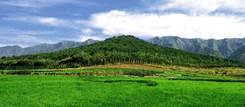
The ancient city of Xi'an in China holds many treasures. And last month, archaeologists working there made an important discovery—a buried palace built in the third century B.C. to honor China's first emperor.
The entire palace measures roughly 2,260 feet long by 820 feet wide. It includes 10 courtyard houses and one main building. Archaeologists found bricks and pieces of pottery at the site of the palace, as well as the remains of walls and roads.
The palace is part of the massive burial complex of Emperor Qin Shihuangdi. He conquered seven warring kingdoms and united ancient China in 211 B.C.
Qin Shihuangdi wanted his legacy, or accomplishments, to be remembered forever. So he hired more than 700,000 workers to build his funeral complex in Xi'an. It represents a miniature version of his vast kingdom.
The complex also includes the world-famous terra-cotta army, a collection of more than 8,000 life-size clay statues. These sculptures represent soldiers, acrobats, and horses from the Qin Dynasty (221 B.C.-206 B.C.). Scientists have not yet found all these terra-cotta warriors, even though they discovered more of the statues last summer.
Farmers discovered the complex by accident in 1974. Since then, scientists studying the site have learned a great deal about life in ancient China. But much of the emperor's tomb has yet to be dug up, or unearthed. Many of the artifacts (objects from the past) are so old that scientists cannot preserve them.
"Archaeologists fully acknowledge that nobody in the world has the technology (to safely dig up Xi'an's treasures) yet," explains Kristin Romey, an expert on Chinese archaeology.
But as technology improves, archaeologists will keep digging to uncover the rest of the wonders that still lie buried in Xi'an.
"It's one of the most important archaeological discoveries that's waiting to be made," says Romey, "and we know where it is."
-
(1) How long is the history of the newly found palace?A . About 820 years. B . About 2,000 years. C . About 2,200 years. D . About 2,400 years.
-
(2) Why did Qin Shihuang have people build his tomb?A . To keep all of his treasures in store. B . To expect people to remember him forever. C . To prevent his body from disappearing soon. D . To collect more than 8,000 life-size clay soldiers.
-
(3) What causes trouble to dig out the emperor's tomb?A . The local government doesn't support it. B . Archaeologists are in great need. C . There isn't plenty of money. D . Technology isn't advanced yet.
-
(4) What might be the most suitable title for the passage?A . An Ancient Palace is Uncovered B . More Terra-cotta Warriors Are Found C . Archeologists Are Waiting to Dig a Tomb D . Technology Helps Discover the New Wonder
-
(1) Going without sleep for a long time makes me feel d and light-headed.
-
(2) Many parents opposed the d of the classes into different sets.
-
(3) Mahoney's p was racing, and he felt nervous.
-
(4) The children were all g at the thought of the coming holidays.
-
(5) When she finished her emotional speech, the audience a.
-
(6) After a few years, he became very (熟练的) at drawing.
-
(7) Suddenly the truck (加速) and shot forward.
-
(8) The dog (嚎叫) when it was shut in the house.
增加:在缺词处加一个漏子符号(∧)并在其下面写出该加的词。
删除:把多余的词用斜线(\)划掉。
修改:在错的词下划一横线,并在该词下面写出修改后的词。
注意:1)每处错误及其修改均仅限一词;
2)只允许修改10处,多者(从第11处起)不计分。
Time flies! This is a third year that I have been in this school. In the past two and a half years, our school had organized many activities. What impressed me best was an activity called “Learning to Farm”. In an autumn afternoon, we were sent to a farm which we learned to plant potatoes. Having been in the city for so a long time, we were so happy to go to the countryside. After divided into three groups, we started to work. Some students cut potatoes into pieces; some dug holes, and the others put the pieces of potatoes into the hole, put the earth back and push them down hard. We continued doing that until all the work was done. Although we were exhausted, but we felt fulfilled on our way back home.
阅读下列短文,从每题所给的四个选项 (A 、B 、C 和 D )中,选出最佳选项。
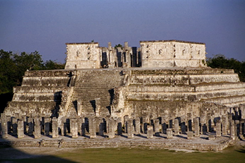
In 1841, a book was published which astonished the world. It was called “Incidents of Travel in Central America, Chiapas and Yucatan”. The author John Loud Stephens had just returned from a long, difficult and dangerous journey through the thick rain forest of southern Mexico and Guatemala. He had once been there with Frederick Catherwood, an architect and artist, to search for the remains of a lost civilization known as the Mayas(玛雅). Very little was known about the Mayas at that time, but Catherwood's drawing in the book showed incredible cities with temples, pyramids and other buildings as impressive as those of their northern neighbors, the Aztecs. These cities, however, were deserted. The inhabitants(居民) had disappeared almost a thousand years before.
Since that time, far more has been learned about this remarkable civilization. The Mayas had a highly-developed system of government and of agriculture, as well as an incredibly accurate system of measuring time. They were also wonderful engineers capable of moving huge blocks stone long distances and cutting them to accurate shapes and sizes.
And yet although the Mayas knew about the wheel, they never used it. Neither did they use metals other than copper. What is ever more surprising is that they suddenly abandoned many of their cities and built new ones in the jungle. Some time around AD 900, Mayan civilization collapsed(崩溃). By the year 1200, their last great capital, Chichen Itza, was deserted.
Who were these strange people and the even stranger gods they worshipped? What brought about their sudden and mysterious collapse? Some writers have tried to prove that the Mayas had contact with visitors from space and even that they themselves came from another planet. Some people believe that their civilization came to an end because the Mayas never developed a proper resistance to local germs and diseases. All we really know is that when the first Europeans appeared off their coast in 1517, this great and mysterious culture was only a memory.
-
(1) Stephen's book astonished the world because .A . it was the first time people heard about Mayas B . the Mayas were excellent builders and farmers C . he had experienced so may difficulties to find this lost civilization D . it described that the Mayas used to be an advanced civilization
-
(2) One of the most surprising findings about Mayas was that .A . they developed accurate system measuring time B . they knew how to build pyramids with stones C . they deserted their cities and moved to new ones D . they built cities which they never lived in
-
(3) At last Mayas disappeared from the world most probably in .A . a thousand years before 1841 B . around AD 900 C . any year between 1200 and 1517 D . 1200
-
(4) What brought about Mayan sudden collapse?A . Tropical germs and diseases. B . European conquest. C . Mysterious force from outer space. D . No one knows for sure.
-
(1) Don't hurry; there is a time to get to the airport.
-
(2) You have the a of marrying or remaining a bachelor.
-
(3) Helen groups all people into two c: those she likes and those she dislikes.
-
(4) Dogs have an a sense of smell.
-
(5) The lion is called the king of (野兽).
-
(6) They built a(n) (简陋的) shelter out of tree trunks.
-
(7) He reached some (不确定的) conclusions about the possible cause of the accident.
-
(1) (不顾危险), he climbed the tower.
-
(2) (不要打搅我) while I'm busy!
-
(3) (我最多可挣250英镑) a night.
-
(4) My mother (正在切肉) when I got home.
- 经测定,某溶液中只含有、Cl-、H+、OH-四种离子,下列说法中错误的是A.溶液中四种离子之间可能满足:c(Cl-)>c
- Bill Gates was born on October 28, 1955. He grew up in Seatt
- 如图,在正三角形中,,,分别是,,上的点,,,,则的面积与的面积之比等于( ) A.1∶3 B.2∶
- 散文诗是介于诗与散文之间的一种文体,它采诗与散文之长,使散文的自由和诗的素质天然成趣、熔为一炉,故它以自己独有的风采立于
- 读图4,回答13--14题。13.甲、乙两区域共同的优势资源有 A.石油B.铁矿 C.水能 D.太阳能 14.乙
- 3.下列各句中,加横线的成语使用恰当的一句是( ) A.司机张师傅冒着生命危险解救乘客的事迹,一经新闻媒体报道,就
- —David, ______ you ______ your report?—No. I finished writin
- 将“挂绝壁松枯倒倚,落残霞孤鹜齐飞”(卢挚《秋景》)扩展成一段借景抒情的文字。
- 世博会山东展馆的外形,体现了“海岱交融”的自然与文化特色,外观以大海的浪涌为顶,以泰山为主视角,形成“青山连绵不绝,绿水
- 弗洛姆深刻地指出“19世纪的问题是上帝死了,20世纪的问题是人死了。”你认为以下哪种理解正确? A.19世纪宗教信仰不存
- “沧海桑田”在地理科学上的含义( ) A.填海造陆种田 B比喻世事的变迁 C.比喻海陆的变迁 D.在海
- CHICAGO (AP) On Jan. l,an order went into effect requir
- 每个时代,都有它特定的时代主题。在世界政治多极化、经济全球化的今天,时代的主题由“战争与革命”转变为“和平与发展”,在这
- 假如你是李华。你看到美国留学生Sharon 在网上发贴,.希望有人能帮助她提高普通话 (Mandarin)水平,她可以教
- 函数的图象一定过定点__________.
- 已知某溶液中存在较多的H+、Ba2+、,则溶液中还可能大量存在的离子组是 A.Fe3+、SCN-、Cl-
- p{font-size:10.5pt;line-height:150%;margin:0;padding:0;}td{f
- 戴·克汽车公司曾宣布,将于2012年正式销售氢燃料电池车。据报道,氢燃料电池公交汽车已经驶上北京街头。下列说法正确的是
- 完形填空 One Sunday afternoon,myyounger brother and I were left
- 中国特色文化建设的中心环节是() A.思想道德建设 B.贯彻“三个代表”重要思想 C.爱国主义教育 D.发展科学


