Unit 3 A healthy life 知识点题库
—________But it's good to see you are all right.( )
—Yes.They are accustomed ________ very late.
A blind man walks into a restaurant. The waiter, who is also the owner, handed him a(n)1. “I'm sorry, sir, but you know I can't2 it. Just bring me a dirty fork from the3customer. I'll smell it and order from there.” A little 4 , the owner walked over to the dirty dish pile and5a fork. He returned and handed it to him. The blind man put the fork to his 6and takes in a deep breath.
“Ah, yes, that's what I'll have — meat and potatoes.”7 , the owner thought as he walked towards the8. The cook happened to be the owner's9. He told her what had just happened.
Several days later, the blind man 10 and the owner mistakenly brought him a menu 11.
“Sir, remember me? I'm the blind man.”
“I'm sorry, I didn't 12 you. I'll go and get you a dirty fork.”
After another deep 13 , the blind man says, “That smells great. I'll take the cheese.” Walking away in14 , the owner told his wife that the next time the blind man comes in he's going to15him.
He returned the following week, but this time the owner saw16 coming and ran to the kitchen.
He tells his wife, “Mary, rub this fork on your dress 17 I take it to the blind man.”
Mary18and handed her husband the fork. As the blind man walked in, the owner was 19 and waiting.
“Good afternoon, sir! This time I remembered you and I already have the fork ready for you.”
The blind man puts the fork to his nose and said,“I didn't know Mary worked here!” To be honest, and don't try to20 the others for you sometimes will be laughed at in your own way.
Growing Up in Australia
Since 2004, Australia has been holding its largest study of children's health ever. This project, “Growing Up in Australia,” is following two groups of children from early childhood until they become adults. The project is being supported by the Australian government and involves hundreds of researchers visiting the homes of 10,000 children. Researchers hope to find a relationship between the children's future behavior and their health, education, and family environments.
When the study began, the first group of children was aged 0-1, while the second group was aged 4-5. In order to make sure that children from every kind of environment and background were chosen, the study found volunteers from each area. Some volunteers are in the countryside, while others are in big cities. The volunteers for both groups were chosen from a variety of different social and ethnic (种族) backgrounds.
The researchers visit the participants' (参与者) homes every two years to gather information. They interview the parents about parenting styles and the child's daily activities. They also take measurements of the children's health and how well the children perform in school. The researchers also collect information such as the income of the child's family, the school the child attends, and the kind of community (社区) in which the child lives. They plan to use the information to improve children's lives.
Researchers have already begun to publish some interesting results. For instance, after examining information from the second group of children when they were 10-11 years old, researchers found that children who spend a lot of time doing organized activities, such as music lessons or sports, have good control of their emotions and behavior. The study also found that they are able to complete their homework without their parents around. On the other hand, it found that children who watch a lot of television get upset easily and have worse behavior. The Australian government is now using this information to make better educational and health policies for Australian children.
-
(1) What is true about children participating in the study?A . They will represent their families in an international competition. B . They will learn social skills from enthusiastic volunteers. C . They come from many different family backgrounds. D . They have to go to various cities in Australia.
-
(2) Researchers who visit the children's homes ________.A . gather information about children in order to help them lead better lives B . go to the children's schools to learn more about Australian education C . measure how well parents can solve their children's problems D . provide health services to children living in the community
-
(3) As a result of the study, researchers found that ________.A . watching television has no effect on children's emotions B . participating in organized activities has a positive effect on children C . children who watch a lot of television are bad at sports D . children who do organized activities like to control their friends
-
(4) What can we learn from the passage?A . Older children have better control of their emotions than younger children B . Australians want the government to spend more money on education. C . The government is unhappy with the results of the study. D . The study follows two separate groups of children.
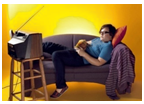
A new study suggests that the more teenagers watch television, the more likely they are to develop depression (忧郁) as young adults.
The researchers used a national long-term survey of adolescent health to survey the relationship between media (媒体) use and depression. They based their findings on more than 4,000 adolescents who were not depressed when the survey began.
As part of the survey, the young people were asked how many hours of television or videos they watched daily. They were also asked how often they played computer games and listened to the radio. Media use totaled an average of five and one-half hours a day. More than two hours of that was spent watching TV.
Seven years later, more than seven percent of the young people had signs of depression. The average age at that time was twenty-one. The researchers say they did not find any such relationship with the use of other media such as movies, video games or radio, etc. But the study did find that every extra hour of television meant an eight percent increase in the chances of developing signs of depression. Young men were more likely than young women to develop depression given the same amount of media use.
Last December, a popular magazine published a study of activities that help lead to happy lives. Researchers from the University of Maryland found that people who describe themselves as happy spend less time watching television than unhappy people. The study found that happy people are more likely to be socially active, to join in outdoor activities and to hang out with friends.
-
(1) We can learn from the survey that ______.A . computer games are teenagers' favorite B . teenagers enjoy watching TV very much C . newspaper is not included in the survey D . most teenagers prefer to listen to the radio
-
(2) What can we know from Paragraph 4?A . Movies and video games may cause depression. B . Less than 7% of the young people became depressed. C . An increase in television watching raises the risk of depression. D . Young women had higher chances of becoming depressed than young men.
-
(3) According to the passage, what can we conclude?A . Teenagers should not watch television any longer. B . Teenagers play more video games instead of watching TV. C . Teenagers should be active in taking part in outdoor activities. D . Teenagers should be more active in reading magazines and newspapers.
-
(1) A series of incidents suggest that drug a is such a serious problem as we should deal with properly.
-
(2) The importance of communication between people cannot be s too much.
-
(3) In my opinion, smoking should be completely b because it is closely related to lung cancer.
-
(4) Four out of five parents worry that their children will become a to the Internet.
-
(5) People who live in these areas have become a to the cold climate.
-
(6) The new traffic rules that took e on January 1 are much stricter than those in the past.
-
(7) We were all d at the news that our picnic was cancelled because of the rain.
-
(8) (自动的) Teller Machine (ATM) is a machine connected to the bank's computer system allowing customers to access their accounts.
-
(9) The article offers some ways to (加强) our memory power.
-
(10) I decided not to leave John alone when he was in such a (绝望的) position.
-
(11) He felt (羞耻的) for having spoken so cruelly.
-
(12) Mark said that he was (不适合的) for the job, so he decided to leave the company.
-
(13) Tired and (气喘吁吁的), we reached the top of the mountain and looked at the beautiful views.
-
(14) As is known to us, physical activity and exercise can improve our (精神上的) health.
-
(15) One research report has shown that listening to music influences (理解) of reading.
I was looking at a picture recently and noticed there was something different. The frame (框架) was 1 The whole picture still looked good but I couldn't2whether or not changing the frame would make it better.
From this an interesting 3 came to mind. At times when I was4 I would spend money on clothes. Because I have a love for 5 I thought I would feel good through buying new clothes. However, the feeling was always 6 Why? Because doing this didn't 7 the real issue. What I needed to do was to pay attention to what was bothering me on the inside 8 trying to cover up my problems by making changes on the outside. I was changing the frame but the picture on the 9was still the same.
We may change the10of our hair or even buy new clothes. There is nothing wrong with doing this once or twice, but if it is being done for the wrong reasons, it may not 11 to how we really feel. If you12 there is something wrong, try to change that; this way you will truly feel better on the inside.13time with family, having a conversation with a friend, or even letting your pen write your innermost (最深处的) feelings can 14You will get true peace and joy inside 15This way, not only will you be better able to 16 your life but also display colorful images of love for others.
So17 necessary, don't just change the frame. Change the picture. Getting a new picture may be 18 and may take time; however, with 19 it can be accomplished. In the end, playing your part in building a 20 of even more fine art in this world would be worth it!
-
(1) I think my long and active life must be due the healthy life I live.
-
(2) The old man brought my father's letter me from a place far away.
-
(3) Evidence provided by the school proved that John's grades fell as he became addicted playing computer games.
-
(4) It takes time to really get to know someone and find what they are like.
-
(5) This means that after a while your body becomes accustomed having nicotine in it.
-
(6) Smoking could do terrible damage your heart and lungs or that it was more difficult smoking couples to become pregnant.
-
(7) When he reached the final line, everyone burst laughing.
-
(8) When I was taken the school football team because I was unfit, I knew it was time to quit smoking.
-
(9) Roy was one of the few people who were kind me.
-
(10) If you start to feel nervous or stressed, do not reach a cigarette.
注意:1)词数100左右;
2)可适当增加细节,以使行文连贯;
3)开头和结尾已给出,不计入总词数。
Dear editor,
I'm a Senior Two student in a high school. I'm writing to tell you about some symptoms of anxiety among us students before exams. ……
Yours,
Li Hua
- 无线充电是一种增加手机续航时间的方式.市场上支持无线充电的智能手机和充电器大部分都符合总部位于美国的业界团体“无线充电联
- Annecouldn't concentrate ____ what she was doing while her
- 阅读下面语段,按要求回答问题: 不要过分地依赖语言。不要总是企图在语言上占上风。语言解不开的,事实可以解开。语言解开丁而
- 计算
- 如图所示,闭合开关后,将滑动变阻器的滑片向右滑动的过程中,下列说法正确的是()A. 电流表读数变小 B. 电磁铁
- 水是重要的自然资源,保护水资源是公民应尽的义务。在下列情况下,一般不会造成河水污染的是( ) A.工业生产中废水、
- 丙氨酸是形成蛋白质的一种氨基酸,下列关于丙氨酸说法不正确的是( ) A. 丙氨酸是由多原子的分子构成的
- 科学家将细胞膜中的磷脂成分提取出来,并将它在“空气﹣水”界面上铺成单分子层,发现这个单分子层的表面积相当于原细胞膜表面积
- 1811~1833年,穆罕默德·阿里进行一系列扩张战争的结果和影响有( ) ①埃及获得了事实上的独立②建立了一
- 下列各种情况,物体一定受力的是A.物体匀速地从M点运动到N点 B.物体运动方向改变但速度大小不变 C.物体的位置改变 D
- 漓江情韵 雨霏霏,雾茫茫。雨雾好像是漓江的纱巾,笼罩在它美丽的面颊之上。江里的渔舟、游船以及江边的垂钓者.都成了一个个逗
- 下列各句中,加点的成语使用恰当的一项是 A.在繁忙而紧张的高三学习中,父母见微知著的关怀,老师循循善诱的教导,使同学们倍
- 如同系列化合物按以下顺序排列:CH3CH=CHCHO CH3CH=CHCH=CHCHO CH3(CH=CH)3CHO
- 下列各句中,没有语病的一项是 A.去年底,印度洋发生的罕见大海啸,给沿岸多国带来巨大人员伤亡和财产损失,可能重创刚刚走出
- 甲、乙两个圆柱形容器中盛有两种不同的液体A、B,液面位置如图所示,液体对两个容器底的压强相等,则 。现将两个质量相
- 玄奘西游是中外文化交流史上的佳话,其体现的唐朝文化的特征是( ) A.兼收并蓄 B.全面繁荣 C. 影响
- I wanted to catch early train,but couldn’t get ride
- 不管是中国内地,港澳台地区,还是海外华人,每到清明都会祭祖扫墓,端午吃粽子赛龙舟,中秋赏月,重阳登高,除夕吃年夜饭。这说
- 一项工程,甲队单独干需天完成,乙队单独干需天完成,现在先由甲队干天,然后乙队再加入,合干天后,完成的工作量是_____.
- a、b∈R,下列各式总能成立的是( )A.()6=a-b B.=a2+b2C


