月考专区(九年级上) 知识点题库
Students' Night at Catch-Up!!
Every Wednesday & Thursday
Show your student card to enjoy a special price of ¥80 for everything on the menu!!(full price:¥120)
For a table of six or more, we treat each to a special drink!
Not a student anymore? Dig out your old school uniform and wear it to Catch-Up!!
You can also enjoy a special price of ¥100 on Students' Night.
Catch up with your friends at Catch-Up, the finest restaurant in town!
We open every day 5:00pm-11:30pm
-
(1) What is “Catch-Up”?A . It's the name of special dish. B . It's the name of a movie theater. C . It's the name of a restaurant. D . It's the name of a summer camp.
-
(2) How often do they have a students' night at Catch-Up?A . Every day. B . Two days a week. C . Three days a week. D . Four days a week.
-
(3) If six or more students come to Catch-Up, what can they get?A . They can get a free movie ticket. B . They can have a free drink each. C . They can get a school uniform. D . They can just pay half the price.
-
(4) What do we know about the Students' Night at Catch-Up?A . The waiters all wear school uniforms every night. B . Students who come to Catch-Up will get a free drink. C . Catch-Up opens later on Students' Night than on other days. D . People who are not students still have a chance to get a special price.
-
(5) Last Thursday Patty and her parents all put on their school uniforms and had dinner at Catch-Up.They should pay .A . ¥240. B . ¥280. C . ¥300. D . ¥320.
It's a nice winter day. The sun is(照耀) brightly in the sky. The trees and flowers are covered with snow just like wearing a (银色的) coat. Everyone is happy because the Christmas(旺季) is coming in December, the(第十二) month of the year. They can't wait to go out to the street. They look at different(招牌) in front of the shops to find something they want. Children are running and singing on the street happily with colorful(旗子).
However, an old man called David is unhappy. He is(加拿大的) and now he lives alone in US. Last year, he prepared and (摆放)some biscuits and candies on the table to welcome the children around here, but this year he is sick and he(认为) he can't continue to do that. To his surprise, the children make a(乐队) to celebrate the festival for him. David is so moved. Friends get together and sing songs happily. They do this for fun and bring spirit of Christmas to the people in the house.
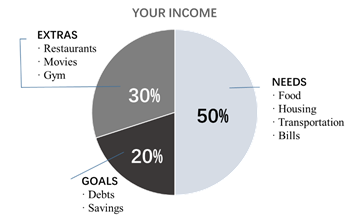

If you want to stay out of debt(债务), you need to set a budget(预算). You should know what you are spending your money on. Write down what you buy and how much you spend. You can use an app or a computer program. First, write how much your food, housing, transportation, and other monthly bills like electricity cost. These are your needs. Then write your goals. These are any debts you have to pay and money you want to save. Then write the other things you enjoy. These are extras, such as going to restaurants, movies, or the gym. These are the things you like but don't need. How much do you spend on these extras each month?
Now look at your income. Your income is the amount of money you make each month. How much of it do you spend on needs, goals, and extras? One good rule is 50 percent of your paycheck is for your needs. Pay for things in this order: needs first, goals second, and extras third. The first step in setting a budget is to know where your money goes. Then you can make payments, plan for your goals, and make good choices.
-
(1) Which of the following does housing belong in according to the text?A . Monthly income. B . Needs. C . Goals. D . Extras.
-
(2) How much of your income is spent on goals according to the chart?A . 20%. B . 30%. C . 50%. D . 100%.
-
(3) The passage is mainly about________.A . a method for how to borrow money B . a plan for how to spend money C . a suggestion on how to lend money D . a test on how to use money
The story of the magazine
When you look at the different kinds of colorful magazines in the shops (and online) today, it's easy to think that they are a modern idea. However, magazines have been around since the 18th century and they have been an important part of people's daily lives for hundreds of years.
One of the earliest magazines was The Gentleman's Magazine which was started in London in 1731 by a man called Edward Cave. He was the first person to use the word "magazine" about a regular publication. The word comes from the Arabic makhzan or storehouse. His idea was that his magazine was a storehouse, or place that you could keep information about many different things.
Magazines became more popular in the 19th century. They gave people tips to help them with their daily lives, and they often had serialized (系列的) stories which gave the readers a new episode every week. Each part finished at a very exciting point in the story. Famous writers such as Charles Dickens and Sir Arthur Conan Doyle created serialized novels for magazines.
One very important serialized novel was Hard Times by Dickens. It came out in 20 weekly parts between 1 April and 12 August, 1854 in the magazine Household Words. This magazine was very good value and it was a cheap way for readers to buy a version of' a novel.
Soap operas on TV today are often similar to the serialized novels. These old stories have often been made into modern films or TV series and they are still popular with modern audiences because they are so exciting.
|
A. Weekly stories by important writers. B. Magazines are not a new thing. C. The earliest magazine for women. D. Why these magazines are still popular today. E. How people could read expensive novels. F. An early example of a magazine. |
(连词成句)
— Yes, go along this street and turn right. You will find the library on your right.
The first time I ever really noticed a disabled person, I was studying in the third grade. I saw some disabled people before, but I never really knew or cared about what those persons go through.
When a new student arrived in my third grade class, I thought he would just be a common student, but this student was different. His name was Derek and he had autism(孤独症).He sometimes had random outbursts(随意的发作) during class and we would stand there, doing nothing because we didn't know why he was doing that. When he sat down at desk, we would try to get away from him. After class, we would play jokes on each other, imitating(模仿) Derek and laughing about it.
Then one day, Derek's mom came to our class and talked with us. She told us that Derek wasn't just having random outbursts—he was trying to communicate. Then she chose a volunteer and filled that person's mouth with soft sweets. When we found the volunteer had great trouble in trying to speak, the mother explained that was Derek was going through every day. We all understand her meaning.
After this talk, no one tried to make fun of Derek or run away from him. We accepted his outbursts in class and he became one of our friends. Having a class with Derek has taught me to have an open mind to those who are different from us. My experience in having an autistic classmate has provided me with a good lesson.
Now whenever I meet a family with a child who's behaving differently. I always remember what I have learned in my third grade class and go up to him or her.
-
(1) What did the author think of the boy before the mother's talk?A . Friendly B . Humorous C . Generous D . Strange
-
(2) According to Derek's mother, Derek .A . was too shy to be with others B . had problems in expressing himself C . Was good at communicating with others D . didn't like the way others treated him
-
(3) After Derek's mom's talk, we did the following EXCEPT that .A . we became friends B . we played together C . we played jokes on him D . we communicated with him
-
(4) Which is the best title for the passage?A . Living with an Open Mind B . Believing in Yourself C . Behaving in different ways D . Making friends with the Disabled

“Mom! I found one! I found a rock!”
I heard those1 again and again last summer as I sat by the window, which faces a park in the small town where I live.
The Kindness Rocks Project, which was2 a few years ago by a mom in Massachusetts, has3around the world. Kids, families, and people of all ages are taking part in painting rocks,4rocks, and finding painted rocks all over the place. Some post5 of the rocks on social media(媒体), and others6 move the rocks for someone else to find. Some take the7 home and then replace them with new ones that they8 and hid.
Nine-year-old twins Harry and Hannah DeVrieze have9 hundreds of rocks with their parents. Most evenings, the family and their small dog walk around with a wagon (小推车) full of rocks that they hide as they10.
“It's a fun family11,” Hannah says.
“We will do it in the winter too,” Hannah says.
Ben Burinsky, age nine, and his brother, Luke, age seven, were12 relatives when they found their first painted rock in a park. They were so13 that they went home and painted their own rocks, then hid them for others to find.
“My boys loved finding the rock in the park, especially since it was a superhero,” their mother, Judy Burinsky, says. “I love how something so14 can bring a smile to my children's faces.15, they learn the value of giving back to others.”
In 1492, Columbus, a well-known Italian voyager, discovered the New World—the Americas. He brought a lot of things to Europe from South America. Rubber was one of them, but people didn't know the use of rubber at that time. In 1770, people found that the rubber could be used as erasers.
Macintosh was a worker in an eraser factory in Scotland. One day he spilled the rubber liquid over his clothes carelessly when making erasers. He was too busy to clean it and went back home wearing the dirty clothes. On the way home, it rained heavily. Having no umbrella, Macintosh had to run quickly. When he got home, he took off the wet clothes. To his surprise, the area of the clothes with rubber wasn't wet. "Why not make a rubber raincoat?" Macintosh thought. The next day he brushed the rubber liquid all over a coat. He wore the "rubber coat" on rainy days and took a walk in the field to test if it could really keep off the rain. Surprisingly, the clothes inside the "rubber coat" weren't wet at all. The rubber raincoat was created in this way by chance.
The rubber raincoats soon appeared on the market. However, they were sticky in summer and hardened in winter. Year after year, people kept on improving the raincoats. Today raincoats are widely used in our daily life.
-
(1) Who was the rubber raincoat invented by?A . A Chinese. B . An Italian. C . An Englishman. D . An American.
-
(2) What did Columbus bring to Europe in 1492?A . Rubber. B . Umbrella. C . Erasers. D . Raincoats.
-
(3) Why did Macintosh wear the "rubber coat" on rainy days?A . To show his nice "rubber coat". B . To sell it to a farmer. C . To test if it could keep off the rain. D . To go to work in the field.
-
(4) Which of the following is TRUE according to the passage?A . Macintosh worked in a market in Scotland. B . The rubber raincoat was created by chance. C . The first rubber raincoat was sticky in winter. D . The umbrella was invented after the rubber raincoat.
Do you have any plans for the coming winter? Superkid Winter Camp is an exciting camp with rock climbing, golfing, skating and creative activities!
The camp runs for two weeks during the winter. Please check the dates, prices and information for Superkid Winter Camp 2020.
Begins: December 4, 2019
Need: $ 100 deposit (定金)and completed Registration(登记)Form
Age requirements: 6-14 years old children
Mailing is a choice: 720 Proud foot Lane, London
If you have any questions, please call: 519-472-9310 Rose Tucker-Camp Manager
What did Superkids'parents from past years have to say about the camp?
"My son thought that the camp had just the right activities to keep the children interested. The rock climbing, golfing, as well as the outdoor activities were perfect. He was very tired but in a good way. My son wants to return next year."
—Mrs. White
"I think this is one of the best camps that my children have taken part in. The people in charge of the camp are warm-hearted and friendly. The program is excellent, and it is the only camp that they ask us to go back to."
—Kristin and Doug
"My children had an excellent time at your camp. I was very moved by your friendly and helpful staff. I
Recommend (推荐) it to my friends!"
—Joseph McRae "One of the best organized camps we've ever experienced. I'm glad that my child was in a safe, responsible and fun environment."
-
(1) What can we learn about the camp?A . It will be held every month in 2020. B . Students at all ages can join the camp. C . All the children can take part in the camp for free. D . The campers can register by mailing.
-
(2) What can we learn from the last part of the passage?A . Kristin thought the camp was the best in the world. B . Joseph McRae had a good time at the camp last year. C . Mrs. White's son may attend the camp in 2020. D . George Kerhoulas thought some activities were dangerous.
-
(3) You can probably read the passage in a .A . science fiction B . student's newspaper C . sports magazine D . storybook—George Kerhoulas
- (1)做“探究凸透镜成像规律”的实验,小明所用凸透镜焦距为10cm。图中虚线表示透镜的主光轴,请在主光轴上标出该凸透镜焦
- 下列属于生物的是( ) ①草 ②煮熟的鱼 ③珊瑚 ④钟乳石 ⑤冬眠的蛇 ⑥恐龙化石 ⑦蘑菇 ⑧家鸽 A
- X、Y、Z、M代表四种金属元素。金属X和Z用导线连接放入稀硫酸中时,X溶解,Z极上有氢气放出;若电解Y2+和Z2+离子共
- “一五”计划期间,我国实行粮食计划供应制度,各地根据国家粮食计划供应的相关规定,以户籍为依据确定粮食供应的对象与数量。
- 大多数生物群落在空间上有垂直分层现象,称为群落的垂直结构。引起森林群落中植物和动物垂直分层现象的主要因素分别是 A.温度
- 如图所示,某同学在研究平抛运动的实验中,在小方格纸上画出小球平抛运动的轨迹以后,又在轨迹上取出a、b、c、d四个点(轨
- 如果一条直线与一个平面平行,那么称此直线与平面构成一个“平行线面组”.在一个长方体中,由两个顶点确定的直线与含有四个顶点
- 在鸟卵的结构中,提供胚胎发育所需营养物质的结构是 A.卵壳 B.卵黄 C.卵白 D
- 将下面的句子改写为一个单句,可以适当增删个别词语,要求保留全部信息。 从广陵村返回,仰望天空,隐隐约约地从云缝里看见一只
- 洗涤做过银镜反应的试管可以选用的试剂是A.氨水 B.NaOH溶液 C.稀硝酸 D.
- 【弘扬精神 勇担责任】(8分)材料一:2011年9月20日晚,第三届全国道德模范评选表彰颁奖典礼在北京举行。郭明义等11
- . “Don’t just stand there,” goes a typical bit of Ame
- Speeding off in a stolen car, the thief thinks he has got a
- (2011年安徽,1题)蔗糖是生活中常用的调味品,其溶解度曲线如下图。下列说法正确的是 A.蔗糖在热水中的溶解度比在冷水
- 下列哪种情况下尿液会相对增加( ) ①剧烈运动 ②天气转冷 ③患糖尿病时 ④静脉注射一定剂量的适当浓度
- 古诗文默写。 (1)还顾望旧乡,长路漫浩浩。 , 。(《涉江采芙蓉》) (2)
- 已知tanα=m(m≠0),求cscα的值.
- —Excuse me, would you mind passing me that English-Chinese d
- 2016年3月20日联合国发布报告:到2030年,全球将有40%的国家和地区面临干旱问题。节约用水和合理开发利用水资源是
- It is reported that the police will soon ____ the case of th


