高三英语试题
— No worries! I've been on this boat dozens of times.
— ________ ? I don't like science, anyway.
— ________ Oh, yes! It's past the post office, next to a big market.
be equipped with little more than hunt for consist of be content with owing to appeal to break up break down be located in
-
(1) In order to improve the teaching quality, every classroom has multimedia teaching facilities since last year.
-
(2) He spent a whole month a new method, but got nothing.
-
(3) The factory the suburb of the city, so it will take us a long time to go there.
-
(4) “I my current life as a kindergarten teacher, because I like these kids,” the teacher said.
-
(5) her lack of experience, it was very difficult for her to accomplish the task.
-
(6) She was no good at cooking and she could do potato chips and tomato soup.
-
(7) Police moved in to the crowd.
-
(8) — Did he say anything that you especially?
— Not really. Actually I slept through his speech.
—Lots of sunshine,wonderful food,and amazing nightlife—________a great vacation.
Kids undergo a large amount of pressure and stress during their school exams, which can often become quite overwhelming (to much) for them. It may be the first experience of stress, at this level, they have ever experienced and therefore quite frightening. Yes, you may say that it's all a part of growing up and therefore good lessons for them to learn, and to an extent I agree with you. However, it's important to learn how to prepare for life's challenges so that they aren't overwhelming or scary and so that we are able to manage them the best we can.
Here are some tips you can use during your kids exam time.
Break their revision plan down into small parts. Doing this will help transform what once seemed like a huge impossible task into a more manageable one.
Help them arrange properly so that the subjects they like the least (perhaps ones that require more time and effort) are worked on first; once they are out of the way, it will help reduce the worry.
Plan week on week to make sure they are on track. Ticking items of a list each week will help them to feel good about themselves and their progress.
Create rewards for all the ticks - a favourite TV programme, a delicious snack, an hour's surfing the Internet, computer games or whatever it was that they enjoy the most. This will encourage them to carry on and make them feel good.
Think of strategies on how to deal with exams calmly so their anxieties don't get the better of them.
Talk about times in their lives when they had been successful at something and look at the qualities they used to get them there - determination, persistence, hard work, patience, positivity, dedication - discuss how they can apply these skills to their exams.
Acknowledge that if they do their best that is good enough.
Ensure they realize that this period in their lives will pass and that exams are only a temporary time in their lives; nothing can and does last forever.
Ensure they keep their eye on the prize: enjoying their long summer holiday when the exams are finished; giving them something to look forward to will help to motivate them and provide a positive end in sight.
-
(1) According to paragraph 1, it's important to learn how to prepare for exams because___.A . it is a part of growing up. B . It is the first experience of stress C . it helps kid release stress and do better. D . it is important to get a good mark in exams.
-
(2) Which subjects should be worked on first?A . Their best ones. B . Their favourite ones. C . the easiest ones D . the most difficult ones
-
(3) According to the passage, which of the following is true?A . Kid should become aware of the importance of exams. B . Kids should learn to deal with exam pressure independently. C . Parents should keep their kids away from entertainment. D . Parents should care about the psychological development of children.
Is there link between humans and climate change or not? This question was first studied in the early 1900s. Since then, many scientists have thought that our actions do make a difference. In 1997, the Kyoto Protocol explained our role in the Earth's changing atmosphere and set international limits for gas emissions(排放) from 2008 to 2012. Some countries have decided to continue these reductions until 2020. More recently, the Paris Agreement, stuck by nearly 200 countries, also aims to limit global warming. But just now how much warmer it will get depends on how deeply countries cut carbon emissions.
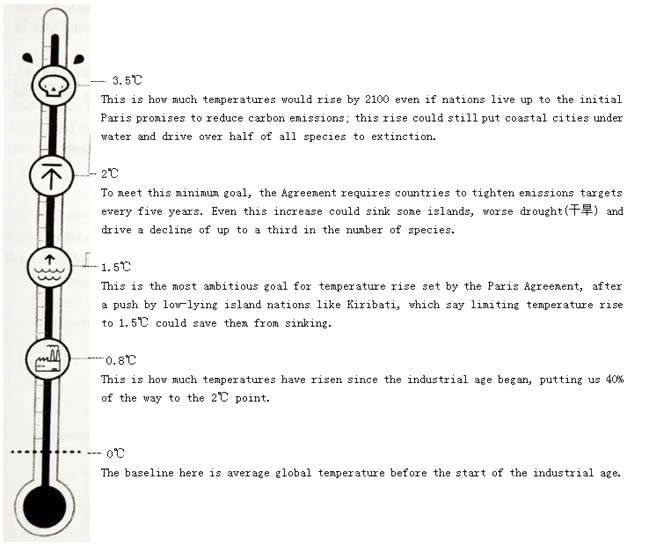
-
(1) It can be concluded from paragraph 1 that ________.A . the problem of global warming will have been quite solved by 2020 B . gas emissions have been effectively reduced in developed countries C . the Paris Agreements is more influential than the Kyoto Protocol D . humans have made continuous efforts to slow down global warming
-
(2) If nations could only keep the initial promises of the Paris Agreement, what would happen by the year 2100?A . The human population would increase by one third. B . Little over 50% of all species would still exist. C . Nations would not need to tighten their emissions targets. D . The Agreement's minimum goal would not be reached.
-
(3) If those island nations not far above sea level are to survive, the maximum temperature rise, since the start of the industrial age, should be_______.A . 0.8℃ B . 1.5℃ C . 2℃ D . 3.5℃
Is there a magic cutoff period when offspring become accountable for their own actions? Is there a wonderful moment when parents can become spectators (旁观者) in the lives of their children and shrug, "It' s their life," and feel nothing?
When I was in my twenties, I stood in a hospital corridor waiting for doctors to put a few stitches in my son's head. I was asked, "When do you stop worrying?" A nurse said, "When they get out of the accident stage." My mother just smiled faintly and said nothing.
When I was in my thirties, I sat on a little chair in a classroom and heard how one of my children talked incessantly, disrupted (打断) the class, and was headed for a career making license plates. As if to read my mind, a teacher said, "Don't worry. They all go through this stage, and then you can sit back, relax, and enjoy them." My mother listened and said nothing.
When I was in my forties, I spent a lifetime waiting for the phone to ring and the cars to come home, the front door to open.
My friends said that when my kids got married I could stop worrying and lead my own life. I wanted to believe that, but I was haunted by my mother' s wan ( 淡淡的 ) smile and her occasional words, "You look pale. Are you all right? Call me the minute you get home."
Can it be that parents are sentenced to a lifetime of worry? Is concern for one another handed down like a torch to blaze the trail of human frailties and the fears of the unknown? Is concern a curse? Or is it a virtue that elevates us to the highest form of life?
One of my children became quite irritable recently, saying to me, "Where were you? I've been calling for three days, and no one answered. I was worried!!!"
I smiled a wan smile.
-
(1) What can we know about the author's mother from the passage?A . She has a thorough understanding of the author. B . She is not concerned about the author. C . She seems to laugh at the author. D . She tries to give the author some encouragement.
-
(2) What did the author do in her forties?A . She would like her children to see her often. B . She couldn't stop worrying about her children. C . She was less concerned about her children. D . She became more patient with her children.
-
(3) Why did the author smile a wan smile at the end of the passage?A . She wanted to learn from her mother. B . She got a kind of satisfaction from her child's concern. C . She succeeded in tricking her children. D . She stopped worrying about her children at last.
-
(4) The main purpose of the passage is to tell us that ________.A . parents show more concern for their children B . Parents' love for their children is selfless C . the concern between parents and children is natural D . parents will worry about their children all their lives
Time is something from which we can' t escape. Even if we ignore it, it's still going by, ticking away, second by second, minute by minute, hour by hour. the main issue in using your time well is "Who's in charge?" We can allow time to slip by let it be our enemy. Or we can take control of it and make it ally(同盟) .
By taking control of you spend your time, you'll increase your chances of becoming more successful student. Perhaps more importantly, the better you are at managing the time you devote your studies, the more time you'II have to spend on your outside interests .
The aim of time management is to schedule every moment so we become slaves of a timetable governs every waking moment of the day. Instead, the aim is to make informed choices as to how we use our time.
— ___________
- 下列物质中熔点最高的是A.干冰 B.氯化钠 C.金刚石w.D.汞
- Can you imagine that several hundred years ago, tomatoes wer
- 18.在下面一段文字横线处补写恰当的语句,使整段文字语意完整连贯,内容贴切,逻辑严密。每处不超过15个字。(6分) 一档
- 假设你是李华,你的笔友Tom对中国文化非常感兴趣,他和他的家人准备今年来中国过春节,写信向你咨询相关事宜。请根据所给提示
- 设函数f(x)=sin(ωx+φ)+cos(ωx+φ)的最小正周期为π,且f(-x)=f(x),则() A.f(x)在上
- 书面表达(共1题;满分10分)假如你叫肖华,请你以“A healthy lifestyle”为题,写一篇英语短文,介绍你
- is mentioned above, it won't be long before you re
- 某校春季运动会比赛中,八年级(1)班、(5)班的竞技实力相当,关于比赛结果,甲同学说:(1)班与(5)班得分比为65;乙
- 下列关于K2的说法中正确的是( )A.K2在任何相互独立问题中都可以用检验有关还是无关B.K2的值越大,两个事件的
- ......
- 老年人跌倒后容易发生骨折,这是因为老年人骨A、无机物超过2/3 B、有机物超过1/3 C、红骨髓减少
- ThoughLiu Xiang has retired(退役) from ournational team, we wi
- 子弹以200 m/s的速度射入固定的木板,穿出时速度为100 m/s,若子弹损失的机械能完全转化为内能,并有50%被子弹
- 山东省是我国的粮食、棉花、花生生产大省。近年来,随着农业产业结构的调整,一些地区逐渐形成了以花卉、蔬菜、水果为主的出
- 下面的实验中有关氧气的制取、收集、验满、验证性质的操作,其中正确的是() A. B. C. D.
- 下列实验现象描述正确的是()A. 铁丝在空气中剧烈燃烧,火星四射 B. 木炭在氧气中燃烧生成二氧化碳 C. 硫在氧气中燃
- The whole team were wild with joy when their captain________
- 在中世纪的欧洲,下列哪一领域受到封建基督教会的控制最严格( ) A、神学 B、物理学 C、数学 D
- 已知f()=,那么f(x)的解析式为( ) A. B. C.


